In short
- The basic table setting is often the caterer's; colours, charger plates and centrepieces are often extras.
- Decide on the mood starting from the venue: a farmhouse, a villa and a terrace call for different choices.
- Show the caterer the table plan and seating chart in advance: they need them to organise the service.
- Ask to see plates, glasses and tablecloths in person, perhaps at the tasting.
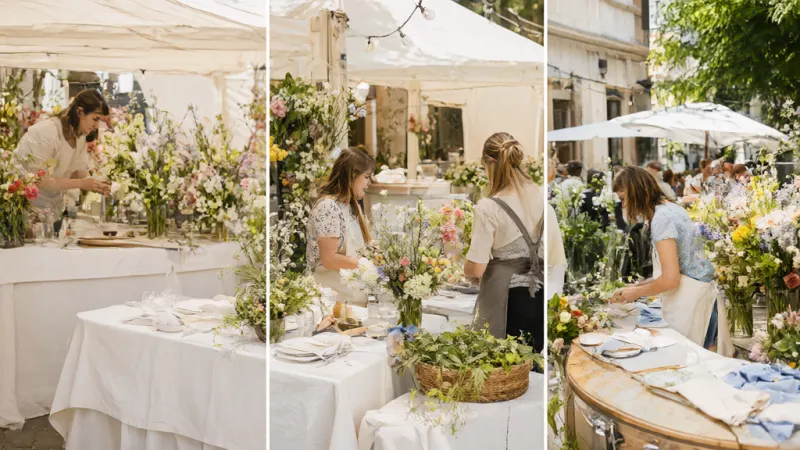
The set-up is the part of the reception that appears in every photo. Tables, tablecloths, glasses, flowers, lights. Part of it comes from the caterer, part from a set designer or florist, part from the venue. This guide helps you work out what to decide and with whom.
What set-up means
When a caterer talks about set-up, it usually means three things:
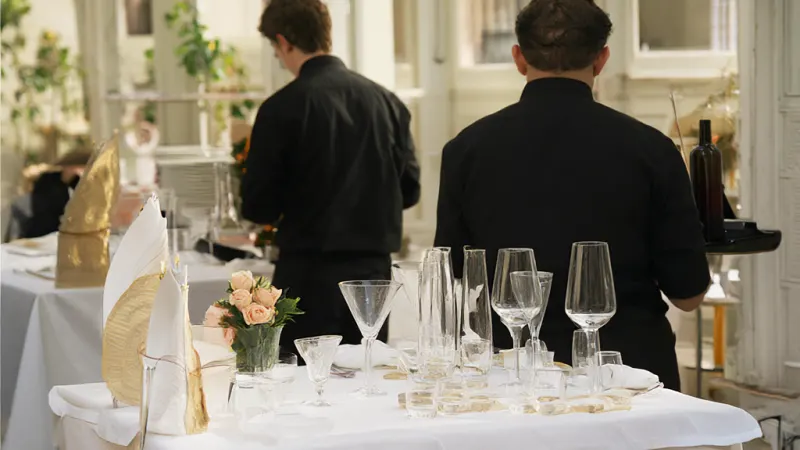
- The mise en place: how the table is laid. Tablecloth, napkin, plates, cutlery, glasses, possibly a charger plate, place cards.
- The service areas: buffet, aperitivo stations, bar counter, dessert corner. How they are dressed and arranged.
- The scenery: centrepieces, flowers, candles, lighting, seating chart, lounge furniture. This part often comes from other suppliers.
The further you move from the table, the more likely it is that you need an outside supplier.
Start from the venue and the mood
Before choosing a tablecloth, look at the space. The mood (the overall style, the first impression) starts there.
| Venue | What defines it | Choices that usually work |
|---|---|---|
| Farmhouse in the Roman countryside | Stone, beams, lawn | Rough linen, wood, ceramics, wild flowers |
| Historic villa on the Appia or in the Castelli | Garden, statues, grand rooms | Pale tablecloths, crystal, more structured arrangements |
| Terrace in the centre or in Roma Nord | View, wind, limited space | Simple lines, low and heavy centrepieces, few loose decorations |
| Historic palazzo | Frescoes, its own furniture | Little decoration, neutral colours that do not hide the space |
| Industrial space or loft | Bare walls, lighting to create | Lighting, long banquet tables, contrasting materials |
This table is a starting point, not a rule. The taste is yours. But a set-up that works against the space costs more and achieves less.
The table setting: choices to make
Table linen
Floor-length or short tablecloths, white or coloured, linen or cotton. The caterer usually has a basic range. If you want a particular colour or fabric, it can hire it or ask you to arrange it with a set designer. Ask about napkins too: fabric, colour, folding.
Plates, cutlery, glasses
The number depends on the menu. A plated meal with four courses and three wines puts more pieces on the table than a buffet. Ask the caterer to show you a table laid for your menu. For special ranges read the guide to glassware and tableware hire.
Charger plates and place cards
The charger plate gives the table structure. The place card shows where each guest sits. They can come from the caterer, the set designer or yourself. Decide who brings them and who sets them out.
Round or banquet tables
Round tables make conversation and service easier. Banquet tables (long, placed end to end) make a strong visual impression but need more space for the waiting staff to pass. Ask the caterer what suits the space and the service format.
Centrepieces: shape and size
The centrepiece is where set-up and service meet. Two practical rules:
- It must not block the view. Guests need to be able to talk to each other. Use low arrangements or very tall, slender ones.
- It must not take up space. On a table laid for a plated meal with many glasses, a wide centrepiece causes problems for the waiting staff.
If a florist makes the centrepieces, put them in touch with the caterer. The guide to flowers and centrepieces goes into detail.
Seating chart and table plan
The tableau de mariage is the board that tells each guest their table. For the caterer it is also a working tool: with the table plan it knows where the children are, who has an allergy, who has a vegetarian menu.
Send the caterer the final plan a few days in advance, with:
- number and name of each table;
- guests per table, children included;
- special diets and allergies, table by table;
- position of the couple's table, buffet, bar and music.
For special menus and allergens read the guide to special diets.
The service areas
The aperitivo and the buffet are as visible as the table. Ask how the buffet tables are dressed, what serving dishes are used, whether there are risers and signs. A floor-length cloth hides boxes and supplies. Aperitivo stations (cheeses, cured meats, fried food, raw seafood) should be placed with the flow of guests in mind, not just appearance. We cover this in the guide to the wedding aperitivo.
Lighting
Often forgotten. A garden on the Appia Antica in September gets dark around eight in the evening. You need light for the tables, the paths, the buffet and the kitchen. Candles and lanterns create atmosphere but are not enough to work by. Ask who brings the lighting and who installs it.
Set-up times
The set-up takes hours. Ask:
- what time each supplier can enter the venue;
- who sets up the tables, tablecloths and table setting;
- who arranges the centrepieces and place cards;
- how much time is needed before guests arrive.
If the venue has another event the evening before, the timing gets tighter. The same applies to clearing away: see the guide to cleaning and take-down.
See it first: the table trial
Photos on a website or a phone are not enough. A tablecloth colour changes a great deal between the light of a hall and that of a garden at sunset. Ask the caterer to lay a trial table, perhaps on the day of the tasting: you see plates, glasses, tablecloths and food together.
If you are working with a florist or set designer, invite them to the trial or send them the photos. It is the simplest way to see whether centrepieces, tablecloths and tableware go together, and whether there is room for the service.
Questions to ask the caterer
- What does your basic table setting include?
- Can I see the tablecloths, plates and glasses available? Also at the tasting?
- Do you have alternative ranges or colours? At what cost?
- Do you work with a set designer or florist you trust?
- If I bring my own decorations, who sets them out and when?
- Which tables do you recommend for this space and this format?
- When do you need the final table plan?
- What time do you set up and how long do you need?
To finish
The set-up works when one person decides the style and every supplier follows it: you, the wedding planner or the caterer itself, if it offers a turnkey service (one supplier handling everything). For an overview of all the services around the food, read the guide to catering add-on services.
If you are planning a wedding, look at the wedding caterers and compare what they include. When you have a venue and guest numbers, request a quote and ask for the set-up to be itemised.