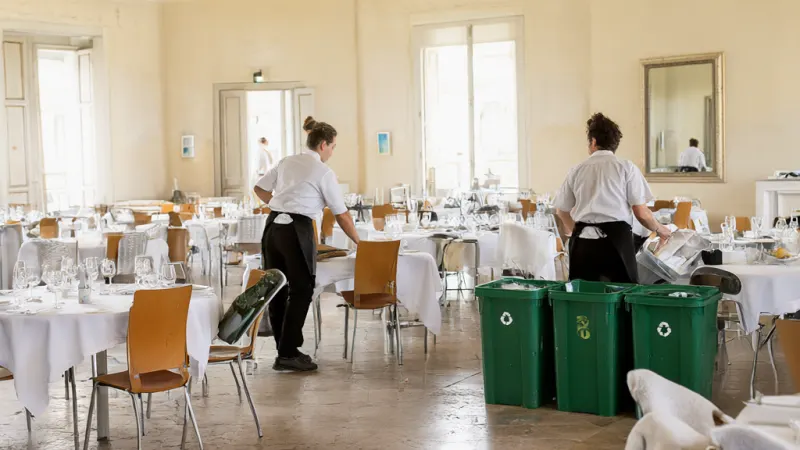
In short
- The caterer usually cleans its own area; full cleaning of the space must be agreed.
- Rubbish must be sorted: decide who takes it away and where it ends up.
- The venue's exit time decides when the party ends, not the other way round.
- Put who cleans what, and by when, into the contract.
The party ends, the guests leave. But the work doesn't. There is still the kitchen to dismantle, the tables to clear, the rubbish to take away, the hired items to return. This is the part nobody looks at in quotes and the one that causes the most arguments. This guide helps you divide it up beforehand.
Who does what: the typical split
The table is indicative: every caterer and every venue has its own rules. It helps you ask the right questions.
| Task | Usually | To clarify |
|---|---|---|
| Breaking down the caterer's kitchen and equipment | Caterer | Time and how long it takes |
| Clearing and collecting the caterer's tableware | Caterer | Whether they also take what you hired |
| Cleaning the kitchen and buffet area | Caterer | To what level (clearing or real cleaning) |
| Caterer's rubbish | Caterer or venue | Who takes it away, where it is left |
| Cleaning the room, toilets, garden | Venue or cleaning company | Whether it is included in the hire fee |
| Taking down styling and flowers | Stylist, florist | Time, what stays |
| Marquees and hired items | Hire company | Whether breakdown is the same night or the next day |
The finishing time
This is the first question to ask. Many venues, especially villas and farmhouses around Rome, have a cut-off time: for music, for guests and for suppliers. Sometimes these are three different times.
Ask the venue, in writing:
- until what time guests can stay;
- until what time music can be played (see also the guide on music and entertainment);
- by when suppliers must have cleared the space;
- whether breakdown can be completed the next day, and at what time.
Then work backwards. If suppliers must leave at a set time and breaking down the kitchen takes a certain amount of time, service must finish earlier. Ask the caterer how long they need: it depends on how much they have set up.
The caterer's breakdown
After the last service, the caterer:
- clears and collects tableware, glasses and linen;
- dismantles the buffet, bar, stations and field kitchen;
- loads the vans;
- cleans and clears its own area.
The staff who break down are often the same ones who served. Breakdown hours may already be included or may count as working hours: ask. If the party runs late, breakdown slips too, and with it the overtime. We cover this in the guide on front-of-house staff.
Rubbish and waste sorting
An event produces a lot of rubbish: organic waste, glass, plastic, paper, general waste, sometimes frying oil. Rome has compulsory waste sorting, and the rules are set by AMA, the city's waste service. Arrangements differ between areas and between households and businesses: check on AMA's website.
Decide beforehand:
- who takes away the rubbish: the caterer, the venue, you;
- where it is left, if it stays on site: the venue's bins, collection points, street bins (within the neighbourhood's limits on quantity and times);
- used frying oil: it must never go down the drain. The caterer usually takes it away for disposal: ask;
- glass: with an open bar there are a lot of bottles. You need a dedicated container.
At an event at home this point matters more: a building's bins are not designed for the rubbish from a party with many guests. Also read the guide to the apericena at home.
Cleaning the space
The caterer cleans its own area. Everything else must be agreed. Ask the venue whether final cleaning is included in the hire fee, what it covers (room, toilets, garden, terrace) and whether there are extra charges for unusual mess (candle wax, confetti, wine on fabrics).
If the event is at a private villa or at home, consider a cleaning company for the next day. It is a cost, but it saves you spending Sunday cleaning.
Confetti, rice and petals look lovely in photos and are hard to pick up, especially on gravel and lawn. Many venues have precise rules on what can be thrown: ask for them.
Hired items, flowers and styling
Each supplier takes down what it brought. But the timings overlap. The florist collecting vases, the hire company picking up chairs, the caterer loading crates: all in the same hour, often through the same door.
Put breakdown times in the running order, just like set-up times. Ask the hire company whether collection is the same night or the next day, and who will be there to hand things over. Marquees can take hours to dismantle: read the guide on marquees and gazebos.
Leftover food
There is often food left over. Ask the caterer what happens: some leave it to the client in containers, others don't, for food safety reasons (cold chain, time on display). If you want to donate surplus food, there are associations that collect it: ask the caterer whether they have done this before and on what terms. Rules on food donation exist at national level, but precise procedures must be followed: find out beforehand.
Questions to ask the caterer
- How long do you need to break down and clear the space?
- Are breakdown hours included or counted separately?
- What do you clean: only your own area or more?
- Do you take away the rubbish? Including glass and frying oil?
- If rubbish stays on site, where do you leave it and how is it sorted?
- Do you also collect the equipment I hired?
- What happens to leftover food?
- Do you know this venue's exit times?
To finish
Breakdown is the last item of the evening and the first to cause problems if nobody has written it down. Gather the venue's times, ask each supplier how long they need and put it all in the contract. The guide on what to check in a catering contract helps you do this; the one on catering add-on services gives you the full picture of everything around the food.
To find the right caterer for your event, use find a caterer or browse the list of caterers in Rome. When you have a date and a venue, request a quote and ask for cleaning and breakdown to be described item by item.
Sources
- AMA Roma, waste sorting: https://www.amaroma.it