In short
- Flowers almost always come from a florist: put them in touch with the caterer before the event.
- The centrepiece must leave sightlines and space for plates, glasses and service.
- Seasonal flowers are easier to find: ask the florist what is available in your month.
- On the buffet, flowers must not touch the food or drop petals and pollen.
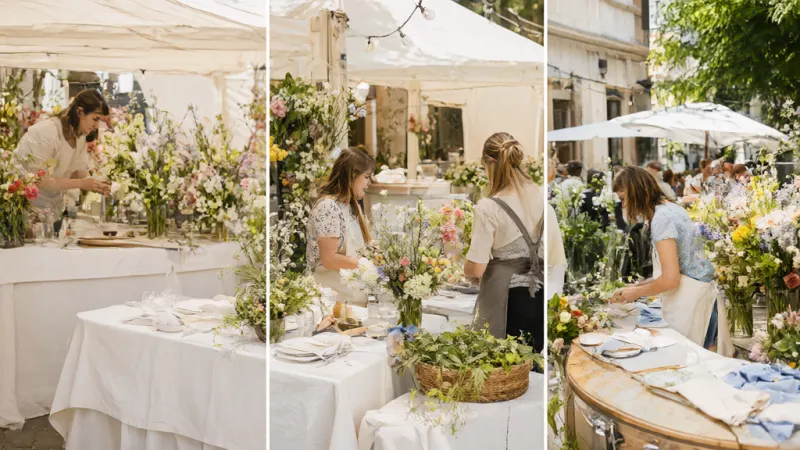
Flowers give the event its colour. But they sit on the same table as the dishes, next to the buffet, along the waiters' routes. That is why florist and caterer need to talk to each other. This guide helps you choose flowers and centrepieces that also work during service.
Who does what
In most cases:
- the florist designs and prepares arrangements, centrepieces, flowers for the ceremony and for the spaces;
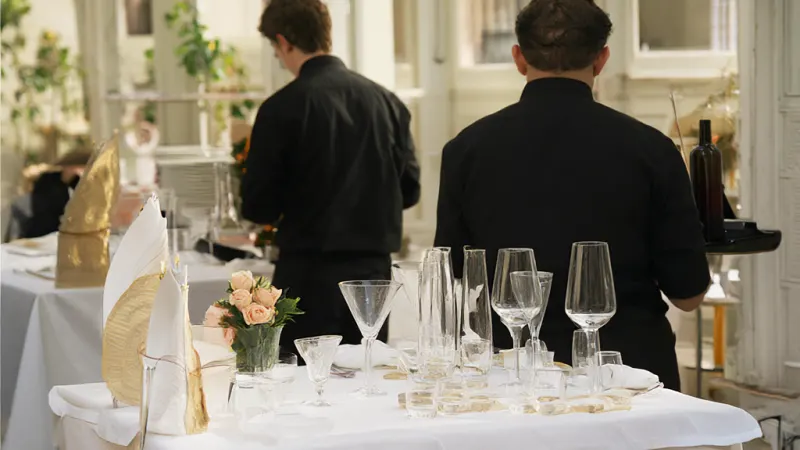
- the caterer lays the table and serves, and needs to know how much space the flowers take up;
- the venue may have rules on what can be hung, where and until what time.
Some caterers offer simple centrepieces or work with a florist they trust. That is fine, as long as it is clear in the quote. For an overview of all the services around the food, read the guide to catering add-on services.
The centrepiece on the laid table
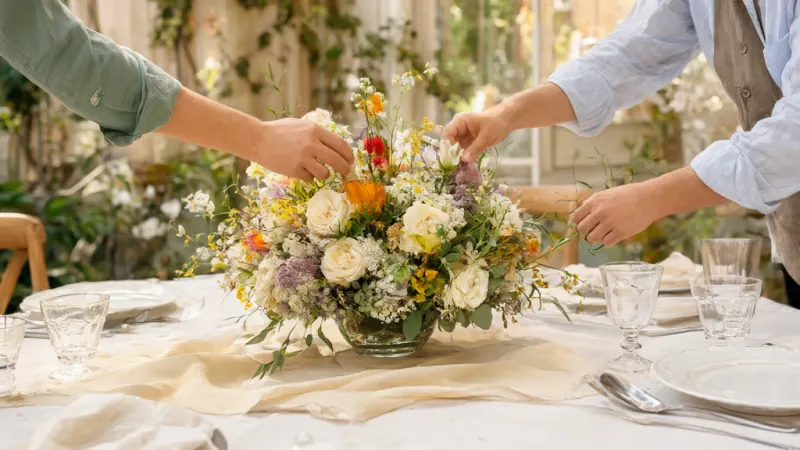
The centrepiece is where flowers and service meet. Three things to keep in mind:
- Sightlines. Guests must be able to see and talk to each other. Low arrangements or, on the contrary, very tall and slender ones.
- Space. A served meal with several courses and several wines puts a lot of glasses on the table. A wide centrepiece takes up space and makes service difficult.
- Stability. On a terrace or in a garden, wind topples tall, light vases. You need heavy bases.
Ask the florist for a trial on a real table, with the caterer's mise en place. If that is not possible, send them the table measurements, the number of covers and photos of the laid table.
Round and long banquet tables
| Table | Typical centrepiece | Watch out for |
|---|---|---|
| Round | One arrangement in the centre, low or tall | Not hiding the face of the person opposite |
| Long banquet table (imperiale) | A garland or low arrangements spread along it | Leaving room for serving dishes and bottles |
| Couple's table | Front-facing arrangement | Not hiding the couple in the photos |
These are common solutions, not rules. The florist will be able to suggest others.
Seasonal flowers
Choosing seasonal flowers helps you find them fresh and in quantity. The seasons below are indicative: they depend on the year, the origin and what your florist can find. Always ask them.
| Season | Flowers often available |
|---|---|
| Spring (March-May) | Ranunculus, anemones, tulips, peonies towards May, wild flowers |
| Summer (June-August) | Hydrangeas, sunflowers, lavender, garden roses |
| Autumn (September-November) | Dahlias, chrysanthemums, roses, berries and coloured leaves |
| Winter (December-February) | Amaryllis, anemones, hellebores, branches and greenery |
Some flowers are available all year round, such as greenhouse roses. But a seasonal centrepiece also ties in well with the menu: artichokes and broad beans in spring, figs and grapes in autumn. If you like this idea, read the guide to the seasonal menu in Rome.
Flowers and heat
From June to August, the Roman heat puts flowers to the test. Some wilt within a few hours in the sun. Ask the florist:
- which flowers hold up better in the heat and being outdoors;
- what time they deliver and set up, to reduce time in the sun;
- whether the arrangements have a water reserve;
- where to keep them before set-up.
The same goes for the cake and the buffet: in the heat, everything that is outdoors needs careful handling.
Flowers near food
On the buffet, at the aperitivo stations and next to the cake, flowers sit close to food. Agree with the caterer:
- that the flowers do not touch food, trays or serving cutlery;
- that they do not drop petals or pollen on the dishes (some flowers shed a lot);
- that any decorative flowers on the cake are suitable and agreed with whoever makes it;
- where they can go without getting in the way of people serving themselves.
The caterer is responsible for the safety of the food it serves: follow its guidance. If you use edible flowers in a dish, the caterer should choose and prepare them.
Scents and allergies
Some flowers have a strong scent. At the table it can overpower the food or bother guests. Ask the florist for lightly scented arrangements for the tables and keep the more intense ones for the entrances or the ceremony. If any guests are allergic to pollen, mention it.
Delivery, set-up, collection
Florist and caterer often work at the same time, in the hours before the guests arrive. Ask:
- when the florist arrives and when the caterer lays the tables;
- who puts the centrepieces on the tables: before or after the mise en place;
- whether the ceremony flowers are moved to the reception, and who does it;
- at the end, who takes away the arrangements and whether guests can take them home.
For end-of-event timings, read the guide on cleaning and take-down.
Flowers for corporate events
Not only weddings. A corporate dinner, a launch or a conference often uses flowers and greenery for tables, stage and reception. Here the needs change: more restrained arrangements, colours linked to the brand, potted plants that can be reused or given away. The stage needs low arrangements that do not hide the speakers. Coordinate the florist with whoever handles the room set-up and with the caterer, who needs to know where it cannot put down trays and drinks.
The flower budget
We do not give figures, because the cost depends on the flowers chosen, quantities, type of arrangement and the florist's work. To keep it in check, some choices help: seasonal flowers, greenery and branches instead of expensive flowers, arrangements reused from the ceremony at the reception, fewer pieces but better placed.
Questions to ask the caterer
- How much space is left on the table with your mise en place?
- What maximum size do you recommend for the centrepiece?
- Where can the flowers go on the buffet and near the cake?
- Do you work with a florist you trust? On what terms?
- What time do you lay the tables? Can the florist set up before or after?
- Who moves the flowers from the ceremony to the reception?
- Do you use edible flowers in the dishes? Which ones?
To finish
The simplest way to avoid mistakes is to put the florist and the caterer in direct contact, with the table plan in hand. For table styling, read the guide on styling with the caterer.
If you are planning a wedding, see the wedding caterers or use find a caterer to narrow the choice. When you have a date and venue, request a quote and ask what the table set-up includes.