In short
- The welcome aperitivo often lasts 60-90 minutes: the time it takes for the couple's photos.
- The most common format mixes food stations and finger food passed by waiters.
- The number of pieces per person depends on length and what follows: ask for it in writing.
- In Rome, from May to September, shade, cold water and timing matter as much as the menu.
The aperitivo, the Italian equivalent of the cocktail hour, is the first moment when guests eat and drink together. They arrive from the church or the town hall, often after a transfer, and want a cool drink and something to eat straight away. If the aperitivo works, the whole evening starts at the right pace.
What the aperitivo has to do
The wedding aperitivo has three practical jobs:
- Fill the wait while the couple have their photos taken.
- Introduce the guests from both families, standing and moving around.
- Prepare for dinner without filling people up too much.
The third point is the one most often got wrong. An aperitivo that is too generous, followed by three served courses, leaves full plates on the tables. If the dinner menu is substantial, the aperitivo should be lighter.
How long it lasts
The most common length is between 60 and 90 minutes. It depends on:
- the distance between ceremony and reception: if there is a transfer, guests arrive in waves;
- the photo shoot: ask the photographer how much time they need with the couple;
- the light: at a villa on the Appia or in the Castelli, sunset is the most sought-after time for photos. In June it comes late, in October much earlier.
Beyond 90 minutes guests start looking for a chair. If the wait is long, provide seating and an extra round of hot finger food.
Stations, passed service or both
| Format | How it works | Pros | Cons |
|---|---|---|---|
| Passed finger food | Waiters circulate with trays | Reaches everyone, even those seated | Needs more staff |
| Stations | Themed tables where guests help themselves or are served | Movement, visual impact, live cooking | Queues if there are too few stations |
| Mixed | Some stations and passed service | A balance of the two | Needs good coordination |
The most requested stations
- Fried food: tempura, croquettes, olive ascolane (stuffed fried olives) or, for a Roman touch, supplì (fried rice balls), courgette flowers and carciofi alla giudia (Jewish-style fried artichokes) in spring. Fried on site, not reheated.
- Cured meats and cheeses: Italian or from Lazio, such as porchetta from Ariccia, pecorino romano, ricotta and coppiette (dried spiced meat strips), with bread or pizza bianca.
- Sushi: made to order by a chef, with rice and fish kept in the cold chain.
- Raw seafood: oysters, tartares, raw fish from the coast. They need a serious cold chain, especially in summer.
- Mozzarella: buffalo mozzarella cut to order is a classic of southern Lazio.
- Live cooking: risotto or cacio e pepe tossed in a wheel of cheese, or a station serving tasting portions of pasta.
A practical rule on stations: more guests means more stations or longer ones, not just more food. Ask the caterer how many stations it plans for your number of guests.
How many pieces per person
Honesty is needed here: there is no official source saying how many pieces you need. Caterers work with their own schemes. As an indicative order of magnitude:
- a short aperitivo followed by a full served dinner: a few pieces per person, plus the stations;
- a long aperitivo, over 90 minutes: more pieces, with some extra hot ones;
- an aperitivo that replaces dinner (a cocktail dînatoire): many pieces and bowl dishes.
The exact figure depends on length, size of the pieces and whether there are stations. Ask for the quote to state how many pieces per person and over what length of time. To think about quantities there is a dedicated guide to how much food per person, and plenty of ideas for bites in the guide to finger food for events.
Aperitivo drinks
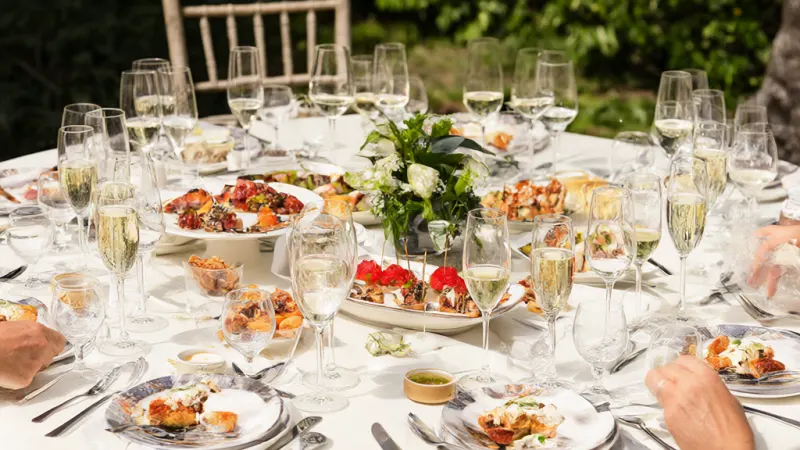
People drink a lot during the aperitivo, especially in the heat. The basics:
- cold water, still and sparkling, plenty of it and clearly visible;
- sparkling wine or white wine from the Castelli;
- a well-thought-out alcohol-free drink, not just fruit juice: children, non-drinkers and drivers appreciate it;
- possibly a welcome cocktail or a spritz.
If you have planned an open bar after dinner, the aperitivo can stay simple. For formats, quantities and rules, read the guide to the wedding open bar.
Heat, shade and plan B
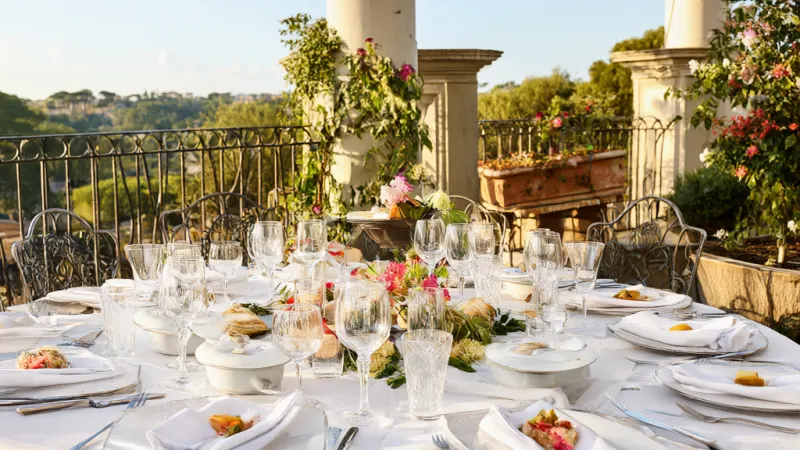
In Rome the weather decides a lot about the aperitivo. From June to August the afternoon is hot even in villa gardens.
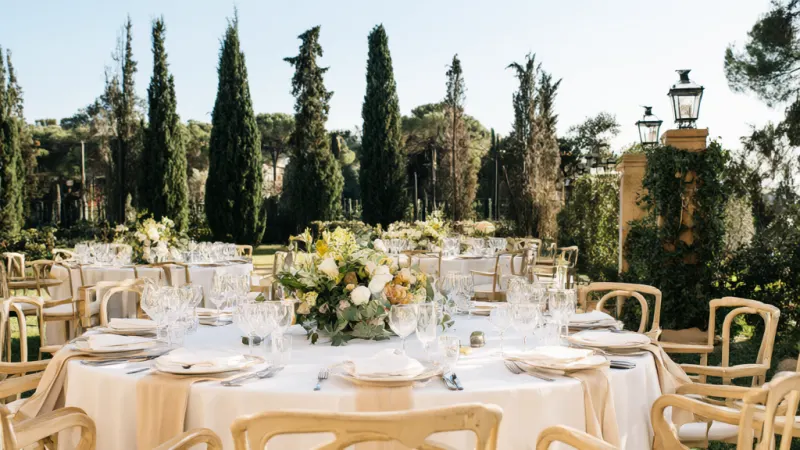
- Shade: trees, gazebos, umbrellas. Ask the venue where the aperitivo will be at the time of your wedding, not at midday during the site visit.
- Cold chain: raw seafood, mozzarella and cream desserts cannot stay in the sun for long. Ask how they are displayed and replaced.
- Insects: mosquitoes at sunset near lakes and lawns. Ask the venue whether it treats the grounds.
- Rain: between October and April a plan B is a must. It has to be a specific place, with a time by which the decision is made.
For outdoor events there is a dedicated guide to outdoor catering in Rome.
Setting up the stations
Looks matter, but layout matters even more. Stations should be spread out across the space so that everyone does not crowd into the same spot.
- Spread them out: fried food in one place, cured meats in another, the bar in a third.
- Provide surfaces: high tables where guests can put down a glass and a small plate. Without them guests eat less and tire sooner.
- Collection: a waiter clearing empty glasses and plates keeps the garden tidy.
- Light: if the aperitivo continues after sunset, the stations need proper lighting, not just atmospheric lights.
Ask the caterer for a plan of the aperitivo showing the stations, bar and seating. It is the quickest way to spot a mistake before the wedding day.
Guests not to forget
- Older guests: seating near the stations and a waiter to bring them plates.
- Children: a simple station (pizza, mini mozzarella, fruit) and something to drink that is not fizzy.
- Special diets: mark on the station cards what is vegetarian, gluten-free or contains nuts. EU Regulation 1169/2011 requires information on the 14 allergens even for unpackaged food: ask the caterer how it makes this available to guests.
Questions to ask the caterer
- How long is the aperitivo in the quote, and what happens if it runs over?
- How many pieces per person are included? How many hot and how many cold?
- How many stations do you plan for our number of guests?
- Is the fried food prepared on site? Do you need an outdoor kitchen area?
- How many waiters circulate with trays during the aperitivo?
- Which drinks are included? Is there a dedicated alcohol-free option?
- How do you handle raw seafood, dairy and desserts in the heat?
- Where does the aperitivo move to if it rains, and who decides?
To close
A good aperitivo is barely noticed: guests eat, drink, greet each other and arrive at the table happy. To see caterers that handle wedding aperitivi, look at the wedding catering section or the one dedicated to finger food. With the length, number of guests and venue in hand, request a quote from several caterers and compare pieces, stations and staff.
Sources
- Regulation (EU) No 1169/2011, EUR-Lex: https://eur-lex.europa.eu/legal-content/IT/TXT/?uri=CELEX:32011R1169