In short
- The dessert station comes after the cake or replaces a sweet course: scale it to what guests have already eaten.
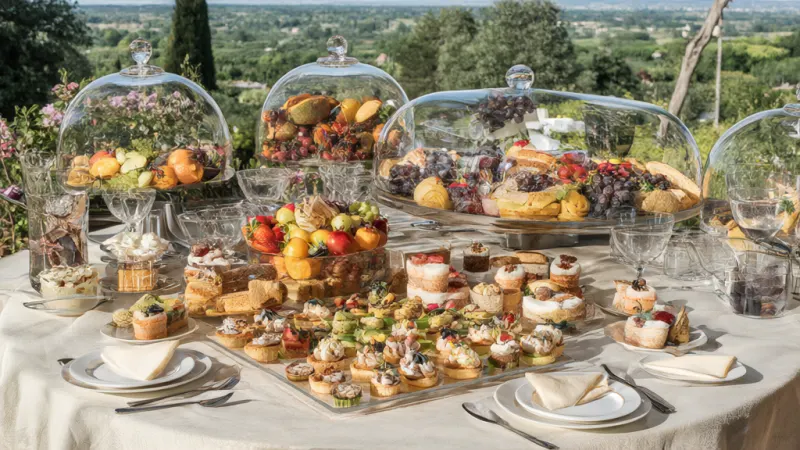
- Mini pastries, spoon desserts, cheesecake or, for a local touch, Roman sweets such as mini maritozzi and ricotta and sour cherry tart.
- Lazio's seasonal fruit is the lightest choice: Nemi strawberries, watermelon, figs, Latina kiwis.
- In summer, cream and custard need to stay cold until the last moment, with small top-ups.
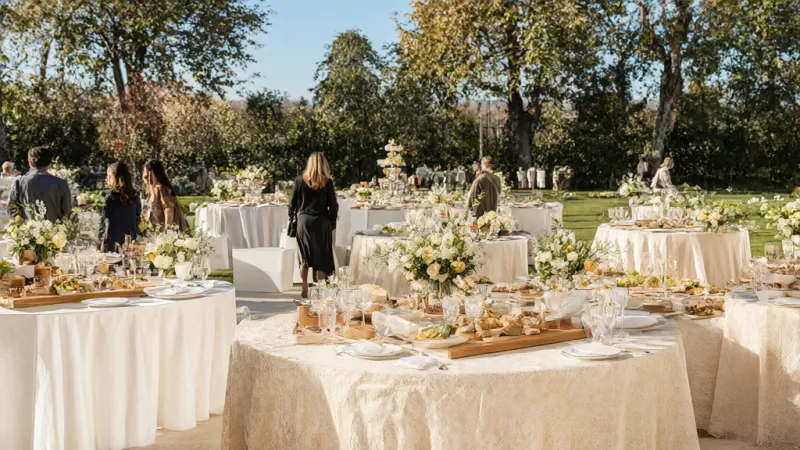
The dessert station is the last stop of the evening, often after the cake cutting and before the dancing. Guests pass by with a coffee or a glass, take one or two bites and go back to dance. That's why the right choice matters more than the quantity.
What the dessert station is for
It can play three different roles:
- after the cake, as an extra taste for those who want to carry on;
- instead of the cake, with a cake that is just for show;
- at an event with no dinner, as the finale of an apericena (an aperitivo that replaces dinner) or a cocktail reception.
In the first case a small, well-presented station is enough. In the third you need more variety. There's a dedicated guide to the wedding cake and the confettata: wedding cake and confettata.
Desserts for the station: classic and Roman
The station can hold any kind of pastry: classic mini pastries, tiramisù and panna cotta in small cups, cheesecake, macarons, chocolate mousse, small fruit tarts. If you'd like a local touch, here are the Roman sweets most often served at events.
| Dessert | Season or moment | Note |
|---|---|---|
| Maritozzi with cream (mini) | All year | The cream must be kept cold |
| Ricotta and sour cherry tart | All year, with Roman ricotta | A dessert from the Roman Jewish tradition |
| Bignè di San Giuseppe | Around St Joseph's Day, 19 March | Fried or baked choux buns, with custard |
| Frappe and castagnole | Carnival | Fried, to be served on the day |
| Ciambelline al vino and tozzetti | All year | Wine biscuits and almond biscuits, with a sweet or passito wine from Lazio |
| Pangiallo | Winter, around Christmas | Dried fruit, nuts and honey |
| Gelato | Spring and summer | Cup, cone or cart |
For more ideas and the story behind these sweets, read the guide to Roman desserts for events.
Format matters. Mini pastries and single portions work at a station: they are picked up by hand or with a teaspoon, without large plates. A whole tart badly cut at the end of the evening makes more mess than celebration.
Seasonal fruit
Fruit is the lightest part and the most welcome after a long dinner. Follow Lazio's seasons:
| Period | Typical fruit |
|---|---|
| Spring | Strawberries, including the small Nemi strawberries in late spring, loquats, cherries |
| Summer | Watermelon, melon, peaches, apricots, figs in late summer |
| Autumn | Grapes, figs, pomegranates, persimmons |
| Winter | Citrus, kiwis (Lazio has the Kiwi Latina IGP), apples, pears |
Watermelon in summer has a Roman story: the cocomerari, watermelon sellers along the Tiber and in the old districts. A cold slice in a garden in July is a simple gesture guests remember.
Fruit can be presented in several ways:
- cut and ready, in small cups or on skewers;
- whole and eye-catching, with someone cutting it to order (pineapple, watermelon);
- as a fruit salad or with gelato.
For a full calendar of Lazio produce, read the guide to the seasonal menu in Rome.
Gelato, chocolate and special stations
Some dessert stations need equipment:
- gelato cart: needs power for the freezer or dry ice, and someone to serve;
- chocolate fountain: eye-catching, but needs power, space and care with hygiene, because many guests dip in the same spot;
- crêpes or fritters made in view: a griddle and a cook, like a small show cooking station.
Ask the caterer whether these stations are their own or from an outside supplier, and whether they are priced separately.
Heat and the cold chain
A dessert station in July in a farmhouse in the Castelli Romani or on a terrace in Monteverde is a real test. Cream, custard, mascarpone and gelato can't stay out for long.
What to ask for:
- refrigerated display cases or trays on ice for desserts with cream and custard;
- short display times and small top-ups from the kitchen;
- a shaded position, away from lamps and heat sources;
- more stable desserts for summer: tarts, biscuits, fruit, sorbets.
Presidential Decree 327/1980 sets storage temperatures for some perishable foods, including pastries with custard and cream. The caterer should know them; you can ask how they meet them at an outdoor event. Check the current text on Normattiva.
How many desserts per person
There is no official source. It's approximate, and depends on:
- whether a cake is also served to everyone;
- how rich the dinner was;
- how long the party after dinner lasts.
After a wedding with an aperitivo, three courses and cake, many guests take one or two bites. At an apericena with no cake, the dessert station works harder. Ask the caterer how many pieces per person they plan, and on what number of adult guests.
Allergens and diets
The dessert station holds almost all the most common allergens in EU Regulation 1169/2011: gluten, milk, eggs, nuts (almonds, hazelnuts, pistachios), sometimes soy and sesame. You need:
- a label for each dessert, with its allergens;
- some gluten-free desserts prepared and served separately;
- a dairy-free and vegan alternative, such as fruit and sorbets.
For coeliac disease and other diets, read the guide to catering for special diets.
Questions to ask the caterer
- Are the station's desserts made by you or by an outside pastry shop?
- Which desserts can you offer in the month of our event? Do you also make Roman sweets?
- Which seasonal fruit do you plan, and how do you present it?
- Do you have refrigerated display cases for cream and custard?
- Are the gelato and the chocolate fountain your own? How much do they cost on top?
- How many pieces per person do you plan, taking the cake into account?
- Are there gluten-free, dairy-free and vegan desserts?
- How do you show allergens?
To finish
A dessert station works if it's small when the dinner is rich and more varied when there is no dinner. To see how it fits with the other stations, read the guide to buffet food stations. Wedding caterers are in the wedding catering section. Once you've decided on the cake and stations, request a quote with desserts as a separate item.
Sources
- Presidential Decree No 327/1980, Normattiva: https://www.normattiva.it
- Kiwi Latina IGP, eAmbrosia: https://ec.europa.eu/agriculture/eambrosia/
- Regulation (EU) No 1169/2011, EUR-Lex: https://eur-lex.europa.eu/legal-content/IT/TXT/?uri=CELEX:32011R1169