In short
- The cheese and cured meat station is the easiest to run and almost always the first to be rushed.
- Lazio has products with protected names: pecorino romano DOP, ricotta romana DOP, porchetta di Ariccia IGP.
- Other typical products, such as guanciale and Bassiano ham, have no DOP: present them without labels.
- Ask for slicing to order, labels with origin and allergens, and an alternative for guests who don't eat raw cured meats.
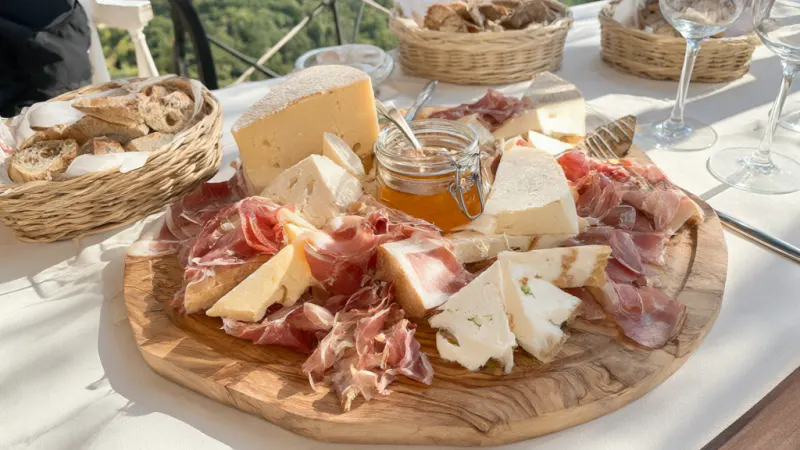
It's the station that is nearly always there. Guests arrive, take a glass and look for a piece of pecorino and a slice of prosciutto. To make it different from a bar board you need well-chosen products, well described, and someone slicing to order.
Why this station works
It's cold, so it needs no hobs or gas. It holds up well over a long aperitivo. Almost all adults like it. It suits any menu, from seafood to international, with Italian or foreign cheeses and cured meats. If you want to tell the story of the area, Lazio's products are the ones guests know: the pecorino of cacio e pepe, the porchetta of the fraschette (country taverns) in the Castelli, the guanciale of pasta alla gricia.
It has two limits: it doesn't suit vegans or those who avoid raw cured meats, and in summer fresh cheeses suffer in the heat.
Lazio cheeses
| Cheese | Protected name | What to know |
|---|---|---|
| Pecorino romano | DOP | Sheep's milk. The specification requires at least 5 months' ageing for table cheese and 8 for grating cheese. Production area: Lazio, Sardinia and the province of Grosseto. |
| Ricotta romana | DOP | Ricotta from the whey of Lazio sheep's milk. Serve it fresh and chilled. |
| Mozzarella di bufala campana | DOP | The production area also covers part of southern Lazio, in the provinces of Latina and Frosinone. Excellent cut to order. |
| Caciottas and pecorinos from small producers | Usually none | From the Roman countryside, Tuscia or Sabina. Ask for the producer's name. |
Pecorino romano lends itself to a bit of theatre: the wheel opened on the counter, with shavings cut in front of the guests. Honey, raw broad beans in spring (a Roman tradition on 1 May) and pears go well alongside.
Lazio cured meats
| Cured meat | Protected name | What to know |
|---|---|---|
| Porchetta di Ariccia | IGP (EU Reg. 567/2011) | Whole pig or rolled cut, oven-roasted, seasoned with salt, pepper, garlic and rosemary. Carved to order. |
| Bassiano ham | No DOP or IGP | Cured ham from the Monti Lepini (Latina). ARSIAL describes it as weighing 8 to 14 kg, with long ageing. |
| Guanciale | No DOP or IGP | Cured pork cheek; guanciale amatriciano is linked to the Amatrice area. Slice it thinly at the station. |
| Coppiette | Usually none | Spiced strips of dried meat, typical of the Castelli and its taverns. Very good with wine. |
| Cured sausages and lonza | Varies | Products from Tuscia, Sabina and Ciociaria. Ask about origin. |
An honest rule: the DOP and IGP labels are only used if the product has them. If a quote says "Bassiano ham DOP", ask for clarification. You can check protected names on the European eAmbrosia register or on the Italian Ministry of Agriculture's website.
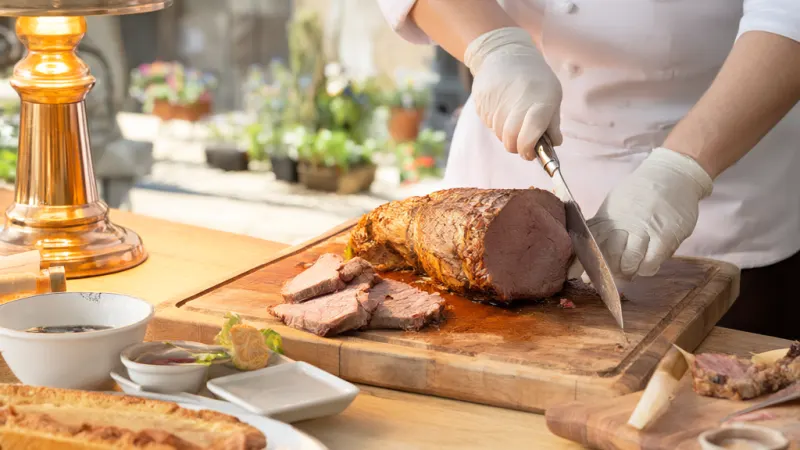
Porchetta, carved to order and served warm, becomes almost a station of its own. We cover it in the guide to the carving station.
Bread, pairings and sides
The station isn't made of cheese and cured meats alone. You need:
- bread: Roman pizza bianca, pane casereccio di Genzano (which has an IGP), Lariano bread;
- preserves and honeys for the pecorinos;
- vegetables in oil and olives, for example Gaeta olives;
- seasonal fruit: pears and figs in autumn, broad beans in spring;
- extra virgin olive oil from Lazio, with bread, for those who don't eat cured meats.
For wine, a white from the Castelli or a red from Lazio works well. You'll find some ideas in the guide to Lazio wines for events.
Quantities and slicing
There is no official table of grams per person for this station. The quantity depends on three things:
- whether the aperitivo comes before a served dinner, or replaces it;
- how many other stations there are;
- how long the aperitivo lasts.
Ask the caterer how many grams per person they plan and for how long. It's the way to compare two quotes that both say "cheese and cured meat station".
Slicing makes the difference. Prosciutto sliced to order, by hand or on a slicer, is something else compared with trays prepared hours earlier. Ask whether there's a dedicated slicer and whether the slicing machine is included. For station staffing in general, read the guide on how many waiters you need.
Heat, cold and safety
In summer, in a garden on the Via Appia or a farmhouse in Sabina, fresh cheeses such as ricotta and mozzarella can't stay in the sun for long. Ask for:
- a counter in the shade or under a gazebo;
- ricotta and mozzarella on ice or in refrigerated display cases;
- small top-ups, not everything on display at the start;
- cured meats sliced in waves, so they don't dry out.
Guests who don't eat cured meats
Some guests don't eat pork for religious or personal reasons. Others avoid raw cured meats and raw-milk cheeses: for example, doctors often advise pregnant women to be careful with these foods. This isn't a rule we set: anyone with doubts should ask their own doctor. For the station it's worth planning:
- hard cheeses or pasteurised-milk cheeses, clearly labelled;
- cooked meats, such as porchetta, alongside the raw ones;
- a plant-based corner with vegetables, oil and bread.
For guests who keep kosher or halal, you need certified products and separate handling. Read the guide to catering for special diets.
Allergens
Milk is among the 14 allergens in EU Regulation 1169/2011. Some cured meats also contain milk, gluten or nuts (for example mortadella with pistachios). Ask for a label for each product.
Questions to ask the caterer
- Which cheeses and cured meats do you offer, and from which producers?
- Which ones really have a DOP or an IGP? Can I see the label?
- Is there someone slicing? Is the slicing machine included?
- How many grams per person do you plan, and for how long?
- How do you keep ricotta and mozzarella cold in summer?
- Do you have an alternative for guests who don't eat pork or raw cured meats?
- Which bread do you serve?
- How do you show origin and allergens on the labels?
To finish
A well-made cheese and cured meat station tells the story of Lazio in a few metres of counter. To see how it fits with the other stations, read the guide to buffet food stations. Caterers who work at weddings are in the wedding catering section. Once you've decided on products and guest numbers, request a quote from several caterers with the same questions.
Sources
- Pecorino Romano DOP product specification, Consorzio per la tutela del formaggio Pecorino Romano: https://www.pecorinoromano.com
- Implementing Regulation (EU) No 567/2011 (Porchetta di Ariccia IGP), EUR-Lex: https://eur-lex.europa.eu/eli/reg_impl/2011/567/oj
- ARSIAL, "Porchetta di Ariccia IGP" fact sheet: https://www.arsial.it/wp-content/uploads/2025/06/PorchettaAricciaIGP.pdf
- ARSIAL, "Prosciutto di Bassiano" fact sheet: https://www.arsial.it/wp-content/uploads/2025/06/PROSCIUTTO-DI-BASSIANO.pdf
- eAmbrosia, the EU register of geographical indications: https://ec.europa.eu/agriculture/eambrosia/
- Regulation (EU) No 1169/2011, EUR-Lex: https://eur-lex.europa.eu/legal-content/IT/TXT/?uri=CELEX:32011R1169