In short
- Decide early who makes the cake: the caterer, an outside pastry shop or the venue. It changes costs and rules.
- If the cake comes from outside, ask whether there is a cutting and serving fee.
- In summer in Rome, cream and custards must be kept within the cold chain until the cutting.
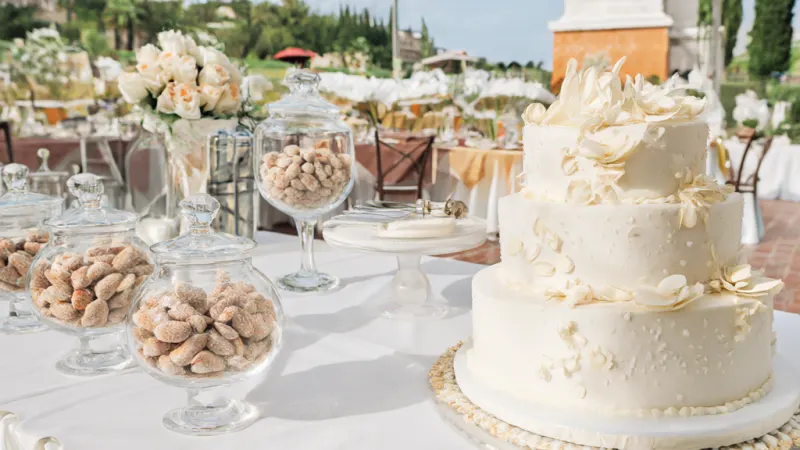
- The confettata is an Italian tradition, a table of confetti (sugared almonds), which can be set out as a buffet, with or without favours.
The cutting of the cake is the moment when everyone stands up, phone in hand. Behind that minute lie practical choices: who makes the cake, how it arrives, where it waits, who cuts it. Together with the dessert buffet and the confettata, it closes the food side of the reception.
Who makes the cake: three options
| Who makes it | How it works | What to check |
|---|---|---|
| The caterer | Cake included in the menu or as an extra | Tasting at the menu trial, possible flavours, decoration |
| A pastry shop you choose | The cake arrives on the wedding day | Whether the caterer accepts it, cutting fee, delivery |
| The venue | In-house or partner pastry shop | Whether it is compulsory, as with an exclusive caterer |
The caterer's cake
This is the simplest solution. The caterer knows the venue's kitchen, manages the fridge and the timings, and cuts and serves with no extra charge. Ask to taste it at the menu tasting, not just to see photos.
A cake from an outside pastry shop
Many Roman couples have a family pastry shop, or want a designer cake. In this case you need three confirmations:
- the caterer and the venue accept outside desserts;
- there is a cutting and serving fee, often called the "cake fee" (diritto di torta);
- who handles delivery, the fridge and assembling the tiers.
For food safety reasons the caterer may ask for documents on where the cake comes from. This is reasonable: whoever serves is responsible for what goes on the table. Check what is required and have it written into the contract. For all the useful clauses, read the guide on what to check in a catering contract.
The cake in the Roman heat
A July wedding in a garden in the Castelli Romani or on the Via Appia puts any dessert to the test. Cream, custard and mascarpone cannot stay out of the fridge for long.
What to ask for:
- more stable fillings for summer weddings, to be agreed with the pastry chef;
- a fridge large enough for the cake in the venue's kitchen;
- short display time: the cake comes out shortly before the cutting, not at the start of dinner;
- a table in the shade, away from heat sources such as lamps and flames;
- fresh flower decorations only if they are safe in contact with food.
A common solution is a smaller showpiece cake, cut in front of everyone, alongside portions already prepared in the kitchen. Guests get their dessert faster and the risk from the heat is reduced.
The dessert buffet
After the cake, many weddings have a dessert buffet: small pastries, fruit, ice cream, spoon desserts. It is also the right place for a local touch, with traditional Roman desserts alongside the others:
- mini maritozzi (sweet buns) with cream;
- ricotta and sour cherry tart, a dessert linked to the cooking of Rome's Jewish Ghetto;
- bignè di San Giuseppe (cream puffs) for March weddings;
- ciambelline al vino (wine biscuits) and tozzetti (almond biscuits) with a sweet wine from the Castelli Romani;
- ice cream in cups or from a cart, very popular in summer;
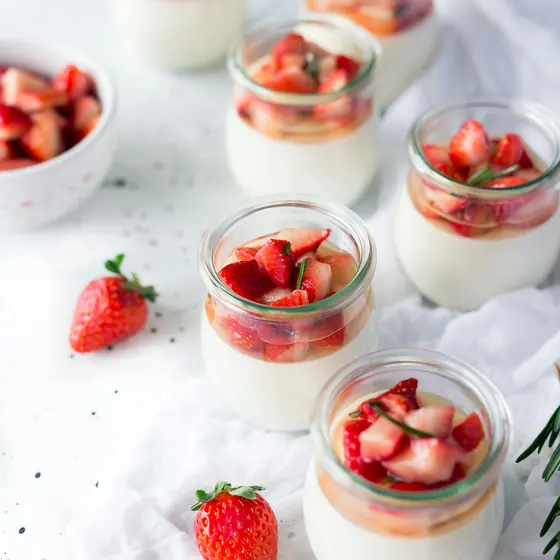
- seasonal fruit: Nemi strawberries in late spring, figs in September, citrus in winter.
You will find more ideas in the guide to Roman desserts for events. If dinner has been long, a small, carefully chosen buffet is better. Many guests only taste one or two desserts.
The confettata
The confettata is a table or corner where confetti are displayed and guests take their share, often in bags or small boxes. It can replace the traditional wedding favour (bomboniera) or sit alongside it.
The sugared almond tradition
In Italian tradition, wedding confetti are white and come in odd numbers. The five sugared almonds are said to represent five wishes for the couple: health, fertility, long life, happiness and wealth. It is a widespread custom, not a rule: today you see coloured, chocolate and fruit-flavoured confetti.
Sulmona, in Abruzzo, is the Italian town most closely linked to confetti, with a long-standing production tradition. Many confettate in Rome use sugared almonds from this area.
How to organise it
- Choose where to put it: near the exit, so guests find it as they leave.
- Several flavours, clearly labelled: cards with the flavour and the allergens (almond, hazelnut, chocolate, milk).
- Who sets it up: the caterer, the wedding planner or a dedicated supplier. Ask, so it isn't left with nobody to tidy it.
- Bags and scoops: you need containers and tools so guests can help themselves hygienically.
Remember that almonds and nuts are among the 14 allergens in EU Regulation 1169/2011. Classic almond confetti must be labelled.
Cake, desserts and confettata: getting the balance right
With a cake, a dessert buffet and a confettata there is a risk of overdoing it. After a generous aperitivo and a three-course dinner, few guests eat everything. A few practical criteria:
- if the cake is large and served to everyone, the dessert buffet can be reduced to fruit and small pastries;
- if you choose a generous dessert buffet, the cake can be just for show, with few portions;
- the confettata is not a dessert to eat on the spot: it is a keepsake to take home, and should be thought about separately.
There is no right quantity for everyone. Ask the caterer how many portions of cake and how many pastries they allow per person, and for how many adult guests. That way you can compare different quotes on the same basis.
Timings and the moment of cutting
The cutting of the cake usually closes dinner and opens the party. A few practical tips:
- agree with the caterer how many minutes it takes to bring out the cake and serve it;
- tell the photographer and musicians: it is one of the most photographed moments;
- plan the toast with sparkling wine straight after the cutting;
- if there is also an open bar, decide whether it opens before or after the cutting. We cover this in the guide to the wedding open bar.
Questions to ask the caterer
- Is the cake included in the menu? Can I taste it at the tasting?
- Do you accept a cake from an outside pastry shop? With what documents?
- Is there a fee for cutting and serving an outside cake?
- Is there a fridge at the venue large enough for the cake?
- Which fillings do you recommend for a summer wedding?
- Is the dessert buffet included? Which desserts can you offer, including Roman ones?
- Who sets up the confettata and who tidies it during the evening?
- How do you label the allergens in the cake, desserts and confetti?
To finish
Cake, dessert buffet and confettata are three different choices, to be decided together so you don't end up with too much or too little. For caterers who work at weddings, see the wedding caterers section and, for all the additional items, the guide to extra catering costs. When you know who will make the cake, request a quote stating whether it is included or from outside: the offers will be easier to compare.
Sources
- Regulation (EU) No 1169/2011, Annex II (substances causing allergies or intolerances), EUR-Lex: https://eur-lex.europa.eu/legal-content/IT/TXT/?uri=CELEX:32011R1169