In short
- The event date decides the ingredients of the menu even before the format.
- The calendar below is approximate: weather and the year can shift the windows by a few weeks.
- Lazio has several DOP and IGP products that are useful on an event menu.
- Fix the final menu 2-3 months before, when the season is more predictable.
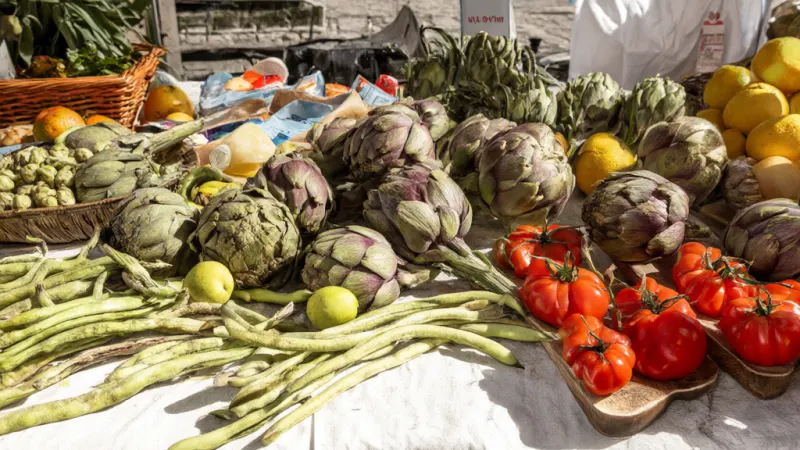
A seasonal menu isn't a fashion. It's the simplest way to get fresh ingredients, reasonable prices and dishes tied to the area, whatever the style of cooking: seafood, creative, international or Roman. An artichoke in October comes from far away; in March it comes from the Roman countryside or the coast.
Why the season matters for catering
- Freshness. The caterer finds the produce nearby, in quantity, at the right time.
- Cost. Seasonal produce is usually more available and therefore cheaper. It's not a fixed rule, but it's a good starting point in negotiation.
- Coherence. A summer menu with courgette flowers and tomatoes reflects the time of the event.
- Results. Some dishes only make sense in one month: vignarola in spring, puntarelle in winter.
The calendar month by month
The calendar is approximate: it depends on the weather, the growing area and the year. Some references are verified: for Turismo Roma, the Romanesco artichoke runs from January to May, at its peak between March and April; the Romanesco courgette is a late-spring and summer product but can be found until November; Romanesco broccoli is a winter vegetable harvested until May.
| Month | Vegetables | Fruit | Other | Menu ideas |
|---|---|---|---|---|
| January | Romanesco broccoli, puntarelle, chicory, first artichokes | Oranges, kiwis | Dried pulses | Pasta and broccoli, puntarelle, soups |
| February | Artichokes, broccoli, fennel | Oranges, apples | Carnival frappe and castagnole | Roman-style artichokes, Carnival fried sweets |
| March | Artichokes (peak), asparagus, broad beans, peas | Citrus | Bignè di San Giuseppe (19 March) | Jewish-style artichokes, vignarola |
| April | Artichokes, broad beans, peas, Roman lettuce | Strawberries (early) | Abbacchio, eggs (Easter) | Abbacchio, broad beans and pecorino |
| May | Broad beans, last artichokes, courgettes (early) | Strawberries, cherries | Fresh pecorino | Broad beans and pecorino, pasta with spring vegetables |
| June | Courgettes, courgette flowers, green beans | Cherries, apricots, sour cherries | Ricotta | Courgette flowers, sour cherry tart |
| July | Tomatoes, aubergines, peppers | Peaches, watermelons, melons | Fish from the coast | Rice-stuffed tomatoes, panzanella, raw seafood |
| August | Tomatoes, aubergines, peppers | Figs, melons, watermelons | Gelato and granita | Cold, light menus |
| September | Last courgettes, peppers | Grapes, figs | Grape harvest | Figs and prosciutto, pasta with vegetables |
| October | Mushrooms, pumpkin, cabbages | Grapes, chestnuts, pomegranates | Hazelnuts | Pasta with mushrooms, chestnuts in desserts |
| November | Romanesco broccoli, chicory, cauliflower | Persimmons, chestnuts, mandarins | New-season olive oil | Bruschetta with new oil, broccoli |
| December | Broccoli, puntarelle, artichokes (early) | Citrus | Festive fried food | Mixed fried food, pangiallo, puntarelle |
Lazio's protected products
Lazio has a list of products with a protected designation of origin, published by the Lazio Region and by Arsial, the regional agency for agricultural development. Those that come up most often on event menus:
| Product | Mark | How to use it |
|---|---|---|
| Pecorino Romano | DOP | Cacio e pepe, broad beans and pecorino, shavings with honey |
| Ricotta Romana | DOP | Desserts, tart with sour cherries, pasta |
| Abbacchio Romano | IGP | Spring main course, grilled scottadito chops |
| Porchetta di Ariccia | IGP | Counter with a slicer, mini rolls |
| Carciofo Romanesco del Lazio | IGP | Roman-style, Jewish-style, as a cream |
| Nocciola Romana | DOP | Desserts, chopped nuts, pralines |
If the caterer writes "DOP" or "IGP" on the menu, you can ask which producer the product comes from. It's a normal question, and a well-prepared caterer will be glad to answer.
Sample menus by season
Four example structures in different styles, to adapt to the format. They're ideas, not set menus: the same seasonal produce goes into a seafood menu, a creative one or a Roman one.
Spring (April), Roman cuisine menu
- Aperitivo: Jewish-style artichokes, broad beans and pecorino, pizza bianca and mortadella
- First course: tonnarelli with artichokes and wild mint
- Main course: roast abbacchio (lamb) with potatoes
- Dessert: bignè or ricotta tart
Summer (June-July), seafood menu
- Aperitivo: fried courgette flowers, raw fish, stuffed cherry tomatoes
- First course: a cold pasta with courgettes and fish, or fettuccine with courgettes and their flowers
- Main course: grilled fish from the coast
- Dessert: fresh fruit, sorbets, fruit tart
Autumn (October), creative Italian menu
- Aperitivo: mushroom crostini, figs and prosciutto, pumpkin finger food
- First course: fettuccine with porcini or pumpkin risotto
- Main course: roast suckling pig or fillet with chestnuts
- Dessert: desserts with chestnuts or hazelnuts
Winter (January), meat menu
- Aperitivo: puntarelle in small cups, battered salt cod, vegetable tempura
- First course: pasta e ceci, or pasta and broccoli
- Main course: roast with winter vegetables, or a braise
- Dessert: citrus, chocolate desserts, mini pastries
More complete menus are in the wedding menu examples and those for corporate events. If you'd like an all-Roman menu, you'll find the dishes in detail in the guide to the Roman cuisine catering menu and, for weddings, in the Roman wedding menu.
When to fix the menu
An event is often booked many months ahead, but the season can't be predicted a year in advance. A practical approach:
| When | What to decide |
|---|---|
| On signing the contract | Format, number of courses, style of cooking |
| 2-3 months before | Final menu with the produce of the period |
| 2-4 weeks before | Confirmation with the caterer on product availability |
Also ask what happens if a product is missing: a cold season can delay the artichokes, a very hot summer can shorten the courgette flower season. A good contract allows for an equivalent substitute.
The Lazio sea
Fish has a season too. The Lazio coast, from Civitavecchia to Gaeta by way of Fiumicino, Anzio and Terracina, brings fish to Rome that changes with the months and the weather. If you choose a seafood menu, ask the caterer what comes in from Lazio's fishing fleets at the time of your event, rather than fixing a precise species now. And if you're planning raw seafood, read the guide to sushi and raw fish at events.
Questions to ask the caterer
- Is the menu you're proposing designed for the month of my event?
- Which products come from Lazio, and from which producers?
- Do you use DOP or IGP products? Which ones?
- What happens if an ingredient isn't available on the day?
- Is the tasting done with seasonal produce or with substitutes?
- Does the price change if I move the event to another season?
- Do you have vegan or gluten-free versions of the seasonal dishes?
Before asking for a quote
Give the date, even approximately: the caterer will suggest a more realistic menu. You can explore all the suppliers in the catering section and, when you're ready, request a quote with the month of the event already stated.
Sources
- Turismo Roma, "I prodotti della campagna romana: le verdure romanesche protagoniste in cucina": https://turismoroma.it/it/node/127323
- Italia.it, Carciofo romanesco del Lazio: https://www.italia.it/it/lazio/cosa-fare/carciofo
- Lazio Region, certified quality products: https://regione.lazio.it/cittadini/agricoltura/qualita-produzioni/Produzioni-qualita-certificate
- Arsial, presentation on Lazio's quality products: https://www.arsial.it/app/uploads/CATTA_291123_Multifunzionalita_RI.pdf