In short
- Start with the groups (families, friends, colleagues), then deal with the special cases: children, older guests, exes, singles.
- The table plan shows the table, the place card the seat: you don't always need both.
- The caterer uses the same numbering to serve and to manage allergies and diets.
- The final version is closed after the deadline for final numbers in the contract.
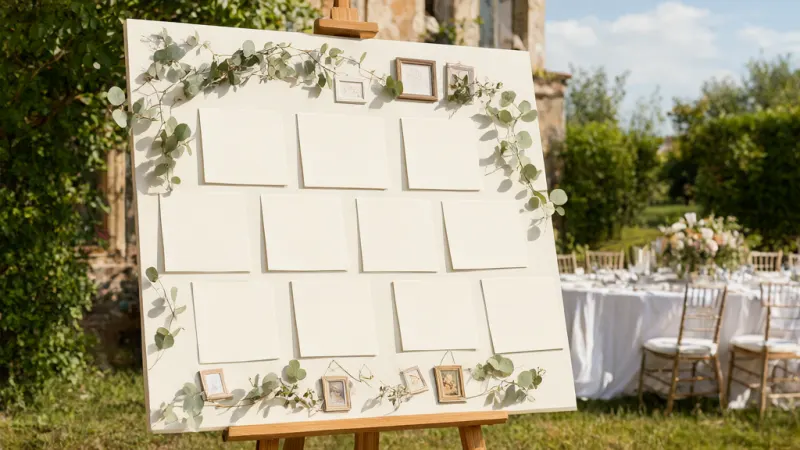
Assigning seats is the task many couples put off until the last week. Then they end up with a sheet full of arrows and an offended aunt. With a simple method it takes two evenings. Here are the criteria, the delicate cases and the timings to coordinate with the caterer. In Italy the seating chart displayed at the entrance is usually called the tableau de mariage.
The shape and arrangement of the tables in the room are covered in the guide to table layout. Here we deal with who sits where.
The method in four steps
- Divide the guests into groups: his family, her family, university friends, colleagues, childhood friends, neighbours.
- Count the groups and compare them with the seats per table. Trade guides suggest 6 to 12 people for round tables: a group of 10 fills a table, a group of 14 has to be split.
- Merge small groups that will get on: her colleagues with his gym friends, if they are of similar age and interests.
- Deal with the special cases and check the whole picture.
A useful tool: a spreadsheet with one row per guest and columns for group, table, diet and age (adult or child). It is the same file you then send to the caterer.
Close to the couple
The couple's table can be just for the two of you, with the witnesses or with the parents. Trade guides describe both solutions. The nearest tables usually go to:
- parents and grandparents, if they are not at the couple's table;
- brothers and sisters with their partners;
- witnesses, if they sit elsewhere.
If the parents are separated, two separate tables of honour, at the same distance from the couple, avoid awkwardness.
The delicate cases
Children
- Young children (up to 4-5): with their parents, with a high chair if needed. Ask the caterer how many high chairs they bring.
- Older children: a dedicated table near the parents, if there are at least six or seven of them. Better with an adult or an entertainer.
- The caterer usually serves the children's menu first: tell them where the children are.
The ages are indicative: decide based on the children you know. Menu ideas in the guide to children's parties.
Older guests
- Away from the speakers and the dance floor.
- Near the toilets and the exit, on a route without steps.
- With at least one family member at the table to look after them.
- If a guest uses a wheelchair, tell the caterer: a chair must be removed and a passage left clear.
Exes, feuding relatives, strained relationships
Different tables, not facing each other, not near the buffet or the bar where they would keep running into each other. But not at the back of the room as a punishment: each with people they get on with.
Singles and plus-ones
Avoid a "singles table" if it sounds like a label. It is better to mix guests who come alone with groups of friends of the same age. Partners who know nobody should sit next to the person who brought them.
Suppliers
The photographer, videographer, musicians and wedding planner usually eat at a separate table, close to the room but not in the front row. The caterer may have a dedicated menu for them: ask the price and include them in the count, as explained in the guide to extra catering costs.
Table plan, place cards, table names
| Element | What it is for | When you need it |
|---|---|---|
| Table plan (tableau de mariage) | Tells each guest their table | Always, above 30-40 guests |
| Place card | Shows the exact seat at the table | Optional, useful with special diets and served dinners |
| Table name or number | Helps people find the table in the room | Always |
| Menu card on the table | Lists the courses | Optional |
The 30-40 guest threshold is indicative: it is the size at which guides talk about micro weddings, where a single table is often enough. Above that, guests need to find their place quickly.
Table names: numbers, Roman squares, neighbourhoods, Roman dishes, Lazio wines. They all work, as long as the sign in the room can be read from a distance. Ask the caterer to use the same names on their floor plan: if you write "Trastevere" and the maître has "table 7", someone will get the wrong dish.
Place cards and diets: a discreet symbol on the place card helps the waiter recognise a gluten-free, vegan or allergy menu. EU Regulation 1169/2011 requires information on the 14 allergens even for unpackaged food: the caterer must know where the guests with allergies are sitting. For coeliac disease and other diets there is the guide to special diets in catering.
Timings with the caterer
| When | What to do |
|---|---|
| Sending the invitations | Ask for confirmation, allergies and diets in the same reply |
| First RSVPs | Draft the groups and tables |
| Deadline for final numbers (from the contract) | List closed, tables confirmed to the caterer |
| Straight afterwards | The caterer confirms the floor plan and numbering |
| Final days | Print the table plan and place cards, final list to the maître |
| On the day | A trusted person checks the table plan before guests arrive |
Guides for couples suggest sending invitations about two or three months before. The deadline for final numbers is set by the contract: read about it in the guide on what to check in a catering contract. The other deadlines are in the event planning timeline.
One thing to do every time: print two copies of the final list with table, name and diet. One for the maître, one for the couple's trusted person.
Questions to ask the caterer
- By when do you need the final list with the tables?
- In what format do you prefer it (spreadsheet, floor plan)?
- Do you use our table names or your own numbering?
- How do you flag guests with allergies and diets in the room?
- Do you serve the children's tables first?
- How many high chairs do you bring?
- Where do the suppliers eat, and with what menu?
- Do you set up the table plan, or does the florist or decorator bring it?
To finish
The table plan is the last thing you print, but the first thing guests look for. Work on it by groups, close it after the final numbers and send it to the caterer with the diets. For the other aspects of the reception, read the guide to wedding catering in Rome, browse the wedding caterers and request a quote when you have an estimate of guest numbers.
Sources
- Regulation (EU) No 1169/2011, EUR-Lex: https://eur-lex.europa.eu/legal-content/IT/TXT/?uri=CELEX:32011R1169