In short
- The per-person price usually covers the menu: staff beyond the agreed hours, hire, the open bar and the cake may be extra.
- Corkage is not set by law: each supplier decides whether to charge it and how much.
- In Rome, logistics (ZTL, floors, distances) are a frequent source of supplements.
- There is one way to avoid surprises: ask in writing about every item before signing.
A quote with a low per-person price can become expensive by the end of the evening. Not because the caterer is dishonest, but because some items were not in the price and nobody asked about them. Here you will find the most common ones, grouped together, with the question to ask for each.
Why extra costs exist
The per-person price describes the menu. Everything that changes from event to event (times, place, equipment, drinks) is easier to price separately. It is a widespread practice and not a problem, as long as it is in writing. The problem arises when the item appears only on the invoice.
We do not give figures for individual items here: they vary too much from supplier to supplier, and there is no reliable source that measures them in Rome. Instead, we give the full list, so you can ask about all of them.
Staff
| Item | Why it is separate | What to ask |
|---|---|---|
| Extra hours | The quote covers a precise time slot | Cost of each hour beyond the agreed time, and who decides when it applies |
| Additional staff | More guests or more stations than planned | Cost of each extra waiter |
| Bartender | Not always included in the floor service | Whether there is one, for how many hours, at what cost |
| On-site cook | For cooking on site or show cooking | Included or extra |
| Cloakroom, hosts | Non-kitchen services | Whether the caterer supplies them or they must be found elsewhere |
"Service included" should always be translated into figures: how many people, in which roles, from what time to what time. To understand how many you really need, there is the guide on how many waiters you need.
Hire and set-up
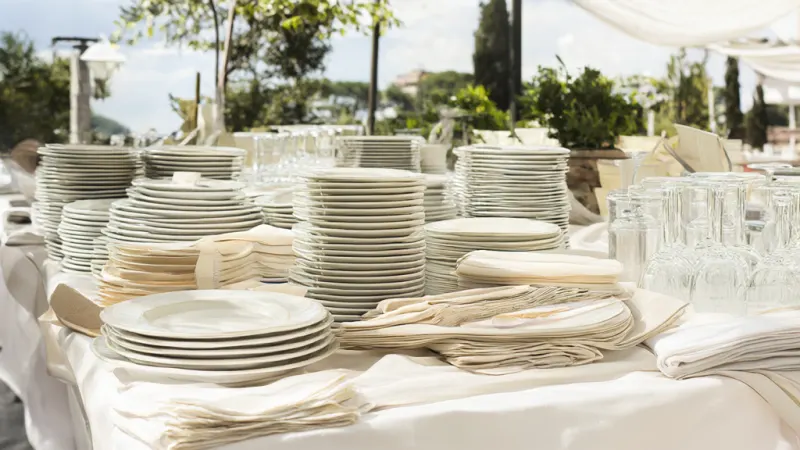
- Table linen: tablecloths, table toppers, cloth napkins. Sometimes included, sometimes hired.
- Tableware: plates, glasses, cutlery. Ask whether they are ceramic and glass or disposable.
- Tables and chairs: included at many venues, to be hired for a private garden or an empty farmhouse.
- Buffet tables, stands, displays: for the aperitivo stations.
- Gazebos and marquees: essential as a plan B for an outdoor event.
- Field kitchen, generator, lighting: when the venue has no kitchen or not enough power.
- Washing and collection: who takes everything away, and when.
To find out who brings what and how it is organised, read the guide to hiring event equipment.
Drinks
- Open bar after dinner: almost always a separate item, by the hour or by consumption.
- Wine beyond the package: when the package includes a set number of bottles, any extra ones are charged separately.
- Corkage: if you bring your own wine or sparkling wine, the caterer may charge a fee per bottle. In Italy it is not regulated by national law: it is the supplier's free choice and usually covers opening, glasses and service. Ask whether it accepts outside bottles and at what price.
- Coffee, amari, spirits: not always included at the end of the meal.
- Ice and cold drinks: in summer, for an outdoor event, ask who supplies them.
Desserts and cake
- Cutting and serving an outside cake: if the cake comes from a pastry shop, the caterer may charge a fee.
- Dessert buffet or confettata (a display of sugared almonds, a wedding tradition): often an extra on top of the dessert on the menu.
- Dessert plates and cutlery: to be checked if the cake comes from outside.
Logistics: the most Roman item
In Rome, logistics can weigh more than elsewhere.
- Historic centre and ZTL: vans need permits to enter the limited traffic zone and must keep to set time slots, as Roma Mobilità explains. Ask who applies for the permit and whether the cost is in the quote.
- Difficult loading and unloading: narrow alleys, courtyards of historic palazzi, terraces with no goods lift. More carrying by hand means more staff.
- Distance: an event in the Castelli Romani, on Lake Bracciano or on the coast at Fregene may carry a mileage supplement.
- Setting up the day before: if the caterer has to set up in advance, the extra work may be a separate item.
Other items not to forget
- Suppliers' meals: the photographer, musicians and wedding planner eat too. There is often a dedicated menu at a different price.
- Children's menu: a reduced price, but with age thresholds that vary from supplier to supplier.
- Special diets: gluten-free, vegan and kosher dishes may cost a different amount. For kosher with rabbinical supervision, the cost of supervision may be separate.
- Venue fee: some open venues charge outside caterers a fee, which then ends up on your bill.
- Rubbish disposal: who takes away food waste, glass and plastic at the end of the event.
- VAT: if the quote excludes VAT, normally add 10% for catering with service.
- Last-minute changes: changes to the menu or guest numbers after the agreed deadline.
Questions to ask the caterer
- What exactly does the per-person price include?
- How many hours of service are included and how much does each extra hour cost?
- Are table linen, tableware, tables and chairs included?
- Is the open bar included? For how many hours, and with which drinks?
- Do you accept wine we bring ourselves? How much do you charge per bottle?
- If I bring a cake from outside, is there a cutting and serving fee?
- Are there supplements for distance, the ZTL, floors with no lift?
- Who applies for and pays for the ZTL permit?
- How much does the suppliers' meal cost?
- Who disposes of the rubbish?
- Is the price inclusive or exclusive of VAT?
- Are there any other costs that might appear only on the invoice?
The last question sounds naive, but it works: it obliges everything to be put on the table.
In summary
Extras are not a trick; they are variable items. You just need to ask about them one by one and have them put in writing. With this list in hand you can read every offer by the same yardstick, following the method in the guide on how to read a catering quote. Starting price ranges are in how much catering costs in Rome.
Once your list is ready, browse the list of caterers in Rome and request a quote from two or three suppliers, asking them all the same questions.
Sources
- Roma Mobilità, ZTL and permits: https://romamobilita.it/it/servizi/ztl