In short
- For Saturdays in May, June and September in Rome, it pays to start 12-18 months ahead.
- Before falling for a caterer, find out whether the venue has exclusive catering.
- The most common format is mixed: an aperitivo buffet, a served dinner, a dessert buffet.
- Fish, meat, creative, international or Roman: whatever cuisine you choose, a good menu follows the season.
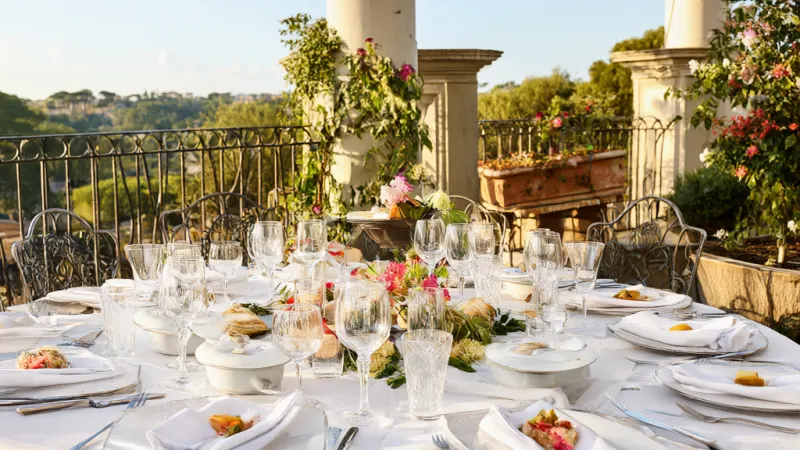
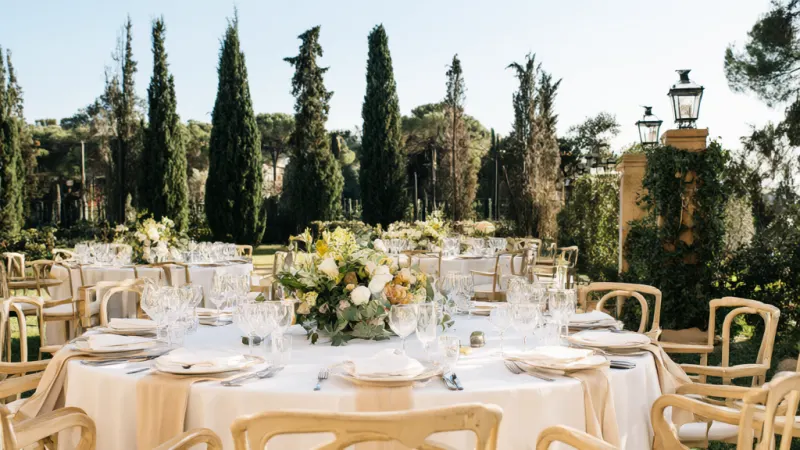
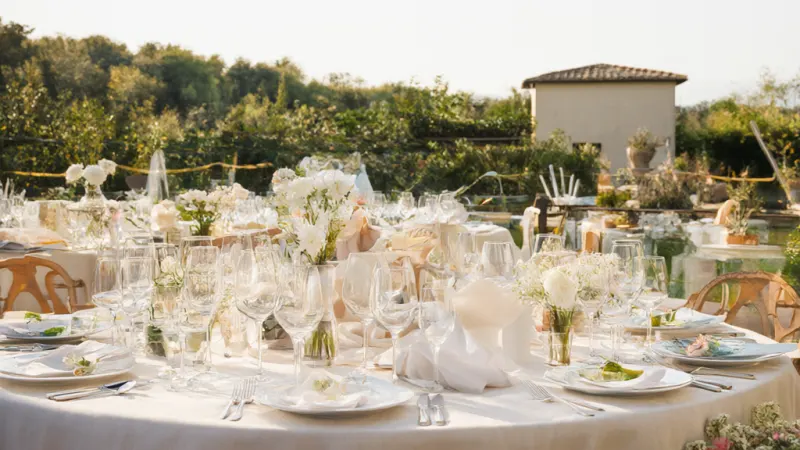
Together with the venue, catering is the decision that most shapes the budget and the atmosphere of a wedding. In Rome you have an enormous choice: historic villas, farmhouses in the Roman countryside, terraces in the centre, houses on Lake Bracciano or in the Castelli Romani. This guide takes you through the choices in the order it makes sense to make them.
Venue first: exclusive or open catering?
This is the first question to ask, because it changes everything else.
Venues with exclusive catering
Many reception venues work only with their own caterer or with a short list of approved suppliers. In these cases:
- you choose the caterer when you choose the venue;
- the price is tied to the venue's price list and is often presented as a per-person "package";
- the logistics are well tested: equipped kitchens, staff who know the spaces, established timings;
- you have less room to bring in outside suppliers (wine, cake, sometimes even the sugared almonds).
Venues with open catering
Other venues rent out the space only and let you choose the supplier. Here:
- you have more freedom over menu and price;
- you need to check that the caterer knows the venue or carries out a site visit;
- the venue may charge extra costs to outside suppliers (use of the kitchen, cleaning, corkage on drinks brought in);
- hire items and set-up may all have to be organised by you.
Middle-ground arrangements
Some venues suggest a "trusted" caterer but also accept a supplier chosen by the couple. Always ask in writing which arrangement applies, what outside suppliers are charged and what time limits there are (end of music, end of service, breakdown).
Reception formats
| Format | How it works | Suits |
|---|---|---|
| Served at the table | Plated courses served in sequence | Classic weddings, predictable timings |
| Buffet | Guests serve themselves from stations | Informal receptions, gardens |
| Themed islands | Stations for first courses, raw fish, cheeses, live cooking | Convivial weddings, many guests on the move |
| Cocktail dînatoire | Generous finger food and bowl food, standing | Evening weddings, city venues |
| Mixed | Aperitivo buffet, served dinner, dessert buffet | The most common solution |
The mixed format is popular because it alternates standing and seated moments. The aperitivo (drinks and small bites) after the ceremony gives the photographer and the couple time; the served dinner brings order; the dessert buffet and the bar close the evening informally.
For indicative costs for each format and to understand what a quote really contains, read how much catering costs in Rome.
The season in Rome: what changes for the caterer
Spring (March-May)
This is the season of the Roman artichoke, which according to Turismo Roma is available from January to May and at its peak in March and April. Broad beans, peas and vignarola (a spring vegetable stew) arrive. It is also the season for abbacchio, Roman milk-fed lamb. May is one of the most requested months for weddings.
Summer (June-August)
Roman courgettes and courgette flowers, tomatoes, aubergines. The heat is the real issue: you need lighter menus, carefully handled raw dishes, plenty of water, shaded areas and close attention to the cold chain at the buffet. August is often less in demand in the city.
Autumn (September-November)
September is another peak month. Mushrooms, chestnuts, grapes and, at the end of the season, new olive oil arrive. The evenings draw in: plan the outdoor aperitivo before sunset.
Winter (December-February)
Romanesco broccoli, puntarelle (a Roman chicory), chicory, pulses. Winter weddings are less common, but for that very reason it is easier to find availability and, often, better terms.
Which cuisine to choose for the reception
Caterers in Rome do not all cook Roman food. Their menus include fish dishes from the coast, creative Italian cooking, meat menus, international options, sushi and raw fish stations, as well as Roman and Lazio cuisine. The choice depends on you, your guests and the season: full examples of each style are in the wedding menu examples, and for seafood there is the guide to the fish menu.
If you want a Roman menu, or a few Roman dishes within a different menu, here are some ideas for each stage:
Aperitivo
- Supplì (fried rice balls) and mini supplì, also in cacio e pepe or amatriciana versions
- Courgette flowers with mozzarella and anchovy (in summer)
- Carciofi alla giudia or alla romana in mini portions (in spring)
- Pizza bianca with mortadella, porchetta from Ariccia, pecorino romano with honey
First courses
- Cacio e pepe tossed to order, in front of guests
- Amatriciana or gricia in tasting portions
- Rigatoni con la pajata (with veal intestines) only if you know your guests enjoy it
Main courses
- Abbacchio scottadito (grilled lamb chops) or roast with potatoes, in spring
- Saltimbocca alla romana
- Fish from the Lazio coast, if you choose a seafood menu
Desserts
- Maritozzi (sweet buns) with cream in mini format
- Ricotta and sour cherry tart
- Wedding cake and dessert buffet
For a fully Roman menu you will find much more detail and a seasonal calendar in the guide to the Roman cuisine menu for catering.
The wedding day timeline
Every wedding is different, but a typical timeline for an afternoon ceremony with an evening reception helps you see what to coordinate with the caterer.
| Moment | What happens | What to ask the caterer |
|---|---|---|
| Morning | Staff arrive, kitchen and set-up assembled | Access times at the venue, who opens up |
| 2-3 hours before the reception | Mise en place, aperitivo preparation | Table check, seating plan, place cards |
| End of ceremony | Welcome aperitivo | Expected duration (often 60-90 minutes) |
| Into the dining area | Served dinner or islands | Timings between courses |
| After dinner | Cake cutting, dessert buffet, toast | Who cuts and serves the cake, any cost |
| Party | Open bar, music | Hours of service included and extra cost |
| End of the evening | Breakdown | The venue's latest finishing time |
Two practical tips:
- Match the timings with the photographer. If the couple disappear for 40 minutes for photos, the aperitivo has to last.
- Plan a meal for the suppliers. Photographers, musicians and wedding planners work for hours: ask the caterer for a staff menu and its cost.
When to book the caterer
Wedding guides generally say to secure the venue and caterer 12 to 18 months before the wedding, with the venue as the first step. In Rome, for Saturdays in May, June and September at the most requested venues, even a year may not be enough.
An indicative schedule:
| When | What to do |
|---|---|
| 12-18 months before | Choose the venue, check for exclusive catering, first quote requests |
| 10-12 months before | Tastings, contract signed, deposit paid |
| 6 months before | Format decided and draft menu |
| 2-3 months before | Final menu, drinks, set-up, allergies and diets collected |
| 2-4 weeks before | Final guest numbers (check the deadline in the contract), seating plan |
| Wedding week | Final site visit, timings confirmed, weather plan B |
Guests' special diets and allergies
Collect allergies, intolerances and diets together with the RSVPs: add a question to the RSVP form. Give the caterer each guest's name, table and requirement. Regulation (EU) 1169/2011 requires caterers to provide information on the 14 allergens even for unpackaged dishes, so ask for the allergen matrix for your menu. For coeliac disease, vegan, kosher and halal menus, read the dedicated guide to special diets.
Final wedding catering checklist
- Does the venue have exclusive catering? Are there charges for outside suppliers?
- Format chosen and number of courses
- Seasonal menu, children's menu, staff menu
- Staff: number of waiters and hours included
- Drinks: what is included, open bar, corkage
- Cake: who makes it, who serves it, cake-cutting fee
- Written weather plan B
- Deadline for final guest numbers
- Deposit and cancellation terms
For all the checks on the contract, health permits and tasting, use the checklist on how to choose a caterer. When you are ready, request a quote or explore the wedding caterers section.
Sources
- Turismo Roma, "I prodotti della campagna romana: le verdure romanesche protagoniste in cucina": https://turismoroma.it/it/node/127323
- Italia.it, Roman artichoke of Lazio: https://www.italia.it/it/lazio/cosa-fare/carciofo
- Regulation (EU) No 1169/2011, EUR-Lex: https://eur-lex.europa.eu/legal-content/IT/TXT/?uri=CELEX:32011R1169