In short
- The per-person prices published by Italian guides are only indicative: they range from a few tens of euros for an aperitivo to over €100 for a wedding.
- The format (buffet, finger food, seated, apericena) weighs on the bill as much as the menu.
- Staff, hire, styling, drinks, VAT and transport can change the total more than the food itself.
- Compare quotes line by line, not just the final figure.
Asking "how much does catering cost in Rome" is a bit like asking how much a house costs: the honest answer is "it depends". But it depends on specific things you can know in advance. In this guide you will find the orders of magnitude published by Italian sources, the factors that move the price, and a method for reading a quote without surprises.
A word of warning before we start: the figures below are national averages or estimates from industry websites, not a Rome price list. In Rome there are caterers below these thresholds and many above them. Use them to judge whether a quote is in the normal range, not to demand a price.
Indicative prices by format and event
The table brings together the indicative ranges found online, based on industry estimates.
| Format / event | Indicative range per person |
|---|---|
| Coffee break | €7-15 |
| Light lunch | €12-18 |
| Aperitivo | €15-20 |
| Cocktail reception | €20-25 |
| Simple lunch or dinner | €20-50 |
| Full basic menu (antipasto, pasta, main, side, dessert) | €35-70 |
| Seated dinner with elaborate dishes | €40-60 and up |
| Wedding banquet | about €125 (average) |
| Wedding catering | €90-150 and up |
| Simple apericena (DIY or very basic) | about €10-20 |
Two useful observations:
- The ranges overlap. A generous aperitivo with craft cocktails can cost more than a simple lunch. The name of the format matters less than what is in it.
- The sources measure different things. Some include staff and drinks, others don't. That is why a Rome quote at €45 can be better value than one at €38, if the first includes what the second charges separately.
Buffet, finger food, seated, apericena: what changes
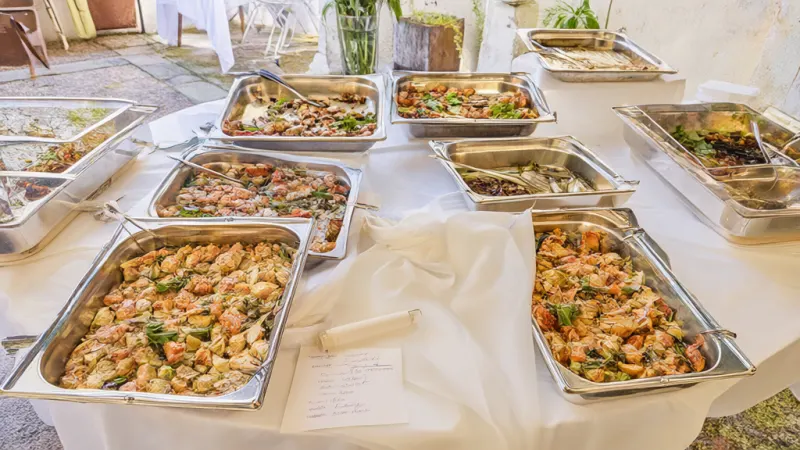
Buffet. Guests serve themselves from one or more stations. It needs fewer front-of-house staff than a seated dinner, but someone must restock and keep things tidy. It is usually among the cheaper formats for the same menu.
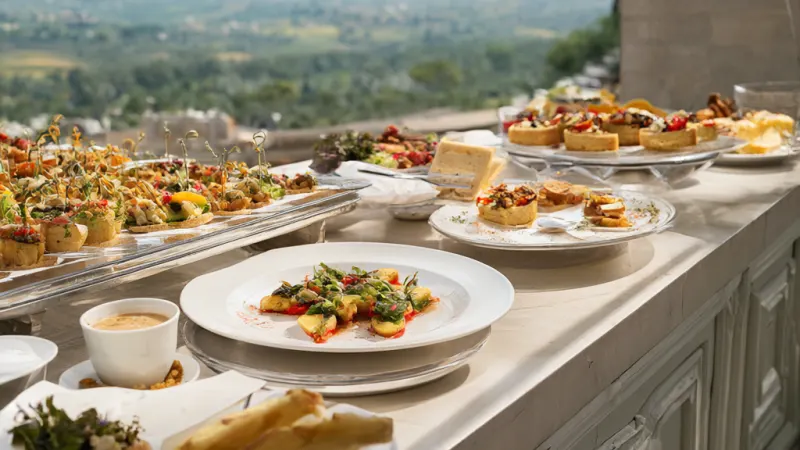
Finger food. Bites eaten standing, passed by waiters or displayed at stations. The cost depends a lot on the number of pieces per person and the complexity of each piece: a mini supplì and a tartare on a spoon don't cost the same.
Seated dinner. Plated courses served in sequence. It is the format that needs the most staff, the most tableware and the most kitchen time. It is also the one with the most predictable price, because portions are fixed.
Apericena. An aperitivo that replaces dinner: plenty of finger food, a few hot dishes, sometimes a pasta station. In Rome it is a very popular format for graduations, birthdays and evening corporate events.
Mixed formats. Very common for weddings: a buffet aperitivo in the garden, then a seated dinner, then a dessert buffet. Each stage has its own cost, and it is worth asking for them separately in the quote.
What pushes the price up (or down)
1. The menu and the ingredients
This is the most obvious item. Raw fish, premium cuts of meat and out-of-season produce cost more. Industry guides note, for example, that a seafood menu raises the cost of the banquet. Conversely, a seasonal menu built on Lazio produce is often better value and tastier too, whatever the style of cooking: if you are interested, read our guide to the seasonal menu.
2. Staff
Waiters, cooks on site, maître, bartenders, cloakroom attendants. A seated dinner needs far more staff than a buffet. Watch out for two details:
- the hours included: many quotes cover a certain number of hours, then charge for each additional hour;
- the number of staff: ask for it in writing. "Service included" without numbers tells you nothing.
3. Styling and hire
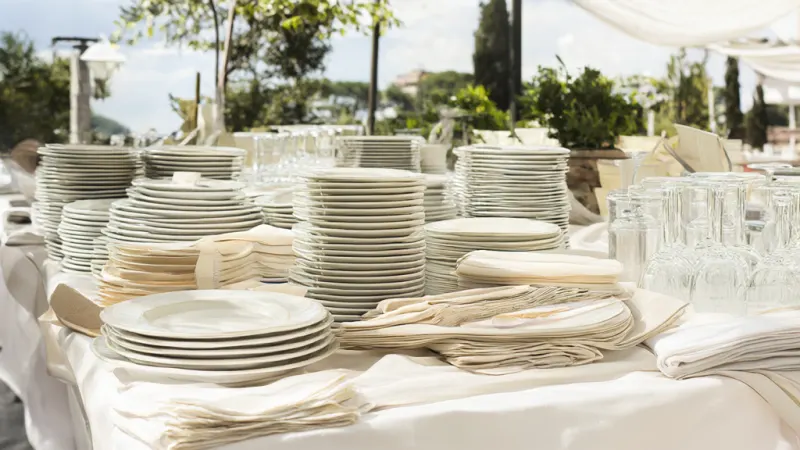
Tables, chairs, linen, plates, glasses, cutlery, gazebos, lighting, a field kitchen. If the venue is already equipped this item shrinks a lot; if you are organising in an empty farmhouse or a private garden it can become significant. Always ask whether hire is included or separate, and whether the caterer collects and washes everything.
4. Drinks
Water, wine, sparkling wine, cocktails, coffee, amari, open bar. Drinks can be quoted in many ways: per person, by consumption, per bottle opened. An included "drinks package" sometimes covers only water, house wine and coffee. If you want an open bar after dinner, ask for it as a separate item.
5. VAT
Food and drink served with service normally carries the reduced VAT rate of 10%, provided the support services (staff, equipment, service) outweigh the simple supply of food. If the caterer only delivers platters, the transaction may be treated as a sale of goods, at the rates of the individual products. Either way, always check whether the price includes or excludes VAT: on an event for 100 people the difference is substantial. For doubtful cases, ask your accountant.
6. Venue and logistics
Distance from the caterer's kitchen, access for vans, floors without a lift, the ZTL (the restricted traffic zone), access permits: all of this has a cost. In Rome, an event in the heart of the historic centre may require fixed loading times and more staff to carry things by hand. If the venue has an exclusive caterer, on the other hand, you don't choose the supplier and the price is the venue's list price.
7. Season and day of the week
May, June and September are high-demand months for weddings and outdoor events, and Saturday is the most contested day. In many cases a Friday, a Sunday or a quieter month lets you negotiate better or find availability that Saturdays don't have. There is no fixed rule: ask directly whether there are different rates for days and periods.
8. Guest numbers and minimum orders
Many caterers have a minimum guest count or a minimum spend. Below that threshold the price per person rises, because staff and transport cost the same even for a few guests. For a small party at home, delivered catering without staff may make more sense.
How to read a catering quote
A good quote is clear even to someone outside the trade. When you receive one, check these items.
| Item | What to check |
|---|---|
| Menu | Full list of dishes, indicative quantities (pieces per person for finger food) |
| Price per person | Inclusive or exclusive of VAT, and on how many guests it is calculated |
| Children | Reduced price or dedicated menu, and up to what age |
| Staff | Number of staff per role, hours included, cost of an extra hour |
| Drinks | What is included, which labels, how extras are paid |
| Hire and styling | List of what is included and what isn't |
| Transport and set-up | Included or separate, any surcharges for the ZTL or difficult access |
| Cake / desserts | Included or supplied by a third party, any cutting and serving fee |
| Payments | Deposit, balance, deadlines, methods |
| Changes | Until when you can change the guest count and the menu |
| Cancellation | What happens to the deposit if you cancel or if the caterer cancels |
Three common traps
- The "from" price. It is the price of the simplest menu with the most favourable guest count. Ask for a quote on your actual event.
- Service not quantified. "Front-of-house staff included" should become "X waiters from 7pm to midnight".
- Extras at the end of the night. Extra hours, open bar, cake cutting, corkage if you bring your own wine: ask in advance what they cost.
How to compare two quotes
Put the quotes on a sheet with the same rows as the table above and fill in every box. Where one caterer includes an item and the other doesn't, ask the second what it costs and add it. Only then compare the totals. The order often changes.
Before you sign, ask for a tasting: it is the most reliable way to see whether the price matches the quality. You will find the full checklist in the guide on how to choose a caterer.
How to save without giving up quality
- Choose the right format for your event. For a graduation, a well-made apericena works better than a seated dinner, and costs less.
- Follow the season. Artichokes in spring, Roman courgettes in summer, Romanesco broccoli in winter: seasonal produce costs less and gives more.
- Cut courses, not quality. Better three carefully made courses than six mediocre ones.
- Consider the day. A Friday evening or a Sunday lunch can give you room to negotiate.
- Settle the guest count early. Last-minute changes are often the ones that cost the most.
Once you are clear on format, date and guest count, you can request a quote from several caterers and compare them on the same basis. If you are planning a wedding, the wedding catering section goes into detail on timing and formats.
Sources
- Roma Mobilità, ZTL and permits: https://romamobilita.it/it/servizi/ztl