In short
- Roman cooking suits catering because it's made of a few strong ingredients and dishes that work in miniature.
- The season decides the menu: artichokes in spring, courgettes and their flowers in summer, Romanesco broccoli and puntarelle in winter.
- Some dishes work better live (cacio e pepe, fried food), others hold up well on a buffet.
- Many Roman sides are already vegan; gluten and lactose need dedicated recipes and equipment.
A Roman menu makes guests feel they're in the right place, whether they're Romans from Monteverde or colleagues arriving from Milan or London. But not every traditional dish works the same way at an event: some need to be eaten freshly made, others shine in small portions. This guide helps you choose.
Roman cooking is one possible path, not everyone's: caterers in and around Rome also offer seafood menus, creative Italian cooking, international food, sushi and finger food. If you're still deciding on the style, start from the wedding menu examples or those for corporate events; if you've chosen Roman cooking, here are the dishes.
Roman dishes that work for catering
Finger food and aperitivo
Supplì. The Roman fried classic: rice in tomato sauce with a mozzarella centre, breadcrumbed and fried. In mini format it's perfect for the aperitivo. Many caterers offer variations (cacio e pepe, amatriciana, carbonara). It must be served hot: if there's no fryer on site, ask how it will be reheated.
Pizza bianca and mortadella. Pizza bianca is Rome's plain flatbread: simple and much loved. It works cut into squares, filled to order or shortly before, so the bread doesn't go soggy.
Courgette flowers. Stuffed with mozzarella and anchovy, battered and fried. Only in season, and ideally fried to order.
Carciofi alla giudia. Jewish-style artichoke, opened "like a flower" and fried twice. Italia.it describes it as cut in a spiral to remove the tough parts and fried twice in hot oil. For catering it's often served in wedges or mini portions.
Carciofi alla romana. Roman-style artichokes, slowly cooked with oil, garlic, parsley, wild mint and pepper. They hold up well even warm and are naturally plant-based.
Porchetta. Porchetta di Ariccia, from the Castelli Romani, lends itself to mini rolls, boards or stations with a carver in view.
Pecorino romano. In shavings, with honey or with fresh broad beans in spring: a classic pairing in the Roman May tradition.
First courses
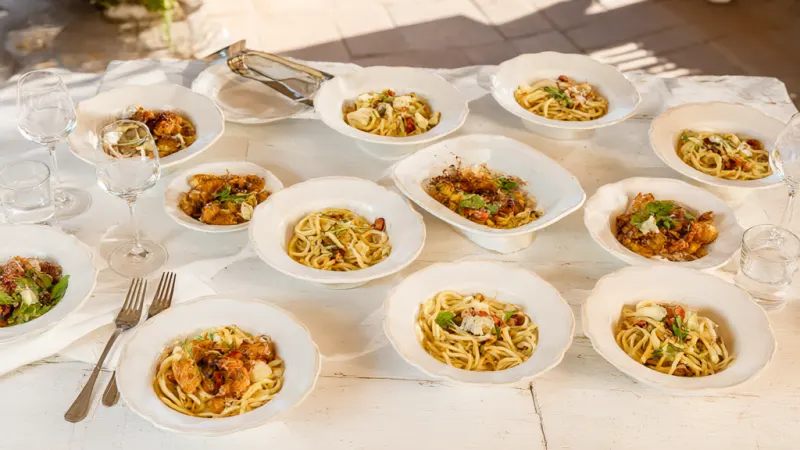
Live cacio e pepe. This is the dish that most deserves a live station: pecorino, pepper and pasta water tossed to order in small batches. Made in large trays and kept warm, it loses its creaminess.
Gricia, amatriciana, carbonara. With cacio e pepe, the four most famous Roman pasta dishes. They work in tasting cups or at the table. Crispy guanciale (cured pork cheek) is the trickiest part: it must be fried close to service.
Pasta e ceci, pasta e patate, soups. Excellent in the cold months, also served in small glasses for a winter aperitivo.
Main courses
Abbacchio. Roman milk-fed lamb, roasted with potatoes or grilled as scottadito chops. It's the main course of spring and Easter.
Saltimbocca alla romana. Veal escalopes with prosciutto and sage. Quick to make, they suit served menus well.
Coda alla vaccinara and tripe. Dishes of the quinto quarto (offal and lesser cuts), much loved by Romans but not by every guest. Offer them as a taste, not as the only main course.
Battered salt cod. A classic of Roman fried food, perfect as finger food too.
Sides
Sautéed chicory, puntarelle, broccoli, artichokes. Roman cooking has vegetable sides with real character. Puntarelle (chicory shoots) with anchovy dressing are a symbol of the Roman winter.
Vignarola. The spring stew of artichokes, broad beans, peas and Roman lettuce. Turismo Roma lists it among the typical dishes made with Roman vegetables.
Desserts
Maritozzi with cream. In mini format, these sweet buns have become a classic of dessert buffets and corporate breakfasts.
Ricotta and sour cherry tart. From the Roman Jewish tradition, a good way to end a lunch.
Bignè di San Giuseppe. Choux buns, fried or baked, linked to St Joseph's Day on 19 March: an idea for March events.
The seasonal calendar
The season is a catering menu's greatest ally: seasonal produce costs less and tastes better. This calendar is approximate: the weather and the year can shift the windows by a few weeks.
| Period | Local produce | Menu ideas |
|---|---|---|
| January-February | Romanesco broccoli, puntarelle, chicory, artichokes (early), oranges | Puntarelle, pasta and broccoli, soups, first artichokes |
| March-April | Romanesco artichokes (peak), broad beans, peas, asparagus, abbacchio | Jewish-style and Roman-style artichokes, vignarola, abbacchio, bignè di San Giuseppe |
| May | Artichokes (late), broad beans and pecorino, strawberries, courgettes (early) | Broad beans and pecorino, pasta with spring vegetables |
| June-August | Romanesco courgettes, courgette flowers, tomatoes, aubergines, peppers | Courgette flowers, concia (marinated fried courgettes), rice-stuffed tomatoes, panzanella |
| September-October | Courgettes (late), mushrooms, grapes, figs, chestnuts | Pasta with mushrooms, figs and prosciutto, fruit tarts |
| November-December | Romanesco broccoli, chicory, fennel, new-season olive oil | Bruschetta with new oil, broccoli, festive mixed fried food |
Some verified references: for Turismo Roma, the Romanesco artichoke runs from January to May, at its peak between March and April; the Romanesco courgette is a late-spring and summer product but can be found at the market until November; and Romanesco broccoli is a winter vegetable harvested until May. The Carciofo Romanesco del Lazio is an IGP product.
Live, buffet or served: what to choose for each dish
| Dish | Live cooking | Buffet | Served |
|---|---|---|---|
| Supplì | excellent (fryer on site) | yes, if reheated well | as a starter |
| Pizza bianca and mortadella | filled to order | excellent | — |
| Carciofi alla giudia | excellent | less so, they lose their crunch | yes |
| Carciofi alla romana | — | excellent | excellent |
| Cacio e pepe | ideal | not recommended | yes, if service is quick |
| Amatriciana / gricia | yes | possible in a chafing dish | excellent |
| Abbacchio | grill in view | yes | excellent |
| Maritozzi | filled to order | excellent | — |
Adapting the Roman menu for vegan and gluten-free guests
Vegan menu
The good news: part of Roman cooking is plant-based by nature.
- Already vegan (always check the caterer's recipe): Roman-style artichokes, sautéed chicory, broccoli, puntarelle (with a dressing without anchovies), vignarola, pasta e ceci without meat stock, bruschetta.
- To be reworked: cacio e pepe (with plant-based "cheese" or cashew cream), carbonara (without eggs and guanciale), supplì (without mozzarella, or with a plant-based alternative), maritozzi (without cream and butter).
A tip: give the reworked versions a clear name ("plant-based cacio e pepe") instead of presenting them as the original. Roman guests will appreciate the honesty.
Gluten-free menu
Many Roman dishes contain gluten because of pasta, bread, breadcrumbs and batters. For coeliac guests:
- gluten-free pasta cooked in dedicated water and pans;
- fried food (supplì, courgette flowers, carciofi alla giudia) only with gluten-free coatings and a dedicated oil and fryer;
- desserts such as maritozzi and bignè in gluten-free versions, prepared separately;
- many mains and sides (roast lamb, Roman-style artichokes, chicory) are naturally gluten-free, but watch out for flour dusting and sauces.
For the full handling of coeliac disease, allergies, kosher and halal, read the guide to catering for special diets.
How to build a balanced Roman menu
- Start from the season. Choose two or three star products of the period.
- Alternate fried and not fried. Roman cooking loves fried food, but an all-fried aperitivo becomes tiring.
- One live "showpiece" dish. Cacio e pepe or carciofi alla giudia made in view create a festive moment.
- An alternative for those who don't like offal. Offer tripe and oxtail as tastes, not as the only choice.
- Think of those who don't eat pork. Guanciale and mortadella are everywhere in Roman cooking: plan alternatives.
- End on something sweet and light. Mini maritozzi and seasonal fruit.
If you're organising a wedding, you'll find menu examples for each stage in the guide to wedding catering in Rome. For a tailored quote, request a quote.
Sources
- Turismo Roma, "I prodotti della campagna romana: le verdure romanesche protagoniste in cucina": https://turismoroma.it/it/node/127323
- Italia.it, Carciofo romanesco del Lazio: https://www.italia.it/it/lazio/cosa-fare/carciofo
- Italian Coeliac Association (AIC), Eating Out Programme: https://www.celiachia.it/dieta-senza-glutine/progetto-alimentazione-fuori-casa/