In short
- Raw fish must be blast-frozen: -20 °C for 24 hours or -35 °C for 15 hours, under EC Reg. 853/2004 and EU Reg. 1276/2011.
- The catch of the day is more honest than a species fixed a year ahead: the sea changes with season and weather.
- In the heat, the critical point is keeping food safe: ice, shade, small trays.
- Always plan a meat or vegetarian alternative for those who don't eat fish.
A seafood menu brings to mind summer, the coast, the terraces by the sea at Fregene or Anzio. In Rome it's a frequent choice for weddings and corporate dinners, but it has its own rules: safety with raw fish, prices that follow the market, guests who don't eat it. Here's how to build it and what to ask.
The Lazio sea
The Lazio coast runs from Civitavecchia to Gaeta, by way of Fiumicino, Anzio and Terracina. These are ports with active fishing fleets that bring fish to Rome. Roman cooking has a few seafood dishes of its own:
- spaghetti alle telline, with the small clams of the Roman coast;
- broccoli and arzilla soup, made with skate, a winter dish;
- battered salt cod, a classic of Roman fried food and Roman Jewish cooking;
- fried or marinated anchovies, the simplest oily fish to serve.
Which species arrive in a given month depends on the season, the weather and the fishing closure periods, which change every year and by area: the official dates are published by the Italian Ministry of Agriculture. That's why it's better to ask the caterer "what comes in from Lazio in the month of my event" rather than fixing a precise species now.
Raw and cooked: how to divide them
A seafood menu doesn't have to be all raw. In fact, cooked dishes are often safer, easier to serve and more popular with everyone.
| Raw | Cooked | |
|---|---|---|
| Examples | Tartares, carpaccios, oysters, red prawns | Fried fish, pasta, baked fillets, octopus |
| Where they work | Aperitivo, dedicated station | Table and buffet |
| Critical point | Freezing and cold chain | Cooking and service times |
| Who doesn't eat them | Pregnant women, young children, those who don't like raw fish | Few, apart from those with allergies |
A common split is to put raw seafood at the aperitivo or on a station, and keep cooked dishes at the table. That way, those who don't eat raw fish don't miss out on dinner.
An example seafood menu
This is an approximate example for a June wedding or dinner, to adapt to season and budget.
Aperitivo
- Courgette flowers with anchovy, battered salt cod
- Tartare of the day's fish in a spoon, raw and frozen
- Frittura di paranza (small mixed fried fish) in paper cones
- Raw seafood station with oysters opened to order
At the table
- Starter: octopus with potatoes and celery
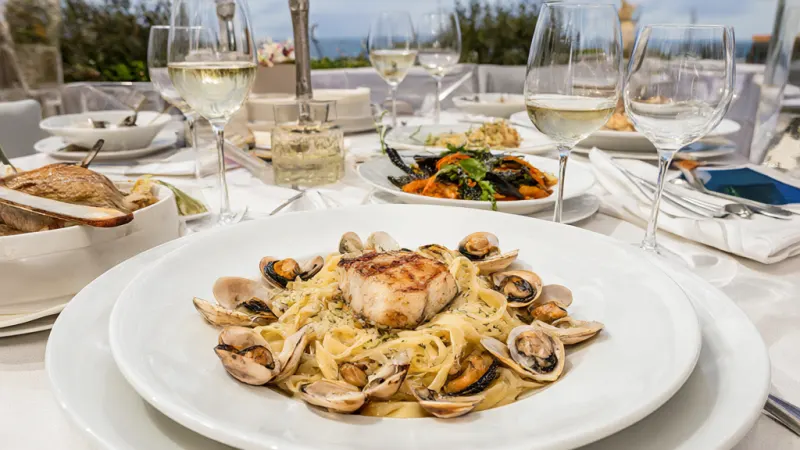
- First course: spaghetti alle telline, or langoustine risotto
- Lemon sorbet
- Main course: fillet of the day's fish with seasonal vegetables
- Dessert and coffee
More complete menus, meat and seafood, are in the wedding menu examples for Rome.
Raw fish safety
EC Regulation 853/2004, as amended by EU Regulation 1276/2011, requires fishery products intended to be eaten raw to be frozen to kill parasites: at least -20 °C for 24 hours or at least -35 °C for 15 hours. This is known as blast freezing. It applies to tartares, carpaccios, sushi and marinated fish.
Two clarifications:
- frozen does not mean fresh: freshness and origin are separate questions;
- oysters and live bivalves are not frozen: they arrive alive from an approved dispatch centre, with a health label.
For a pregnant guest the advice is cautious: many health authorities recommend avoiding raw shellfish, while raw fish is acceptable only if it has been frozen first. Each guest's doctor decides; you can plan a cooked alternative. The rules in detail are in the guide to the raw seafood and oyster station and the one on sushi and food safety.
Keeping food safe in the heat
Fish is the most delicate food on a summer buffet. Food safety guidelines advise not leaving perishable food out of the fridge for more than two hours, or one hour above 32 °C. In a Roman garden in July that threshold is easily passed.
What to ask for:
- raw seafood on ice and in the shade;
- small trays and frequent top-ups from the kitchen;
- a station attendant who removes anything that has been out too long;
- fried fish made to order, not kept warm for an hour.
Cost: what pushes it up
Fish follows the market price. There are no official sources giving a per-person price for seafood event menus: any figure would be made up. The approximate trends are these:
- push it up: raw seafood in quantity, crustaceans (langoustines, red prawns, lobster), oysters, prized species fixed in advance;
- keep it down: catch of the day, oily fish (anchovies, mackerel), molluscs such as mussels and clams, fried fish, seafood pasta.
The general reference for weddings remains the national average of about €125 per person for the banquet. A menu rich in raw seafood tends to sit above it.
Allergens and alternatives
Fish, crustaceans and molluscs are three of the 14 allergens in EU Regulation 1169/2011. On a seafood menu:
- ask for the allergen matrix for each dish;
- put clear labels at the station and buffet, distinguishing crustaceans from molluscs;
- plan a meat or vegetarian alternative for each course, cooked with separate equipment;
- for a guest with a severe allergy, a dedicated dish served at their seat.
The right wine
A seafood menu calls for fresh whites. Lazio has the whites of the Castelli Romani, such as Frascati, which go well with fried fish and seafood pasta. You'll find labels and pairings in the guide to Lazio wines for events.
Questions to ask the caterer
- Do you freeze the raw fish yourselves or does it arrive already frozen? Do you have the paperwork?
- Where does the fish come from? How much of it is from the Lazio coast?
- Can we choose "catch of the day" instead of a fixed species?
- Do the oysters have the dispatch centre's health label?
- How do you keep raw seafood cold outdoors, and how long does it stay out?
- Is fried fish made to order on site?
- What's the alternative for those who don't eat fish or are pregnant?
- Does the price change if the market rises before the event?
To close
A well-made seafood menu starts from the sea of the season and clear rules on raw fish. To choose caterers, look at the wedding catering section or the full list of caterers in Rome, and if you'd like a Japanese station, sushi catering too. Once you have a date and guest numbers, request a quote with your basic seafood menu.
Sources
- Regulation (EC) No 853/2004, Annex III, Sections VII and VIII, EUR-Lex: https://eur-lex.europa.eu/legal-content/IT/TXT/?uri=CELEX:32004R0853
- Regulation (EU) No 1276/2011, EUR-Lex: https://eur-lex.europa.eu/legal-content/IT/TXT/?uri=CELEX:32011R1276
- Regulation (EU) No 1169/2011, EUR-Lex: https://eur-lex.europa.eu/legal-content/IT/TXT/?uri=CELEX:32011R1169
- Italian Ministry of Agriculture, Food Sovereignty and Forestry (fishing and fishing closures): https://www.masaf.gov.it