In short
- The fried food station is the first to empty: top it up in waves, not all at the start.
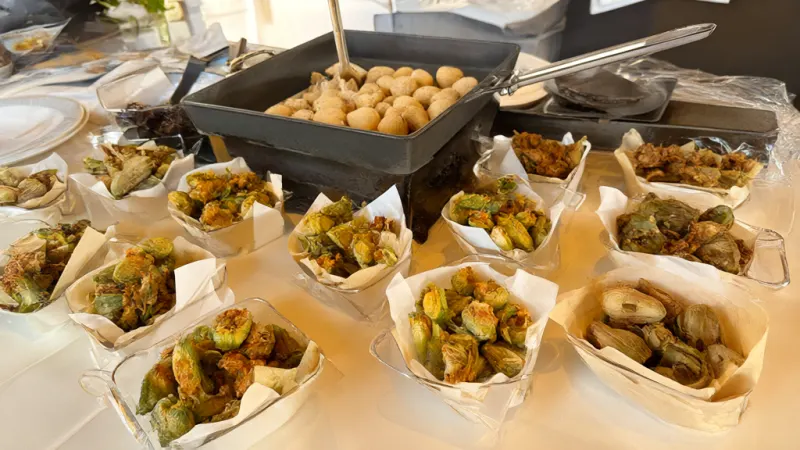
- The Roman classics: supplì, courgette flowers with mozzarella and anchovy, carciofi alla giudia, salt cod fillets.
- Follow the season: artichokes in winter and spring, courgette flowers in summer.
- First of all, ask where the frying happens: at the station, in the venue's kitchen or at the caterer's premises.
Roman fried food is the dish that pleases both grandpa and the cousin from Milan. At a wedding drinks reception or a garden party, a paper cone of supplì and courgette flowers is worth more than many elaborate dishes. But the fried food station has specific technical needs, and it's worth knowing them in advance.
Roman fried food is one option, not the only one: many caterers in Rome also offer tempura, mixed fried fish, olive ascolane (stuffed fried olives) and croquettes. The rules on fryers, oil and fumes below apply to all of them.
The Roman fried food repertoire
| Fried food | What's inside | Season | Common allergens |
|---|---|---|---|
| Supplì | Rice in tomato sauce, sometimes ragù, a mozzarella centre, breadcrumbs | All year | Gluten, eggs, milk, celery |
| Courgette flowers | Flowers stuffed with mozzarella and anchovy, in batter | Late spring, summer | Gluten, milk, fish |
| Carciofi alla giudia | Whole artichoke fried twice, no batter | Winter, spring | Usually none of the 14, but check the oil and the kitchen |
| Salt cod fillets | Desalted salt cod in batter | All year | Gluten, fish |
| Battered vegetables | Courgettes, Romanesco broccoli, apple | Depending on season | Gluten, sometimes eggs |
| Stuffed olives, croquettes | Various | All year | Gluten, eggs, milk |
Carciofi alla giudia (Jewish-style artichokes) come from the Roman Jewish cooking of the Ghetto. The right artichoke is the Romanesco, the carciofo romanesco del Lazio IGP, round and without thorns. At a March or April wedding, it's the fried food most tied to Rome you can offer.
For more traditional dishes to bring to an event, read the guide to Roman street food for events.
Where the frying happens: three models
| Model | How it works | Pros | Cons |
|---|---|---|---|
| Fryer at the station | The cook fries in front of the guests | Hot, crisp food, a bit of theatre | Needs power or gas, space, the venue's permission |
| Venue kitchen | Fried in the kitchen and carried to the station | Fewer fumes among the guests | Only a short walk, but needs an equipped kitchen |
| Caterer's premises | Food arrives ready and is reheated | Easy for the venue | Fried food loses its crunch |
The first model is the most requested at weddings. It needs three things, though:
- power: a professional electric fryer draws a lot of current. Ask the caterer how many kW are needed and check with the venue;
- gas: if the caterer uses cylinders, the venue must allow them. Many historic villas and indoor halls don't;
- air: fumes and smells must disperse. On a terrace in the centre there are neighbours, under a portico there are painted ceilings.
For venues with strict rules, also read the guide to catering in the historic centre.
Oil and safety
Frying oil breaks down with use. In Italy, Ministry of Health Circular No. 1/1991 sets a limit on polar compounds, the substances that form in used oil. The most quoted threshold, also found in French, Spanish and Portuguese rules, is 25%. It's a rule for the caterer, not for you, but a question about oil tells you a lot about how they work: which oil they use, how often they change it, whether they measure polar compounds. Check the current guidance with the official sources or the local health authority (ASL).
Fried food is eaten freshly made. If it sits on a tray, a careful caterer removes it after a short while and replaces it with a fresh batch. Ask how long a tray stays at the station.
How much fried food, and when
There is no official figure. The quantity is approximate and depends on:
- how long the aperitivo lasts;
- whether a served dinner follows;
- how many other stations there are.
Fried food is filling. A whole supplì weighs more than a spoonful of tartare. So if the aperitivo comes before a three-course dinner, a mini format is better: small supplì, half courgette flowers, artichoke wedges.
Rhythm matters as much as quantity. A good pattern:
- a first wave as guests arrive;
- small top-ups every few minutes;
- a last wave before moving to the tables, for late arrivals.
To estimate pieces and grams, see the guide on how much food per person.
How the station is presented
Fried food can be served in different ways:
- paper cones (cuoppi) of food-grade paper, to pick up and eat while walking;
- trays with absorbent paper, served by a member of staff;
- passed round: waiters with trays among the guests, useful if the station is away from the flow.
A craft beer from Lazio or a sparkling white goes well alongside. Ask for plenty of napkins and somewhere to throw the paper away: a detail that makes the difference by the end of the aperitivo.
Coeliac disease and allergens
Fried food is the hardest point for coeliac guests. Even gluten-free fried food becomes contaminated if it cooks in the same oil as battered food. If any guests have coeliac disease, ask:
- whether there is a separate fryer for gluten-free products;
- which fried foods are naturally gluten-free (often carciofi alla giudia) and how they are handled;
- how they are served, with separate utensils and trays.
For the rules and the questions to ask, read the guide to gluten-free catering.
The other common allergens, from the list in EU Regulation 1169/2011: eggs, milk, fish, celery. Each fried item needs a label.
Questions to ask the caterer
- Do you fry at the station, in the venue's kitchen or at your premises?
- How much power is needed? Do you use gas or cylinders?
- Which oil do you use and how often do you change it?
- How long is a tray on display before it is replaced?
- Which fried foods do you offer in the month of our event?
- Are the artichokes Romanesco? Are the courgette flowers fresh?
- Do you have a separate fryer for gluten-free food?
- How do you serve: cones, trays or passed round?
- How many people are at the station?
To finish
A fried food station works if the food arrives hot and the venue allows it. Start with these two questions, then choose the fried foods of the season. To see how it fits with the other stations, read the guide to buffet food stations. For an informal party, look at the finger food caterers, then request a quote saying where frying will be possible.
Sources
- Carciofo Romanesco del Lazio IGP, ARSIAL: https://www.arsial.it
- Regulation (EU) No 1169/2011, EUR-Lex: https://eur-lex.europa.eu/legal-content/IT/TXT/?uri=CELEX:32011R1169