In short
- For someone with coeliac disease, "gluten-free" means preventing cross-contamination, not just swapping the pasta.
- The legal threshold is 20 ppm of gluten (Reg. (EU) 828/2014).
- The Italian Coeliac Association (AIC) runs a network of trained restaurants and caterers: the Alimentazione Fuori Casa (eating out) programme.
- The critical points at an event are fried food, bread, the buffet and desserts.
A coeliac guest at an event is not asking for a favour: they are asking to be able to eat without becoming ill. The right caterer knows how to manage this without making them feel singled out. Here is how to recognise one and what to ask.
Coeliac disease, intolerance, preference: three different things
When you collect your guests' requirements, ask them to be specific.
| Situation | What is needed |
|---|---|
| Coeliac disease | No gluten and prevention of cross-contamination, even minimal |
| Non-coeliac gluten sensitivity | Usually gluten-free ingredients; ask the guest how sensitive they are |
| Personal choice | Gluten-free dishes, without special precautions on traces |
| Wheat allergy | Care with wheat in all its forms, not only gluten |
Coeliac disease is a medical condition: even a few crumbs can cause harm, even without immediate symptoms. That is why the key word is contamination.
What the law says
- Implementing Regulation (EU) 828/2014 states that the claim "gluten-free" may only be used for foods containing no more than 20 mg/kg of gluten (20 ppm).
- Regulation (EU) 1169/2011 lists cereals containing gluten among the 14 allergens that must be declared, including for unpackaged food served by restaurants and caterers.
So the caterer must be able to tell you where there is gluten in the menu. But the law does not tell you how it works in the kitchen: that is something you have to ask.
The AIC eating-out programme
The Associazione Italiana Celiachia (Italian Coeliac Association) runs the Alimentazione Fuori Casa (AFC) programme, a network of businesses trained in the gluten-free diet. The types of business admitted include caterers and reception venues. According to the AIC, members:
- have their staff take a course on coeliac disease and the gluten-free diet;
- follow preparation and service rules set by the AIC;
- appoint a person responsible for the gluten-free service;
- receive regular checks from the regional AIC.
The official list can be found on the AIC website. If the caterer says it is a member, check there. If it is not, it is not necessarily unsuitable: but it must be able to explain its method, point by point.
Where gluten hides in an event menu
Whether the menu is fish, meat, international, a buffet or finger food, gluten hides in the same places: bread, pasta, breadcrumbs, batters and doughs.
| Dish | Where the gluten is | Alternative |
|---|---|---|
| Fried food (supplì, croquettes, tempura, fried small fish) | Breadcrumbs, flour or batter | Gluten-free crumbs and batters, dedicated oil |
| Fried vegetables or carciofi alla giudia | Usually none in the recipe, but the oil is shared with other fried food | Dedicated fryer |
| Pasta first courses (paccheri, risotto finished with ready-made stock, lasagne) | Wheat pasta, stocks and béchamel | Gluten-free pasta in dedicated water and pans, checked stocks |
| Floured main courses (escalopes, saltimbocca, fish fillets in a crust) | Flour coating or crust | Rice or corn starch |
| Finger food (canapés, crostini, mini burgers, focaccia, pizza) | Wheat flour bases | Gluten-free bases baked separately |
| Sushi | Soy sauce, some sauces and tempura | Gluten-free tamari, no tempura |
| Desserts (choux buns, maritozzi, tarts, cake) | Wheat doughs | Gluten-free version from a dedicated kitchen |
| Sauces and gravies | Thickeners, stock cubes, beer | Checked recipes |
Many dishes are naturally gluten-free: grilled or roast meat and fish, raw fish, seasonal vegetables, risottos made with homemade stock, cheeses, fruit. But the pitfalls of flour coatings, ready-made stocks and shared tongs remain.
The critical points at an event
Fried food
This is the main risk. If gluten-free fried food goes into the same oil as ordinary fried food, it is no longer suitable for a coeliac guest. Dedicated oil and fryer are needed, as the AIC points out. If the venue does not allow two fryers, it is better to give up fried food for coeliac guests.
Bread
Baskets on the table, crumbs on the tablecloth, bread cut on the same board. Gluten-free bread should be served packaged or in a separate basket, brought out first.
The buffet
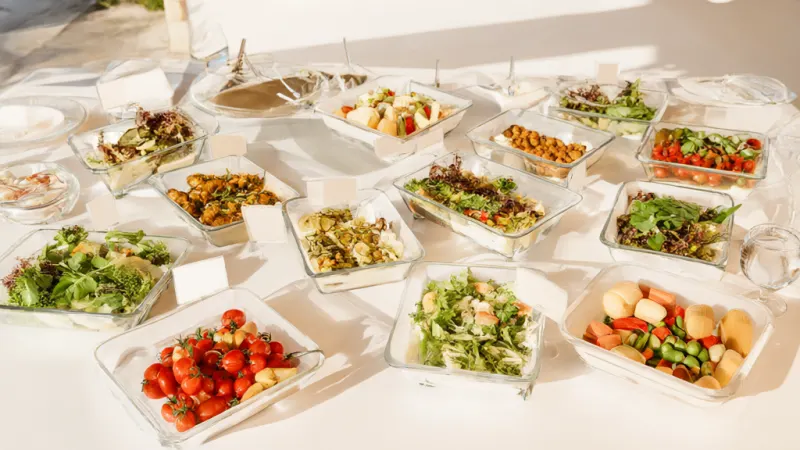
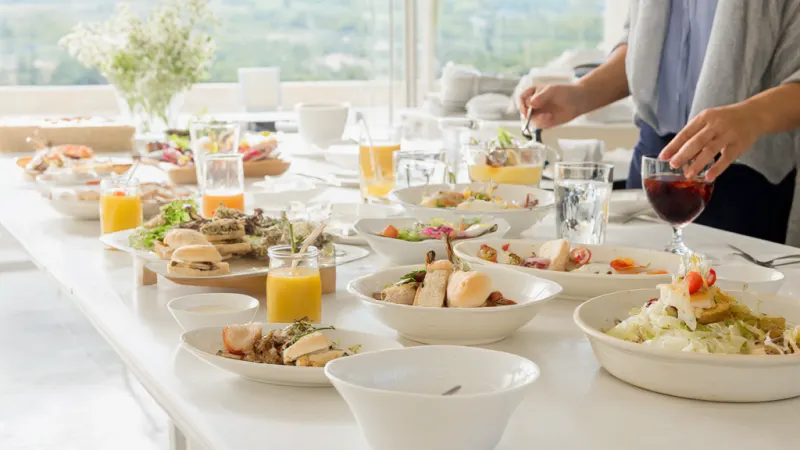
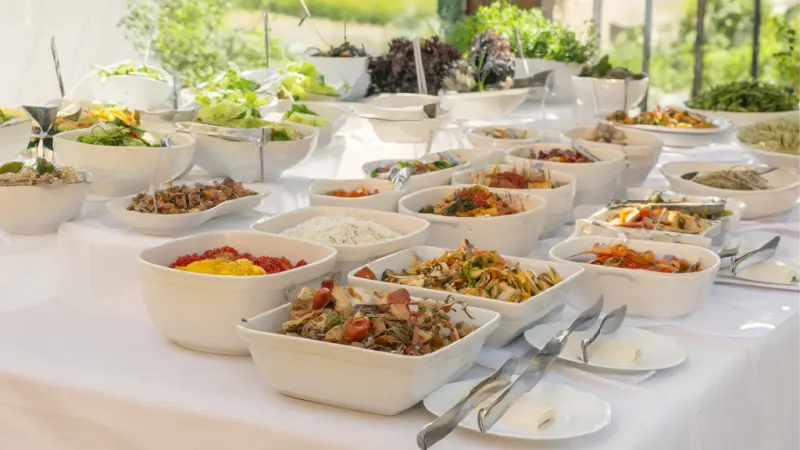
Tongs move from one platter to another, guests put crostini down wherever they can. For a coeliac guest the buffet is the least safe place. Solutions:
- a dedicated dish served at their seat;
- a sealed tray with the guest's name;
- a separate gluten-free station, served by a member of staff.
Desserts and cake
The wedding or birthday cake is often the last moment when a coeliac guest is left out. Ask for a gluten-free cake for everyone or a dedicated dessert, stored and cut separately with clean utensils.
On the day of the event
- A list of coeliac guests with name and table sent to the caterer a few days before.
- A place card or discreet marker agreed with the staff.
- A briefing for the floor staff before service.
- Dedicated dishes served first, before utensils and surfaces become contaminated.
- A contact person from the caterer whom the guest can ask.
The general picture on allergies and diets is in the guide to catering for special diets. If the event is a wedding, collect requirements with the RSVPs: you will find the timings in the guide to wedding catering in Rome.
Collecting information from guests
The work begins before the caterer gets involved. In the RSVP form, or in the invitation message, ask explicitly: "Do you have coeliac disease, allergies or intolerances?". Then, for each coeliac guest, prepare a line with:
- name and table;
- whether they are coeliac or only intolerant;
- whether they have other requirements too, such as lactose or a vegan diet;
- whether they are a child, because the children's menu has to be adapted separately.
Send the list to the caterer in good time and ask for written confirmation that it has been received. The day before, a quick check avoids surprises. If the event is a May wedding at a villa in the Castelli Romani, with 150 guests and four coeliac guests, those four should know beforehand what they will find: a two-line message makes them feel expected.
Questions to ask the caterer
- Are you a member of the AIC Alimentazione Fuori Casa programme? Can I check?
- If not, what training do your staff have on coeliac disease?
- Do you have separate spaces or production slots for gluten-free food?
- Do you use dedicated oil and a dedicated fryer?
- Is the gluten-free pasta cooked in its own water and pans?
- How do you bring bread and dishes for coeliac guests to the table?
- How do you manage the buffet for a coeliac guest?
- Can you make a gluten-free cake for everyone?
- Is there someone on the floor to answer questions about ingredients?
- Does the gluten-free menu cost a different amount?
Before requesting a quote
State from your very first request how many coeliac guests there are. You can compare suppliers in the gluten-free catering section and request a quote from several caterers, asking them all the same questions.
Sources
- Implementing Regulation (EU) No 828/2014, EUR-Lex: https://eur-lex.europa.eu/legal-content/IT/TXT/?uri=CELEX:32014R0828
- Regulation (EU) No 1169/2011, EUR-Lex: https://eur-lex.europa.eu/legal-content/IT/TXT/?uri=CELEX:32011R1169
- Associazione Italiana Celiachia, Alimentazione Fuori Casa programme: https://www.celiachia.it/dieta-senza-glutine/progetto-alimentazione-fuori-casa/
- AIC, "Le contaminazioni nella dieta senza glutine" (cross-contamination in the gluten-free diet): https://static.celiachia.it/assets/uploads/2020/08/Le-contaminazioni-nella-dieta-Senza-Glutine_CN1_2017.pdf