In short
- Roman street food works at parties, graduations, informal corporate events and late-night wedding snacks.
- The key dishes: supplì, pizza bianca with mortadella, porchetta, seasonal fried food, maritozzi.
- It is organised by stations (counters), not by courses.
- The critical point is frying: you need a fryer on site or a good reheating method.
Roman street food is popular because it is familiar and informal. A hot supplì (a fried rice ball with a mozzarella centre) wins over both the colleague from Milan and the uncle from Centocelle. To bring it to an event, ordering trays is not enough: you need stations, timings and a kitchen that can handle frying.
Roman street food is one possible style: in Rome there are caterers and food trucks that also serve street food from other regions and countries, from burgers to tacos. For an overview, read the guide to food trucks for events.
When to choose street food
Street food is a format, not just a menu. It works when the event is standing and guests move around.
| Event | How to use it |
|---|---|
| Graduation or 18th birthday party | Main format, with two or three counters |
| Informal corporate event | Standing lunch or aperitivo after a convention |
| Wedding | After dinner, or a "midnight snack" after the party |
| Opening | Passed bites and a central counter |
| Garden party in the Castelli Romani or Roma Nord | Outdoor counters, perhaps with a food truck |
For a seated dinner for 120 guests, street food on its own is not enough. As an aperitivo or to close the evening, though, it is remembered for the flavour, with no need for special effects.
The Roman repertoire
Supplì
Rice in tomato sauce, a mozzarella centre, breadcrumbs and frying. It is the symbol of Roman fried food. The most requested variations are amatriciana, cacio e pepe and carbonara. It must be eaten hot: a lukewarm supplì loses the stretchy "string" of mozzarella.
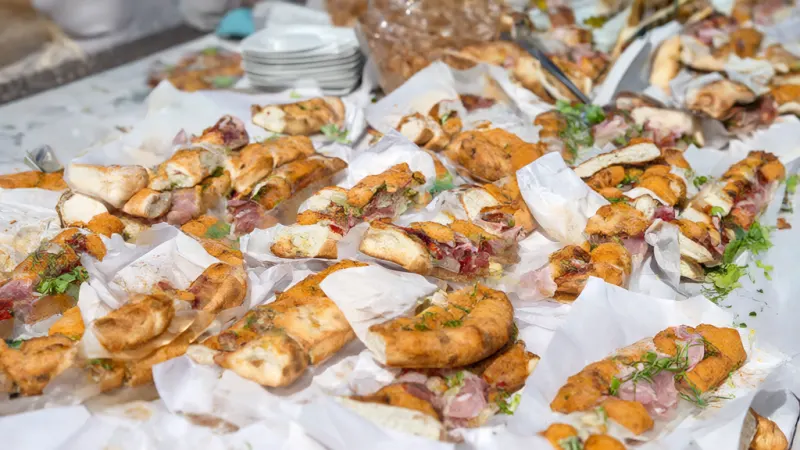
Pizza bianca and mortadella
Roman pizza bianca, thin and glossy with olive oil, cut and filled to order with mortadella. It is served in squares. Variations: with figs in summer, with sautéed chicory, with stracchino cheese.
Porchetta
Porchetta di Ariccia has PGI status (EU Reg. 567/2011). It suits a counter with a slicer or a carving knife in view and mini rolls. Remember that pork excludes some guests: plan an alternative.
Filled pizza pockets
A triangle of pizza bianca opened up and filled with a traditional stew: Roman-style chicken, meatballs in tomato sauce, oxtail stew, or aubergine parmigiana for those who don't eat meat. It is one of the Roman street food formats that has spread in recent years.
Seasonal fried food
- Courgette flowers with mozzarella and anchovy, in summer
- Carciofi alla giudia (Jewish-style fried artichokes), in spring
- Salt cod in batter, all year round
- Olive ascolane (stuffed fried olives) and potato croquettes, also very popular in Rome
Desserts
Mini maritozzi (sweet buns) with cream, ciambelline al vino (wine biscuits), bignè di San Giuseppe (cream puffs) in March. These are desserts you eat in two bites, ideal for finishing on your feet.
Organising the counters
Street food is organised by stations. Each station has one dish or family of dishes and at least one attendant.
| Station | What it needs | Staff |
|---|---|---|
| Fried food | Fryer, extractor hood or open space, electricity or gas | 1-2 attendants |
| Pizza bianca | Work surface, chopping boards, pizza delivered on the day | 1 attendant |
| Porchetta | Slicer or knife, hot plate for the rolls | 1 attendant |
| Filled pockets | Chafing dishes for the fillings | 1 attendant |
| Desserts | Chilled counter for the cream | 1 attendant or self-service |
The number of attendants is indicative: it depends on guests and speed of service. Ask the caterer how many people they plan for each counter and for how many hours.
Indicative quantities
There is no official table for street food. As an indicative starting point:
- street food as an aperitivo: 2-3 bites of each type, four or five types;
- street food instead of a meal: one roll or pocket, two or three fried items, a portion of pizza bianca and one dessert per person, with a little extra for young people.
Quantities depend on time of day, age and duration. For a fuller method, read how much food to allow per person.
The logistics of frying
Frying is the most enjoyable part and the most delicate one.
- Space and ventilation. In a historic hall in the centre or in an apartment, a fryer may not be allowed. Ask the venue before signing.
- Power. Professional electric fryers draw a lot of current. The caterer must tell you how much power they need.
- Safety. Hot oil and passing guests don't mix: the frying counter must be in a protected spot.
- Gluten-free. For a guest with coeliac disease, gluten-free frying requires dedicated oil and a dedicated fryer, as the Italian Coeliac Association points out. See the guide on coeliac disease and catering.
If frying on site is not possible, the caterer fries in its own kitchen and reheats the pieces in the oven. The result varies a great deal from one supplier to another: taste it.
Street food and food trucks
An alternative to counters is the food truck: a kitchen on wheels that arrives and serves. It is practical in gardens, courtyards and private car parks, less so in the historic centre because of the ZTL (limited traffic zone) and narrow access. You will find the pros and cons in the guide to food trucks for events in Rome.
An example: a garden graduation party for 60 people
To see how all this translates in practice, here is a possible structure. It is an example, not a menu recommended by a caterer.
- 18:30, guests arrive. The pizza bianca counter is already open, with mortadella, porchetta and sautéed chicory. Soft drinks and beer at the bar.
- 19:00, the fried food opens. Supplì and croquettes in a continuous cycle, courgette flowers if it is summer.
- 20:00, filled pockets. Two stewed fillings, one meat and one vegetarian, kept warm in chafing dishes.
- 21:30, desserts. Mini maritozzi filled to order, ciambelline al vino.
- 22:30, the counters close. The bar and music carry on.
Three counters and four attendants are usually enough for a party of this size, but the caterer must confirm the number. The important thing is not to open everything at once: staggered service keeps guests near the counters and the food hot.
Questions to ask the caterer
- Is the fried food made on site or reheated? With what equipment?
- How much power do you need? Do you bring a generator?
- How many counters and attendants do you plan for my guests?
- How many hours does each counter stay open?
- Does the pizza bianca arrive on the day? From which bakery?
- Is the porchetta PGI? From which producer?
- Which dishes are pork-free, vegetarian or gluten-free?
- How do you label allergens at the counters?
- Who cleans and dismantles at the end of the event?
Before asking for a quote
Street food is an informal format, but the quote must be precise: counters, attendants, hours and quantities. You will find suitable caterers in the finger food and private parties sections. When you have the date, guest numbers and venue, request a quote from two or three suppliers.
Sources
- Associazione Italiana Celiachia (Italian Coeliac Association), Eating Out programme: https://www.celiachia.it/dieta-senza-glutine/progetto-alimentazione-fuori-casa/