In short
- In Rome, July and August average highs above 31 °C: move the service towards the evening and keep the buffet out of the sun.
- The rain plan has to be decided and booked in advance, not on the morning of the event.
- Power, water and lighting are the items most often forgotten in a field.
- Mosquitoes and wind can be handled with simple choices: where the tables go, lighting, covers.
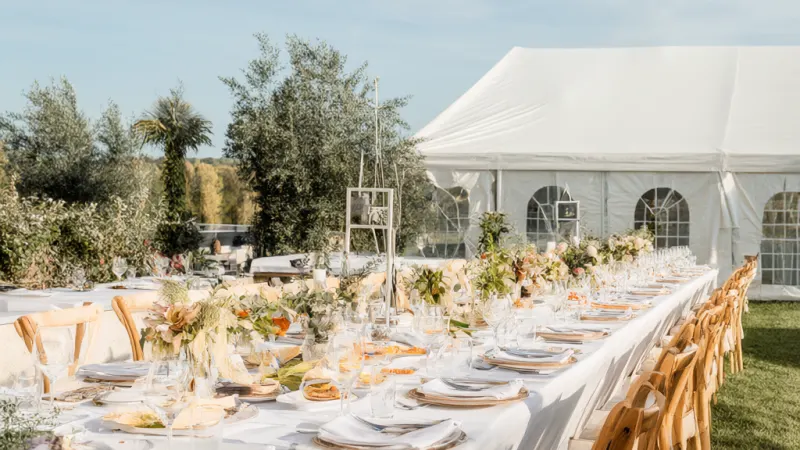
A reception in a garden, in a farmhouse in the Roman countryside or in a villa in the Castelli Romani has a charm no function room can match. But an outdoor event asks for more preparation from the caterer, and from you. This guide sets out the typical problems in Rome, season by season, and the questions to ask.
Rome's climate in numbers
According to the 1971-2000 climate averages for the Roma Urbe weather station, average highs in July and August are above 31 °C, while October and November are the wettest months. These are averages: recent summers have often brought more intense heatwaves.
| Period | What to expect | What changes for the caterer |
|---|---|---|
| April-May | Mild temperatures, the odd shower | Rain plan ready, cool evenings |
| June | Warm, long days | Aperitivo in the shade, plenty of water |
| July-August | Intense heat | Evening service, cold chain, light menu |
| September | Heat easing, storms possible | Very busy month, written rain plan |
| October-November | Wettest months | Covered space needed, heaters |
Heat: protecting guests and food
Timings
In summer an outdoor event works better after sunset. According to the ephemerides, in June the sun sets in Rome after 20:30: an aperitivo (pre-dinner drinks with small bites) at 19:30 still has light, but less direct sun. If the event is at lunchtime, plan for real shade, not just a few scattered umbrellas.
The cold chain
This is the most delicate point. Food safety guidelines say perishable food should not be left at room temperature for more than two hours, and for no more than one hour above 32 °C. In Italy the caterer must follow an HACCP self-monitoring plan (Regulation (EC) 852/2004), which sets its own rules: ask what they are.
In practice:
- buffet in the shade, never in the afternoon sun;
- small portions and frequent top-ups, rather than large platters left out for a long time;
- cold dishes on ice or chilled surfaces;
- take care with creams, mayonnaise, raw fish and fresh cheeses: ask whether the caterer advises against them in the middle of August.
The summer menu
Summer in Rome brings Roman courgettes, courgette flowers, tomatoes, aubergines, peaches and watermelon. Cold dishes such as panzanella or rice-stuffed tomatoes work well, as do light first courses. For ideas, see the seasonal menu and the finger food ideas.
Water
Keep cool water available at all times, even before the service begins. A water station when guests arrive is the first thing they appreciate on a July day.
Rain: the plan B
A serious rain plan has four elements, to be written into the contract:
- Where everyone goes: an indoor room, a portico, a marquee.
- Who sets it up: the venue, the caterer or a hire company.
- When the decision is made: usually the day before, based on the forecast.
- What it costs: included or extra.
If you use a marquee, it often needs booking anyway, because in September it is hard to find one at the last minute. Ask about certifications and wind resistance. We cover this in the guide to hiring event equipment.
Remember that the caterer's kitchen has to be under cover in any case, rain or not.
Wind
In the hills, on the shores of Lake Bracciano or on the coast, wind can be more of a problem than rain. Tablecloths fly, candles go out, the gazebo turns into a sail.
- ask for tablecloths with clips or weights;
- choose enclosed lanterns over open candles;
- check that gazebos and umbrellas are weighted down;
- keep the buffet away from the most exposed areas.
Mosquitoes and insects
In Rome the tiger mosquito is active for much of the warm season, especially near watered lawns, fountains and pots with standing water.
- ask the venue whether it carries out treatments in the days before the event;
- get rid of standing water near the tables;
- place lights and diffusers away from the food;
- always keep buffet dishes covered;
- for guests, a basket of repellents at the entrance is a welcome touch.
Power, water and lighting
A lawn has no sockets. Before the event, agree with the caterer and the venue on:
- the electrical power needed for the kitchen, fridges, lighting and music;
- if a generator is needed, who brings it and where it goes (away from guests and food, because of noise and fumes);
- running water for the kitchen and for hand washing;
- lighting for tables, paths, toilets and car park: in the dark, the steps of a villa become dangerous.
Fire, barbecues and local rules
In summer the Lazio Region normally declares a period of high wildfire risk, with bans on lighting fires near woods and fields. If you are thinking of a barbecue, a mobile wood-fired oven or torches, check the rules in force with the local council and with the venue.
Outdoor music also has limits on hours and volume, which depend on the council and the area. Ask the venue what time the music has to stop.
Toilets, parking and guest comfort
The caterer does not handle everything, but some items affect its work and need coordinating:
- toilets: if the venue has few, portable toilets need hiring and placing away from the kitchen and buffet;
- parking: in the countryside, on the Appia or in the Castelli, guests arrive by car. You need a lit area, and the caterer's van must not get blocked in;
- seating: in the heat nobody stands for long. Even for an aperitivo, plan chairs and tables in the shade for older guests;
- temperature drop: in September and October the evening cools quickly. Patio heaters or blankets on the chairs save the after-dinner part of the evening.
Questions to ask the caterer
- Have you already worked outdoors at this venue?
- How do you manage the cold chain at the buffet in summer? How long are dishes left out?
- Which dishes do you advise against in the heat?
- Where do you set up the kitchen? Do you need a cover?
- How much power do you need? Do you bring a generator?
- What is the rain plan? Who decides, and when?
- Do you handle the marquee, or do I need to hire it?
- How do you protect tablecloths and the buffet from the wind?
- How do you light the buffet and the service area?
- Who takes away rubbish and equipment at the end of the evening?
To sum up
A successful outdoor event is one where guests do not notice all the work done beforehand: shade at the right moment, cool water, light on the steps. Ask these questions early, and put the answers in the contract. The guide on what to check in a catering contract explains how.
If you are planning a garden party, see the caterers for private parties. For a wedding, see the page on wedding caterers. Once you have a date and a venue, request a quote and say straight away that the event is outdoors.
Sources
- Regulation (EC) No 852/2004, EUR-Lex: https://eur-lex.europa.eu/legal-content/IT/TXT/?uri=CELEX:32004R0852
- Lazio Region, civil protection and wildfire prevention: https://www.regione.lazio.it