In short
- Before hiring anything, ask the caterer for a written list of what they bring.
- The items most often forgotten: service tables, a field kitchen, power, lighting, bins.
- For gazebos and marquees ask for certifications and set-up rules, and check permits if you are on public land.
- Read the clause on breakages and damage: you almost always pay.
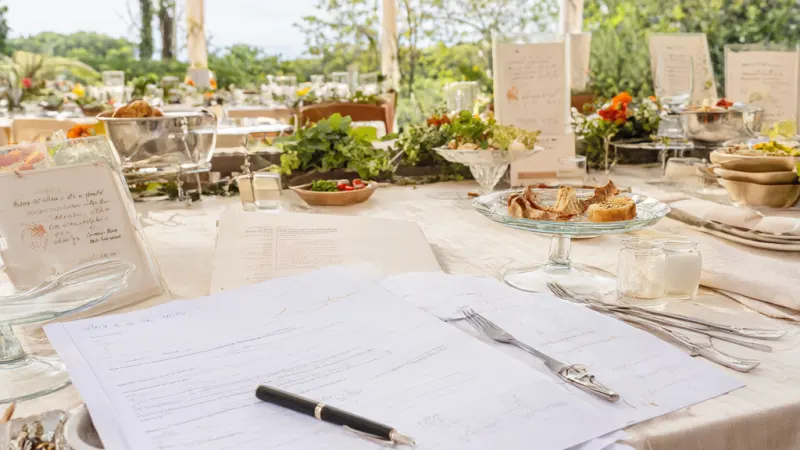
A garden party or a reception in an empty farmhouse needs a lot of things you can't eat: tables, chairs, tablecloths, plates, glasses, lights, sometimes a cover. Some are brought by the caterer, some you hire, some are provided by the venue. The risk is ending up with two of something or none at all. This guide helps you divide the tasks.
Who brings what: the three sources
| Source | What they usually bring | What to ask |
|---|---|---|
| Caterer | Tableware, cutlery, glasses, linen, kitchen and buffet equipment | Written list, styles and colours available |
| Venue | Tables, chairs, sometimes linen and lighting | What the hire fee includes, conditions of use |
| Hire company | Everything else: furniture, marquees, gazebos, lights, heaters, portable toilets | Delivery, set-up, collection, damage |
Arrangements vary a lot. At venues with an exclusive caterer almost everything is already on site. At venues where you can choose your caterer you often have to organise it yourself: read the guide on venues with exclusive or open catering.
The full equipment list
For the table
- tablecloths, overlays and napkins;
- dinner plates, soup plates, dessert and bread plates;
- cutlery for each course;
- glasses for water, wine and sparkling wine;
- charger plates and place cards, if needed.
The quantities depend on the menu. As a rough guide, a seated dinner needs more glasses and cutlery per guest than a buffet, because each course and each wine needs its own. Ask the caterer to calculate them for your menu.
For the guests
- round or long tables, and the couple's or top table;
- chairs (count them for children and suppliers too);
- poseur tables for a standing aperitivo;
- lounge corners, if you want them.
For the service
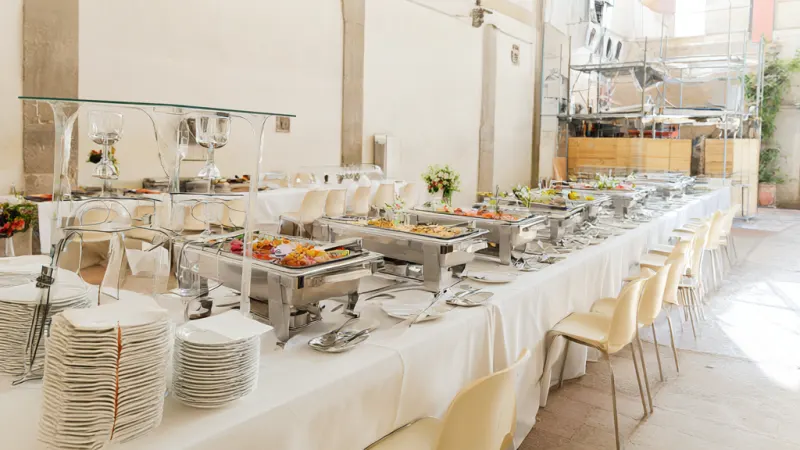
- service and buffet tables, with floor-length linen;
- food warmers, induction hobs, chafing dishes;
- fridges or cold rooms, ice, insulated boxes;
- a bar counter;
- bins for sorted waste. In Rome waste sorting is compulsory: ask the caterer who takes the rubbish away and where.
For the space
- lighting for paths, tables and the kitchen;
- extension leads and electrical panels;
- a generator, if the power supply is not enough;
- patio heaters or fans, depending on the season;
- portable toilets, if the space doesn't have enough;
- gazebos, umbrellas, marquees.
The field kitchen
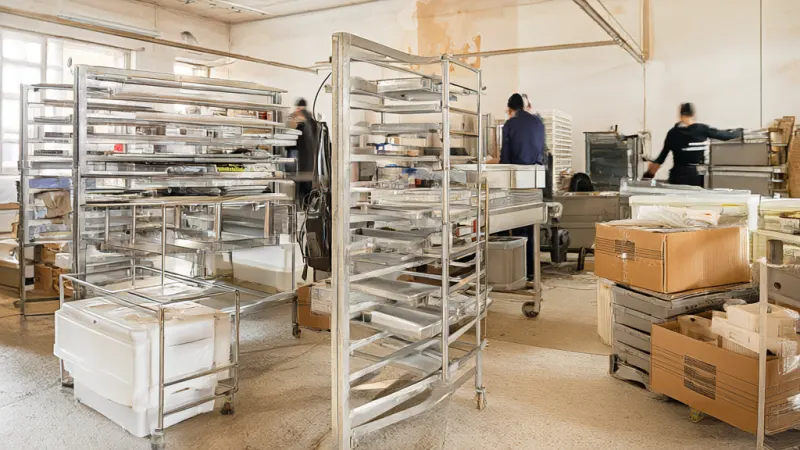
If the venue has no equipped kitchen, the caterer has to set one up. It usually needs:
- a covered, sheltered area, close to but separate from the guests;
- running water or water tanks, and a drainage point;
- enough power for ovens, fridges and dishwashers;
- a direct route between kitchen and dining area.
Ask the caterer what they need in terms of space and electrical power. Then check with the venue or an electrician whether the system can cope. If it can't, you need a generator: ask who brings it, where it goes (noise and fumes) and who pays for the fuel.
Gazebos and marquees
This is the most sensitive item, because it concerns guests' safety.
- Ask for certifications. The hire company must provide documentation on materials, assembly and wind resistance. For larger structures, also ask for a declaration of correct assembly signed by a technician.
- Check the ground. Lawn, gravel or paving change the type of anchoring.
- Think about wind. On a terrace, by the sea or in the hills, wind is a factor. Ask what happens if it exceeds certain levels: some structures must be closed or evacuated.
- Permits. On public land you need an occupation concession from the City of Rome, requested from the relevant Municipio. Events open to the public may need safety checks. For a private party in a private garden the rules are different. Regulations change: check on the Roma Capitale website and with the hire company.
The gazebo is also the heart of the bad-weather plan B. We cover it in the guide to catering for outdoor events in Rome.
Delivery, set-up, collection
Hire doesn't end with delivery. Ask:
- delivery and collection times, compatible with the venue's;
- who sets up and breaks down: the hire company, the caterer or you;
- who checks the goods on arrival and on collection;
- how the equipment must be returned: washed, rinsed or as it is.
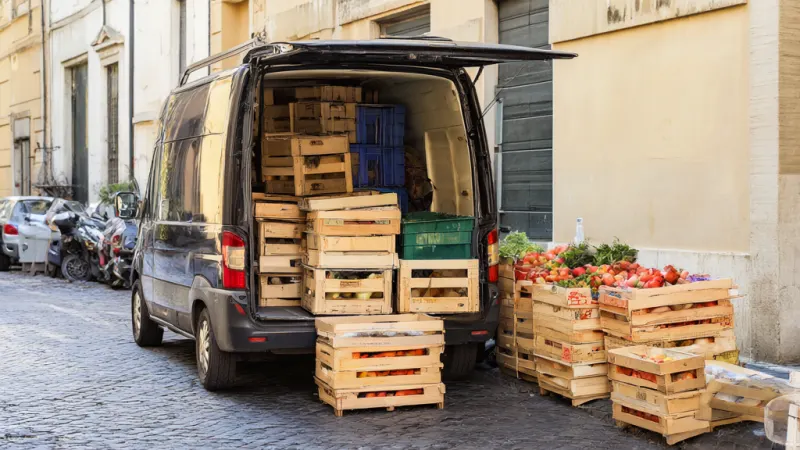
In the historic centre, deliveries and collections depend on the ZTL (the restricted traffic zone), loading times and access for large vehicles. Read the guide to catering in Rome's historic centre.
Breakages and damage
Damage is almost always charged to the hirer. Check:
- the per-item cost for missing or broken glasses, plates and cutlery;
- whether there is an excess or a percentage of breakages already allowed for;
- how permanently stained tablecloths are treated;
- whether a security deposit is required.
Photograph the equipment on arrival, especially furniture and marquees.
Style and consistency
Equipment is not just logistics: it shows in every photo. Before confirming, ask to see the plates, glasses, tablecloths and chairs in person or in photos. Check that they work together and with the venue.
A farmhouse in the Roman countryside, with beams and stone, suits raw linen, wood and ceramics. A modern terrace at EUR calls for simpler lines. A historic palazzo in the centre already has its own furnishings, and often little is needed.
If the caterer, the venue and the hire company each bring a piece, the risk is a muddled whole: tablecloths in one colour, chairs in another style, different glasses for the aperitivo and dinner. Choose one person to decide the style, you or the wedding planner, and run everything through them.
Questions to ask the caterer
- What do you bring? Can you send it as a written list?
- What style are the plates, glasses and tablecloths? Can I see them?
- How much tableware and how many glasses do you calculate for my menu?
- Do you need a field kitchen? How much space and electrical power?
- Do you work with a trusted hire company? Is the cost in the quote?
- Who sets up, who breaks down, who takes away the rubbish?
- Who pays for breakages and damage? Is there an excess?
- Do you handle the gazebo for plan B or do I need to hire it?
To finish
The simplest way to avoid mistakes is a table with three columns, caterer, venue and hire, with every item in one column only. Send it to all suppliers and ask for confirmation. The guide to catering extra costs helps you understand which of these items may appear separately on the bill.
If you are organising a party at home or in a garden, see the private party caterers. When you know how many guests you'll have and where, request a quote and ask for the hire to be itemised line by line.
Sources
- Roma Capitale, occupation of public land (Municipio services): https://www.comune.roma.it
- Roma Capitale, waste sorting (AMA): https://www.amaroma.it