In short
- Send two or three companies the same information: date, guests, venue, format, budget.
- Compare quotes with separate items: food, drinks, staff, hire, logistics, hours.
- Before signing: site visit, tasting, a written contract with a plan B and deadlines for numbers.
- For catering on a fixed date, the 14-day right of withdrawal usually does not apply: the clauses are what count.
Choosing a banqueting company means entrusting someone with the whole reception. The menu matters, but the ability to manage people, spaces and timings matters more. Here you will find a five-step method, the questions to ask and the signs that should make you stop and think.
Step 1: prepare the request
Before writing to companies, settle five things:
- date and approximate times;
- number of guests, even as a range;
- venue, and whether it has exclusive catering;
- the format you have in mind: served, buffet, islands, mixed;
- an indicative budget per person or in total.
If the venue works on an exclusive basis, the choice is already made or narrowed to a few names. Check this with the guide on venues with exclusive or open catering.
Send every company the same information. Only then will the quotes be comparable.
Step 2: look at what they actually do
"Catering and banqueting" is a phrase many use. To understand what lies behind it, look for facts on the official website and in their replies:
- which events they do: weddings, companies, conferences, private parties;
- how many guests they usually handle;
- where they work: central Rome, the Castelli Romani, the coast, the province;
- what they bring: table linen, tableware, tables, a field kitchen;
- diets: kosher with supervision, gluten-free, vegan;
- whether they run several events on the same day: ask who will look after yours.
On our list of caterers in Rome you will find information taken from official websites, for a first comparison.
Step 3: compare the quotes
A banqueting quote should separate the items. Use this table as a grid.
| Item | What to check |
|---|---|
| Menu | Courses, quantities, options for diets and children |
| Drinks | What is included, open bar, corkage |
| Staff | Number per role, hours of service, cost of an extra hour |
| Hire | Table linen, tableware, glasses, tables, chairs |
| Logistics | Transport, field kitchen, set-up, breakdown, rubbish |
| Extras | Cake and cake cutting, staff menu, extra hours, plan B |
| VAT | Included or excluded |
| Payments | Acconto or caparra, balance, due dates |
If one quote costs much less than the others, look for what is missing: often it is staff, hire or hours. There is a step-by-step guide in how to read a catering quote and in catering extra costs.
Step 4: site visit and tasting
The site visit is when the company sees the venue with you. It should ask you where it will set up the kitchen, where the vehicles come in, where the plan B goes. If it does not suggest one for a venue it does not know, ask for it.
The tasting is for trying the dishes and the service. Assess:
- temperatures and the timing between one dish and the next;
- whether the dishes you taste are those on your menu and from your season;
- how they answer questions about allergies and substitutions;
- who is there: the banquet manager who will run the event, or only a salesperson?
Read more in the guide to the catering tasting.
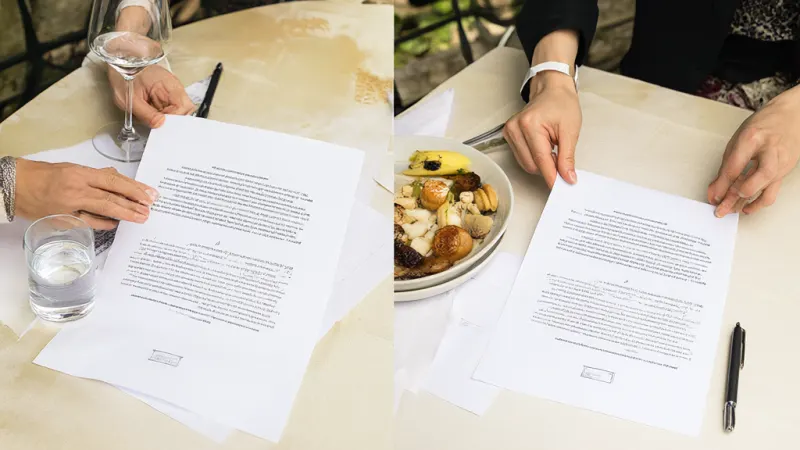
Step 5: the contract
Before signing, check that the following are written down:
- date, times, venue, number of guests and the deadline for the final number;
- menu, drinks, staff by role, hire items included;
- acconto or caparra: an acconto is an advance on the price; a caparra confirmatoria (article 1385 of the Civil Code) is forfeited if you cancel and must be returned twice over if the company fails to perform;
- cancellation penalties and what happens in cases of force majeure;
- the weather plan B and who pays for it;
- hours included and the cost of extra hours;
- how allergens and diets are handled.
Remember: article 59, paragraph 1, letter n) of the Consumer Code excludes the right of withdrawal for catering services with a specific date of performance. The rules for cancelling are those in the contract. For significant contracts, having a lawyer you trust read it is time well spent. Details in the guide to the catering contract.
Signs that should make you stop
- A lump-sum quote with no separate items, or "service included" with no number of people.
- No site visit at a venue the company does not know.
- Vague answers about allergens. Regulation (EU) 1169/2011 requires information on the 14 allergens to be provided even for unpackaged dishes.
- No written contract, or a contract that says nothing about cancellation and plan B.
- Pressure to sign immediately with discounts about to expire.
- Cash-only payments or no receipt.
- No names: you do not know who will be in charge on the day of the event.
- Reviews and figures that cannot be checked as the only argument.
On hygiene: food businesses must be registered with the competent authority, as required by Regulation (EC) 852/2004. You can ask the company how it manages its self-monitoring plan (HACCP) and, for the detailed rules, refer to the ASL (local health authority) or the council.
How to compare two similar offers
It happens often: two companies with similar prices and similar menus. At that point look at the things the price does not tell you. Who answered your questions most clearly? Who asked to see the venue? Who sent you a quote with separate items without being asked? Who gave you the name of the person who will run the event?
Response time is also a clue to how they will work afterwards. It is not a rule, but a company that replies precisely before signing usually does so afterwards too.
Questions to ask the caterer
- Which events similar to mine have you handled, and at which venues?
- Who will be in charge of my event? Will I meet them beforehand?
- How many floor and kitchen staff do you plan, role by role?
- What is included and what is not? Can you separate the items?
- Do you carry out a site visit? Is the tasting included?
- How do you handle allergens and diets? Will you give me the allergen matrix for the menu?
- What is the weather plan B?
- What are the deposit, balance and cancellation penalties?
- By when do I give the final number of guests?
More questions in the full checklist of questions to ask the caterer.
To carry on
The right choice comes from an orderly comparison: the same information, separate items, a contract read calmly. If you need to go over the basics, read what banqueting is. Once you have a date, guests and a venue, request a quote from several companies and compare the replies with the table above.
Sources
- Regulation (EU) No 1169/2011, EUR-Lex: https://eur-lex.europa.eu/legal-content/IT/TXT/?uri=CELEX:32011R1169
- Regulation (EC) No 852/2004 on the hygiene of foodstuffs, EUR-Lex: https://eur-lex.europa.eu/legal-content/IT/TXT/?uri=CELEX:32004R0852