In short
- The banquet manager coordinates, the maître d' runs the room, the chefs de rang look after the tables with the commis.
- In the kitchen are the chef and their brigade; at the bar the bartender; on the wine, when needed, the sommelier.
- For table service, industry guides usually suggest one waiter for every 15-20 guests.
- In the quote, ask for the number of people by role and by hours, not just "service included".
On the day of the event you will mostly see the waiters. Behind them there is a team with precise roles, and the quality of the reception depends on how it is made up. Knowing who does what helps you read the quote and judge whether the number of people proposed makes sense.
The banquet manager
They are the person in charge of the event for the banqueting company. Sometimes they are called the event manager or events room manager.
What they do:
- gather your requests and turn them into a menu, a running order and a work plan;
- coordinate with the venue, the wedding planner, the music and the photographer;
- on the day of the event, keep time and decide when each course goes out;
- handle the unexpected: a late ceremony, rain, a guest with an allergy nobody mentioned.
This is the most important person to get to know beforehand. Ask their name and whether they will be there from the arrival of the guests to the end of service.
The maître d'
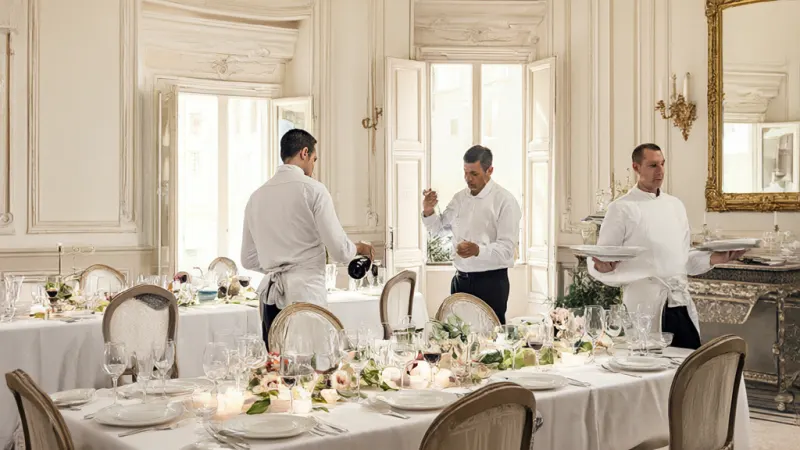
The maître d' (or head of service) leads the waiters in the room. They decide how the ranks are allocated, check the mise en place, give the signal for each course and make sure every table is served evenly.
At small events the banquet manager and the maître d' may be the same person.
Chef de rang and commis
The chef de rang is the waiter responsible for a rank, that is, a group of tables. They know the menu, the allergies in their rank and the timing. They serve and clear.
The front-of-house commis helps them: carries dishes from the kitchen, restocks bread, water and wine, clears. They are often a younger waiter or one in training.
They work in pairs in Italian-style plated service with many courses, and as a team in services where the serving dish is brought into the room, such as Russian service or guéridon service. These are explained in the guide to the types of banqueting service.
The sommelier
The sommelier chooses, presents and serves the wine. In Italy, training usually goes through courses run by associations such as AIS or FISAR.
It makes sense when you pair different wines with the courses or serve important labels. With Lazio wines, from Frascati to Cesanese, they can explain the choice to guests in a few words. Ideas in the guide to Lazio wines for events.
The bartender
The bartender runs the aperitivo and the open bar: cocktails, spirits, ice, glasses. They are often a separate role, sometimes from a specialist outside company.
Industry guides suggest one bartender for every 50-75 guests. If the bar opens all at once after the cake is cut, the lower figure avoids queues. Find out more in the guide to the wedding open bar.
The kitchen: chef, cooks, assistants
In the kitchen works the brigade:
- the chef (or head cook), who signs off the menu and checks the dishes as they go out;
- the station cooks, each on one stage (first courses, mains, desserts, cold dishes);
- the kitchen assistants and dishwashers, essential in a field kitchen.
At banquets with cucina espressa, meaning dishes finished on site, the brigade works at the venue. It needs suitable space, water and power: check with the venue beforehand.
Anyone handling food must have food hygiene training: this is required by Regulation (EC) 852/2004, Annex II, Chapter XII. In Italy the detailed requirements are set by each region: for Lazio, check the guidance from the Region or the local health authority (ASL).
Other roles
Depending on the event, you may also meet:
- buffet attendants, behind the food stations;
- hostesses and cloakroom staff, at corporate events and conferences;
- set-up crew, for tables, chairs, marquees;
- a pastry chef, if the cake is made and assembled on site;
- a show-cooking chef, for a live cooking station.
How many people you need: sourced references
In Italy there is no official rule. The ratios below are those most quoted by industry guides, to be used as an indicative reference.
| Role | Reference ratio |
|---|---|
| Waiters, table service | 1 per 15-20 guests |
| Waiters, finger food on trays | 1 per 25-30 guests |
| Bartenders | 1 per 50-75 guests |
| Buffet | at least 2 people per station |
For banquet managers, maîtres d', cooks and sommeliers we have not found reliable ratios: they depend on menu, kitchen and venue. The guide on how many waiters you need goes into the cases in more detail.
How the team works during dinner
During service the team moves like a chain. The kitchen plates the dishes at the pass, the counter they go out from. The maître d' checks that the room is ready and gives the signal. The chefs de rang and commis carry the dishes to their tables, at the same moment across the whole room. Then they clear, restock wine and water, and the chain starts again with the next course.
Meanwhile, the banquet manager talks to whoever is handling the music and the speeches. If the couple are still outside for sunset photos, they decide to delay the first course by a few minutes. This coordination is invisible, but it is the difference between a reception that flows and one with long waits.
In-house or freelance staff
Many banqueting companies have a fixed core, usually managers, maîtres d' and cooks, and call in extra waiters for large events or for the busiest weekends of May, June and September. That is not a problem in itself. What matters is that the managers belong to the company and that the team gets a briefing before the event on menu, allergies and running order. Ask how they organise it.
Questions to ask the caterer
- Who is the banquet manager for my event? Will I meet them beforehand?
- How many front-of-house, kitchen and bar staff do you plan, role by role?
- How many tables does each chef de rang look after?
- Are the staff your own, or partly freelance?
- From what time to what time is service included? How much does each extra hour cost?
- Do the staff wear a uniform? Can I choose its colour?
- Have you planned a meal for the other suppliers' staff?
To go further
A banqueting quote is above all a quote for people. Ask for the number by role, compare it with the references and then weigh up the rest. To choose the company, read how to choose a banqueting company and browse the list of caterers in Rome. When you are ready, request a quote stating guests and format.
Sources
- Regulation (EC) No 852/2004 on the hygiene of foodstuffs, EUR-Lex: https://eur-lex.europa.eu/legal-content/IT/TXT/?uri=CELEX:32004R0852