In short
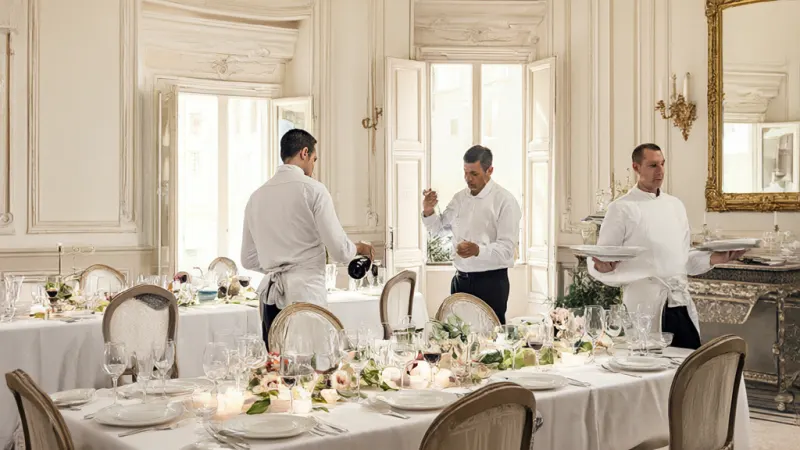
- Mise en place is everything that is set on the table before the guests arrive.
- Round tables for conversation, long banquet tables for visual effect: the shape of the space also decides.
- Interior design guides suggest at least 60 cm per place setting: at a banquet it is better to allow more.
- Cutlery and glasses are laid in the order they are used, from the outside towards the plate.
The table setting is the first thing guests see when they walk into the room. It tells them straight away what kind of dinner awaits them. But it is also a working tool: a well-laid table helps the waiters serve better. Here are the choices to make, in the order it makes sense to make them.
What mise en place is
The French expression means "putting in place". In the dining room it refers to preparing the table: tablecloth, plates, cutlery, glasses, napkins, centrepiece, place cards. In the kitchen it refers to preparing the ingredients before service.
In banqueting, the table setting is usually the caterer's job, laid a few hours before the guests arrive. At villa weddings it is often prepared in the afternoon, while the couple are at the church or the Campidoglio.
Choosing the tables
Round tables
They are the most common at receptions. Everyone sees everyone, conversation flows, and waiters serve the whole table on a circular route. They suit groups of friends, families and colleagues.
According to etiquette, each diner should have at least 60-70 cm. To calculate the seats, the most common method divides the table's circumference (diameter times 3.14) by 60 cm per person. With this method, a 160 cm round table seats 8. Banquets often use larger round tables: ask the caterer or hire company which diameters they have and how many people they seat.
Long banquet table
This is the long rectangular table, sometimes a single row running across the garden or the room. It works well under a pergola at a farmhouse in the Roman countryside or in the long halls of historic palazzi.
Pros: dramatic effect, brings guests together. Cons: you only talk to your neighbours, service must be organised on both sides, and you need a long, clear space.
The couple's table
It can be a separate table, a long table with the witnesses, or a round "sweetheart" table for two. Think about the view: the couple's table is visible from the whole room, so nothing behind it should spoil the photos.
The distance between tables
Waiters must be able to pass between tables carrying plates and, if the service calls for it, trolleys, even when guests are seated with their chairs pushed back. We have not found an official measurement for banquets: check the floor plan with the banquet manager and ask how much space they leave between tables.
The place setting: plates and cutlery
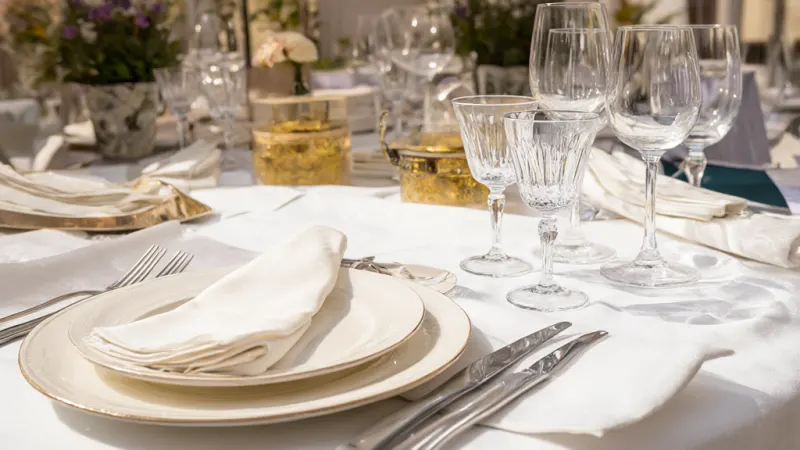
The classic layout, with small variations from one caterer to another:
- charger plate or base plate in the centre, sometimes with the dinner plate on top;
- forks on the left, knives and spoon on the right, with the knife blade facing the plate;
- dessert cutlery above the plate, horizontal;
- bread plate at the top left, if used;
- napkin on the plate or to the left.
The golden rule: cutlery is used from the outside in. Don't lay more cutlery than there are courses. If the menu has many courses, the caterer can change it during service.
The glasses
Glasses go at the top right, above the knives, usually in the order they are used. A typical set for a reception:
| Glass | For | Notes |
|---|---|---|
| Water | The whole dinner | The largest |
| White wine | Starters, fish, light pasta dishes | Smaller glass |
| Red wine | Meat, richer pasta dishes | Wider glass |
| Flute | Toast | Sometimes served only at the moment |
If you serve only one wine, two glasses are enough. If the toast is made standing, the flutes can arrive on a trolley. Fewer glasses also means lower hire costs and fewer breakages: ask what the damage clause covers.
The linen
Table linen includes:
- table felt, the soft cloth under the tablecloth that muffles noise and protects the table;
- tablecloth, which at elegant receptions usually falls to the floor or nearly so;
- overlay or runner, to add colour;
- cloth napkins.
White is the standard and is usually included. Colours, linen and special fabrics may be extra. To find out who brings what, read the guide to event equipment hire.
The centrepiece
The centrepiece gives the room character, but it must not divide the guests. Industry guides advise against arrangements that are too large, otherwise guests cannot see each other, and suggest tall but slim candelabra or vases instead.
Two practical tips:
- leave room for bottles, bread and oil cruets;
- with the wind on a Roman terrace, no open candles and keep arrangements light.
In Rome, seasonal elements work well: lemons and olive branches in summer, pomegranates in autumn, citrus fruit in winter. Agree with the florist and the caterer on who sets up and who clears away.
Place cards, menus and seating plan
- Place cards: each guest's name at their seat. Useful to the caterer for diets too: a discreet symbol helps the waiter recognise a gluten-free or vegan menu.
- Menu: a card per table or per guest.
- Seating plan: shows each guest their table. It is finalised after the final confirmations.
Send the caterer the final list with each guest's table, name and diet. EU Regulation 1169/2011 requires information on the 14 allergens to be provided even for food that is not pre-packed: ask for the menu's allergen matrix and check the details at the official source.
Questions to ask the caterer
- Which tables do you have and in what sizes? How many people do you seat per table?
- Are linen, plates, cutlery and glasses included? Which models?
- Does coloured or linen tablecloth cost extra?
- Who lays the tables and at what time?
- How many glasses do you plan per place setting, and for which drinks?
- How do you flag guests with allergies or special diets in the room?
- Can you send us a floor plan with the tables and walkways?
To continue
A good table setting is decided together with the menu, the service and the venue. For the rest of the banquet, read wedding banqueting in Rome and the banqueting roles. You can compare wedding caterers and, once you have the guest list, request a quote.
Sources
- Regulation (EU) No 1169/2011, EUR-Lex: https://eur-lex.europa.eu/legal-content/IT/TXT/?uri=CELEX:32011R1169