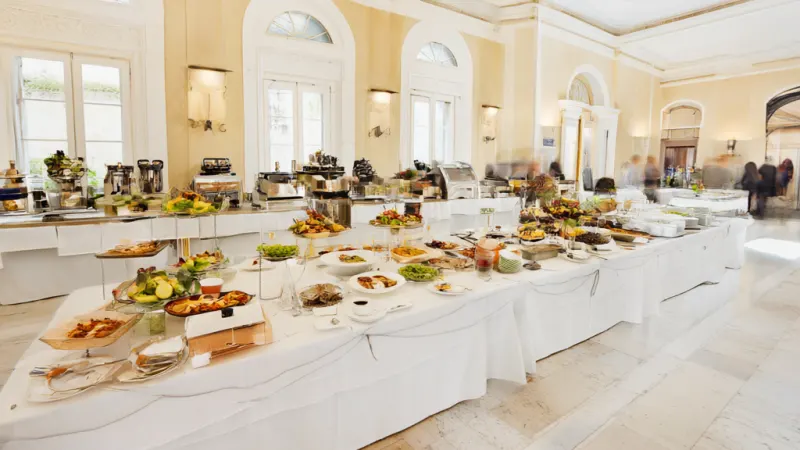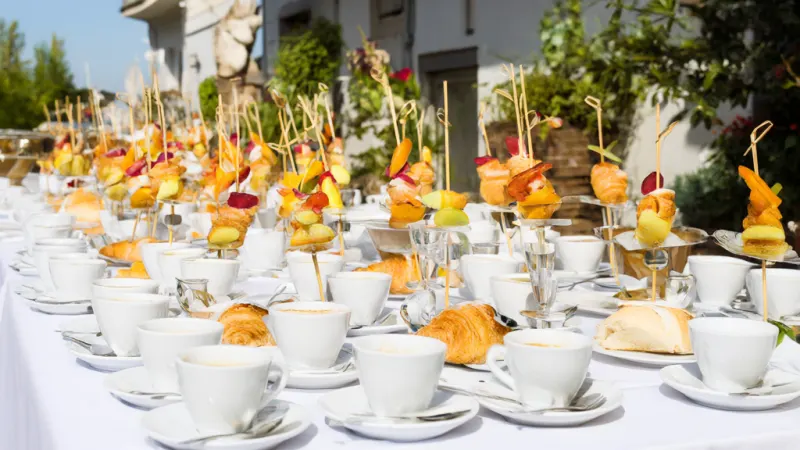
In short
- A coffee break usually lasts 15-30 minutes: the real challenge is avoiding queues.
- Industry estimates give €7-15 per person as an indicative national range.
- The number of stations matters more than the number of products.
- Alongside croissants, fruit and yoghurt, a Roman touch such as mini maritozzi, ciambelline or pizza bianca is popular with visitors.
You have a meeting, a training course or a conference and you need a break that works. The coffee break looks like the simplest part of corporate catering, but it is where you see straight away if something is wrong: a long queue, the coffee run out, the speaker starting again with half the room still at the counter. Here you will find the formats, indicative quantities and the questions to ask before signing.
The formats: welcome coffee, coffee break, afternoon snack
In industry language, breaks have different names depending on the time of day.
| Format | When | What is usually served | Typical duration |
|---|---|---|---|
| Welcome coffee | On arrival, during registration | Coffee, tea, juices, sweet pastries | 20-40 min, staggered |
| Mid-morning coffee break | Between two sessions | Coffee, tea, water, small pastries, fruit | 15-30 min |
| Afternoon coffee break | After lunch, mid-session | Coffee, tea, sweet and savoury, fruit, cold drinks | 15-30 min |
| Continuous break | One-day courses and workshops | Station always open, restocked several times | All day |
The durations are indicative: they depend on the programme and the number of participants.
The welcome coffee greets people as they register. Arrivals are staggered, so queues are shorter. The coffee break in the middle of a session is the critical moment: everyone gets up at once and has only a few minutes.
The continuous break suits internal courses in a meeting room. The caterer sets up a station and restocks it at agreed times. It costs less in staff, but ask who checks that the coffee and water do not run out.
How many stations and how many staff
The bottleneck is almost always the coffee. An espresso needs its own extraction time; with a hundred people and a single machine, a 20-minute break is not enough.
Three levers to shorten the queue:
- More service points. Separate coffee from other drinks and from the food, so people spread out.
- Dispenser coffee alongside espresso. Those in a hurry take an americano, those who want espresso wait.
- Cold drinks ready to pour. Water, juices and fresh juice in jugs need no staff.
The number of staff depends on the format, the type of coffee and the layout of the room: there is no fixed ratio that applies to everyone. Ask the caterer how many people it plans, in which role (barista, buffet attendant, clearing) and until what time. For more on staffing, read the guide on how many waiters you need.
Indicative quantities per person
The quantities below are indicative: many quotes use them as a starting point, but they change with the time of day, the duration and the type of audience. A break at 11:00 after breakfast at home is not the same as a break at 16:00 after a light lunch.
| Item | Mid-morning break | Afternoon break |
|---|---|---|
| Coffee or tea | 1 per person, plus a margin for those who have two | 1 per person |
| Pastries or baked goods | 1-2 mini pieces | 1-2 mini pieces |
| Savoury | optional | 1-2 pieces |
| Fruit | a few portions for those who do not eat sweets | same |
| Water | always, still and sparkling | always |
Indicative: it depends on duration, time of day, the number of breaks in the day and participants' habits.
If there are two breaks in the day, do not repeat the same tray. In the morning, pastries and fruit; in the afternoon, something savoury and a cold drink, especially from May to September.
What to serve: beyond the croissant
A coffee break does not have to be croissants and juice. Muffins, loaf cakes, small focacce, mini sandwiches and fruit work anywhere. If you want to show the city to visitors, there are Roman baked goods that work well in small sizes.
- Mini maritozzi with cream. The classic breakfast of Roman cafés, a soft sweet bun split and filled with whipped cream; in small format it is two bites. Ask how the cream is kept cool in the room.
- Ciambelline al vino. Dry wine biscuits that keep well and do not leave sticky fingers.
- Pizza bianca, Roman white pizza cut into squares, also with a slice of mortadella for the afternoon break.
- Ricotta and sour cherry tart in squares, if you want a sweet from the Roman Jewish tradition.
- Seasonal fruit: strawberries in spring, peaches and apricots in summer, grapes in September, citrus in winter.
For international conferences at EUR or in the centre, a small card with the name of the product in Italian and English helps guests and cuts down on questions to the staff.
Allergies, diets and plant-based drinks
Reg. (EU) 1169/2011 requires anyone serving food to provide information on the 14 allergens, including for unpackaged products. At a coffee break the most common allergens are gluten, milk, eggs and nuts.
Practical pointers:
- collect diets and allergies with the event registration form;
- ask for lactose-free milk and at least one plant-based drink;
- for coeliac guests, individually wrapped gluten-free products reduce the risk of cross-contamination;
- clear labels on every tray.
For coeliac disease, vegan menus and other requirements, read the guide to special diets.
Logistics in Rome
A coffee break is quick to set up, but the caterer has to arrive early: coffee machines to switch on, table linen, trays.
- Historic centre. Deliveries go through Roma Capitale's ZTL (limited traffic zones) and goods ZTL. Ask the caterer how it manages access and check current hours on the Roma Mobilità website.
- EUR and business districts. Access for vans is generally easier, but goods lifts, service entrances and building hours all count.
- Power. Professional espresso machines draw a lot of power. Ask which socket is needed and check with the venue.
- Water. You need a water point nearby or water containers: ask about it at the site visit.
Prices: what changes the bill
Industry estimates give a national range of €7-15 per person for a coffee break. In Rome you may find quotes above or below. The items that move the price:
- the number of breaks in the day;
- espresso with a barista or dispenser coffee;
- artisan or industrial pastries;
- savoury items, fruit, freshly squeezed juice;
- staff and hours on site;
- hire of table linen, ceramic cups or disposables;
- transport and ZTL access.
Always ask whether the price includes or excludes VAT. Food and drink served with service is normally charged at the 10% rate; doubtful cases should be checked with your accounts department. The guide to corporate catering prices compares the different formats.
Questions to ask the caterer
- How many coffee stations do you plan for the number of participants?
- Is the coffee espresso, dispenser or both?
- How many staff are there and in which role? Until what time do they stay?
- What time do you arrive to set up and how long does it take?
- Are cups and glasses ceramic and glass, or disposable? Do you take everything away?
- Which gluten-free and lactose-free products are planned? Do you have the allergen list?
- How does the offer change between the morning and the afternoon break?
- What power and water supply do you need?
- How do you manage access if the premises are in a ZTL?
- Until when can I change the number of participants?
In closing
A good coffee break is barely noticed: people get their coffee, exchange a few words and go back into the room on time. To get there you need to give the caterer three clear pieces of information: number of participants, break times and venue. You will find suppliers that work with companies in the corporate catering section and a full overview in the guide to corporate catering in Rome. Once you have the programme, request a quote from two or three caterers and compare them item by item.
Sources
- Regulation (EU) No 1169/2011, EUR-Lex: https://eur-lex.europa.eu/legal-content/IT/TXT/?uri=CELEX:32011R1169
- Roma Mobilità, ZTL section: https://romamobilita.it/it/servizi/ztl