In short
- The wedding set-up involves several suppliers: caterer, florist, set designer, lighting company.
- First of all, ask what the caterer includes (tables, chairs, table linen, table setting).
- Flowers and colours follow the season and the venue: a villa on the Appia Antica calls for something different from a rooftop terrace in Trastevere.
- Every venue and every church has rules on set-up, candles and times.
The set-up is what guests see as soon as they walk in: the tables, the flowers, the lights, the chairs. The caterer handles part of it; other suppliers handle the rest. To avoid paying twice, or being left with a gap, you need to know who does what. This guide puts the choices in order.
Who does what
| Element | Usually supplied by |
|---|---|
| Tables, basic chairs, table linen | Caterer or venue |
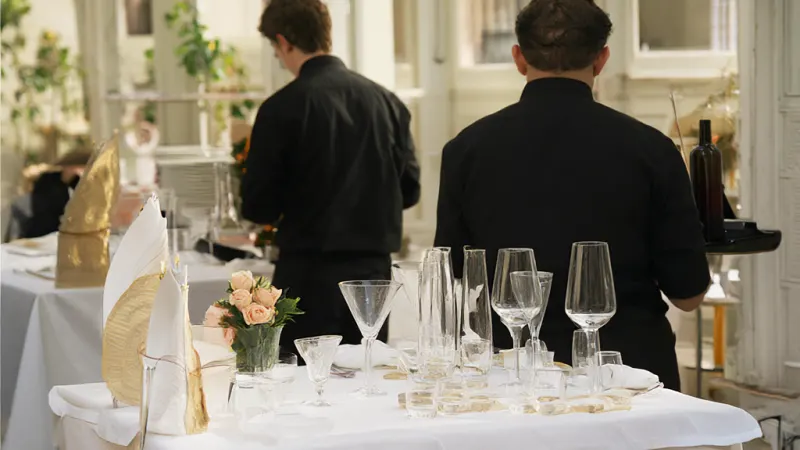
| Plates, glasses, cutlery | Caterer |
| Mise en place (laying the table) | Caterer |
| Flowers and centrepieces | Florist |
| Special chairs, lounge furniture | Set designer or hire company |
| Decorative lighting | Set designer or lighting company |
| Seating plan, place cards, printed menus | The couple, the wedding planner or the set designer |
| Ceremony set-up | Florist, set designer, sometimes the venue |
So the first question for the caterer is: what is included in the price per person? Then work from there to ask for the rest. You will find set-up companies on the page event set-up in Rome.
Tables: shape and layout
| Type of table | Pros | Cons |
|---|---|---|
| Round (8-10 people) | Easy conversation, suits almost any room | A more classic look |
| Banquet (long and continuous) | Striking, convivial | Needs a long space, more complex service |
| Rectangular in a comb layout | Fits narrow rooms | Less comfortable for talking |
| Mixed | Rounds plus a banquet table for the couple and family | Needs careful planning |
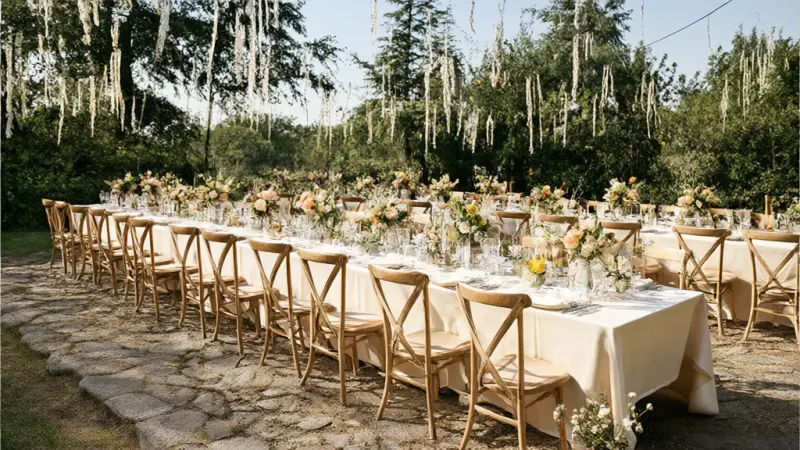
In the villas and farmhouses of the Roman countryside, a long banquet table under a pergola or in a garden is a popular request. Ask the venue how much space there really is, including the gangways for waiting staff.
Seasonal flowers and colours
Flowers cost less and last longer when they are in season. A florist will suggest what is available at the time; some general pointers:
- Spring: peonies, ranunculus, tulips, wild flowers.
- Summer: hydrangeas, garden roses, lavender, plenty of greenery.
- Autumn: dahlias, coloured leaves, branches, fruit.
- Winter: amaryllis, anemones, dark greenery, berries.
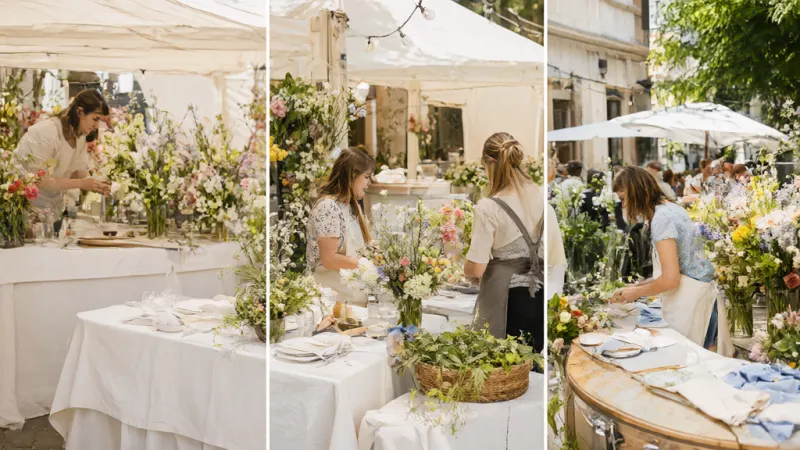
Greenery (olive, ivy, eucalyptus) is the base of many Roman set-ups: it recalls the countryside and copes better with the heat. Low centrepieces let people talk face to face; tall ones make an impression but should sit above eye level. You will find ideas and the costs to ask about in the guide to flowers and centrepieces for events.
The table: style and table setting
The table brings together the work of the caterer and the florist: tablecloth, runner, plates, glasses, cutlery, place cards, flowers, candles. The style varies a great deal: rustic in a farmhouse, classic in a historic villa, minimal on a terrace. In the guide to table setting styles you will find the most common combinations, including Roman-themed ones.
Chairs
Chairs are more visible than you might think, especially at an outdoor ceremony and in photos.
- Caterer's or venue's chairs: included, functional, sometimes with chair covers.
- Chiavari chairs: the light wooden chairs first made in Chiavari, in Liguria, in the 19th century. They are among the most requested for weddings.
- Natural wood chairs or folding garden chairs: for a rustic style.
- Transparent chairs: for a modern style.
Special chairs are almost always hired separately. Ask for the price per chair, transport and who sets them out.
Lighting
A wedding in Rome often begins in daylight and ends at night. The light changes everything:
- fairy lights and festoons above the tables in the garden;
- candles and lanterns (where the venue allows them);
- warm lights for façades, trees and pergolas;
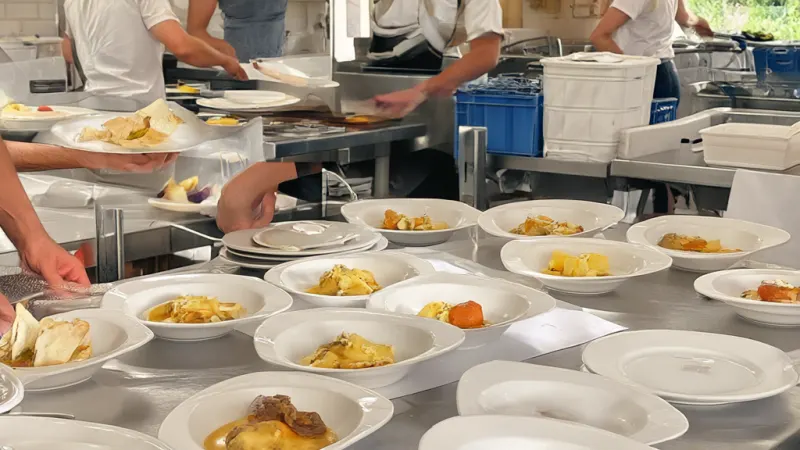
- working lights for the buffet and kitchen, which should not spoil the atmosphere.
Outdoors you need enough power and safe installations. Read the guide to event lighting before asking for a quote.
The ceremony
In church
Each parish has its own rules on flowers, set-up times, petals, rice and photographers. Some ask for a florist they trust. Ask the parish priest for the rules before signing with the florist.
Civil ceremony
In Rome civil weddings are held at the Campidoglio and in other venues designated by Roma Capitale (the city council), with precise rules on times and decorations. Check on the council's website what is allowed in the room you choose.
Ceremony at a villa
If the ceremony takes place at the same venue as the reception, the set-up is freer: floral arch, rows of chairs, aisle runner, lectern. Think about the move from the ceremony to the aperitivo: who moves the chairs, and how long does it take?
Timing, set-up and venue rules
- Ask the venue from what time you can set up and by what time you must clear away.
- Check the rules on candles, naked flames, nails and adhesive tape.
- Some historic villas are protected buildings: no fixings to walls or trees.
- Agree with the caterer where its service tables go, so they are not in the middle of the decor.
The set-up budget
There is no standard cost: it depends on the venue, number of tables, chosen flowers, season and how many items are hired. To keep it under control:
- start from what is already included by the caterer and the venue;
- choose two or three strong elements (for example centrepieces and lighting) and keep the rest simple;
- use seasonal flowers and plenty of greenery;
- reuse the ceremony decorations at the reception, if the venue allows: the arch can become the backdrop for the couple's table;
- ask for quotes with itemised costs: flowers, hire, transport, set-up.
Questions to ask the caterer and set designer
- What is included in the price: tables, chairs, table linen, table setting?
- What kind of chairs and tablecloths do you have? Can I see them?
- Who sets up and clears away? How long does it take?
- Have you worked at this venue before?
- Are there transport and set-up costs?
- Are the flowers in season? What happens if a variety is unavailable?
- Does the lighting need extra power? Who supplies the generator if needed?
- Who coordinates all the suppliers on the wedding day?
- What happens if it rains for the outdoor ceremony?
To finish
A good set-up comes from conversation between caterer, florist and set designer, with a clear list of who brings what. Explore the page event set-up in Rome and the wedding caterers. When you have your date, venue and guest numbers, request a quote.