In short
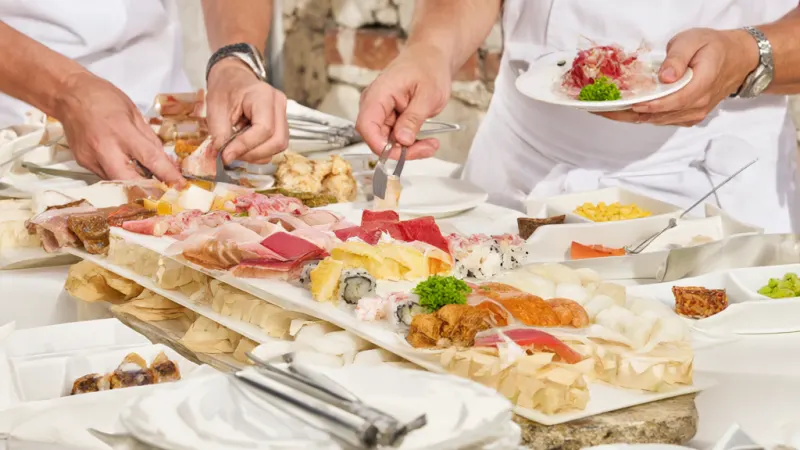
- Sushi at an event comes as a station (a fixed counter) or as a show with the chef in view.
- Raw fish must be blast-frozen: -20 °C for at least 24 hours, under EC Regulation 853/2004.
- Frozen does not mean fresh: freshness and origin are separate questions.
- In hot weather you need a refrigerated station and preparation in small batches.
The sushi station has been part of wedding aperitivi and corporate events in Rome for years, alongside fried food, raw fish platters and cheeses. It works because it is eye-catching and light. But it is also the dish that requires the most care over food safety.
Station, show or platters: the formats
| Format | How it works | Suits |
|---|---|---|
| Sushi station | A counter with prepared pieces that are restocked, sometimes with an attendant | Wedding aperitivi, corporate cocktails |
| Live show | One or more chefs prepare in view, guests come up | Events where sushi is a moment of spectacle |
| Platters or boats | Pieces prepared in the kitchen and delivered | Parties at home, meetings, office lunches |
| Passed service | Waiters with trays of nigiri and uramaki | Standing aperitivi, openings |
The live show is what guests remember: rice shaped on the spot, fish cut in front of them. It does, however, need space, a work surface and a longer service time.
Food safety: the rules to know
Freezing raw fish
EC Regulation 853/2004 (Annex III, Section VIII, Chapter 3, point D) requires fishery products to be eaten raw to be frozen at a temperature no higher than -20 °C in every part of the product for at least 24 hours. The aim is to kill parasites such as Anisakis. In Italy, an earlier circular from the Ministry of Health already set out the same principle for raw fish.
Guidelines from some regional health authorities, such as the Puglia Region's, describe the practice with a dedicated blast chiller, which takes the product well below zero quickly, followed by storage at -20 °C for 24 hours. Operating details can vary: check with the caterer and, if you need to, with the local health authority (ASL).
Frozen does not mean fresh
Freezing is mandatory and concerns safety. It says nothing about how fresh the fish is, where it comes from or how it has been stored. That is why you should also ask the caterer:
- which supplier the fish comes from;
- when it was bought and frozen;
- how it is transported to the venue.
The cold chain at the event
Raw fish stays cold until it is prepared. At the station:
- a refrigerated counter or trays on ice;
- preparation and restocking in small quantities, not everything at the start;
- a shaded position, away from heat sources such as the supplì fryer;
- limited display time: ask the caterer how long a piece stays out before it is removed.
At a summer wedding in a villa in the Castelli Romani or on a terrace in July, this is the point to check most carefully. Also read the guide to catering for outdoor events.
The rice
Sushi rice is seasoned with vinegar and served at room temperature. It is a delicate food too: it must be made on the day and handled according to the caterer's self-monitoring procedures (HACCP).
Allergens and diets
Sushi contains several of the 14 allergens in EU Regulation 1169/2011: fish, crustaceans, molluscs, soya (the sauce), sesame, sometimes eggs and gluten (soy sauce, tempura). Ask for:
- the allergen matrix for each piece;
- gluten-free soy sauce for guests with coeliac disease;
- vegetable pieces (cucumber, avocado, vegetables) for those who don't eat fish;
- clear labels at the station.
Remember that some guests don't eat raw fish by choice or for health reasons, such as pregnant women. The sushi station should be one option among others, not the only one.
For coeliac disease, kosher and other requirements, read the guide to catering for special diets.
How many pieces to allow
There is no official figure. The estimate depends on what else is served around the sushi.
| Situation | Indicative estimate |
|---|---|
| A station within an aperitivo with other dishes | A few pieces per person, because not everyone chooses it |
| A standing aperitivo based on sushi | Many more pieces, with something cooked |
| Sushi as the main meal | The quantity of a full meal, with soup or hot dishes |
Sushi caterers are used to making these estimates. Give them the number of guests, duration, time of day and what else is on the menu.
Sushi alongside other stations
Sushi often works as one of the stations of a broader aperitivo, alongside Italian, seafood or Roman cooking. An example of a wedding aperitivo:
- sushi station with a live chef;
- pizza bianca and mortadella counter;
- seasonal fried food, including Roman classics such as supplì and courgette flowers;
- a station of cheeses from Lazio.
That way every guest finds something they like. You will find more ideas in the guide to finger food ideas for events.
Space and set-up for the station
A sushi station takes up more space than you might think. It needs a work counter for the chef, a refrigerated surface or trays on ice, a spot for the sauces and space in front for waiting guests. Ask the caterer for the minimum dimensions.
Other things to check with the venue:
- power for the refrigerated counter and lighting;
- water nearby, or containers brought by the caterer, for washing utensils and hands;
- a back area where the fish can be kept cold until restocking;
- distance from the hot kitchen and from heat sources.
On a terrace in the centre or in a historic hall, space is often the main limit. In a farmhouse in the Roman countryside the limit is the heat: there, a station under a gazebo or a portico makes sense.
Questions to ask the caterer
- How do you freeze the raw fish? With what equipment?
- Which supplier does the fish come from, and when is it bought?
- How do you transport the fish to the venue?
- Does the station have a refrigerated counter? How long is a piece on display?
- Does the chef prepare in view? How much space and power do they need?
- How many pieces per person do you plan for my event?
- Do you have vegetable pieces and gluten-free soy sauce?
- Can you give me the allergen matrix?
- Is the station priced per person or per station?
Before asking for a quote
State whether sushi is a station or the meal, the number of guests and whether the event is outdoors. You can compare suppliers in the sushi catering section and request a quote from several caterers with the same questions.
Sources
- Regulation (EC) No 853/2004, Annex III, Section VIII, Chapter 3, point D, EUR-Lex: https://eur-lex.europa.eu/legal-content/IT/TXT/?uri=CELEX:32004R0853
- Puglia Region, "Consumare pesce crudo in sicurezza" (Eating raw fish safely, Anisakis leaflet): https://sanita.puglia.it/documents/25619/165077/CONSUMARE+PESCE+CRUDO+IN+SICUREZZA+%28ospuscolo+anisakis+giustover_definitiva+12_10_2010.pdf%29/335ee68d-54ce-4bc0-a822-4fd116e7633c
- Regulation (EU) No 1169/2011, EUR-Lex: https://eur-lex.europa.eu/legal-content/IT/TXT/?uri=CELEX:32011R1169