In short
- Lazio has three DOCGs: Frascati Superiore, Cannellino di Frascati and Cesanese del Piglio.
- Whites from the Castelli Romani go well with fried food, artichokes and Roman pasta dishes.
- Cesanese is the local red for spring lamb and meat mains.
- Quantities are indicative: start from the glasses per bottle and adjust for duration and season.
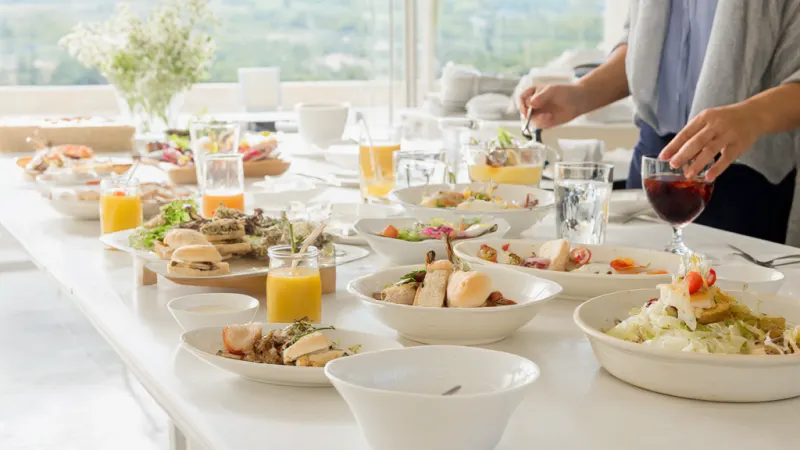
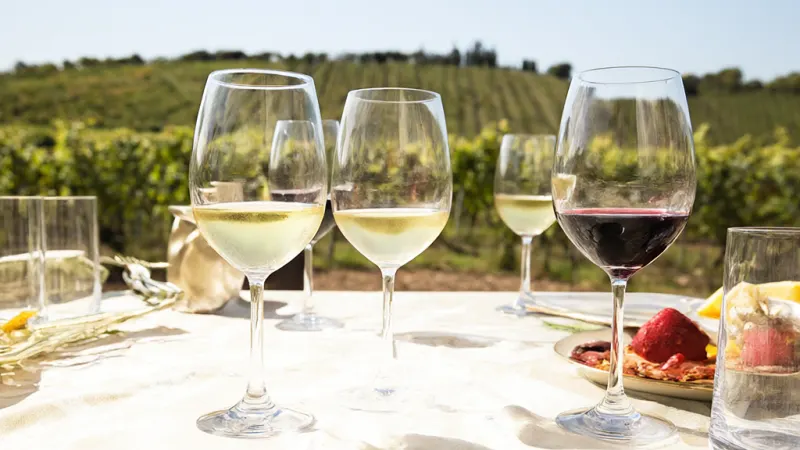
Serving Lazio wines at an event in Rome is a natural choice: they come from vineyards half an hour from the city, from the Castelli Romani to Ciociaria, and they pair with the cooking they have accompanied for centuries. It is not compulsory: many caterers in Rome offer lists with wines from other regions, and a seafood or international menu may call for different labels. This guide helps you choose the appellations, the pairings and the quantities.
Lazio's appellations
Lazio has 3 DOCGs and 27 DOCs. DOCG and DOC are Italy's protected designations of origin, DOCG being the stricter of the two.
The three DOCGs
| DOCG | Type | Area | Use at an event |
|---|---|---|---|
| Frascati Superiore | Dry white | Castelli Romani | Aperitivo, starters, pasta courses |
| Cannellino di Frascati | Sweet white | Castelli Romani | Desserts, ciambelline, cheeses |
| Cesanese del Piglio | Red | Ciociaria, province of Frosinone | Meat mains, spring lamb |
Cesanese is made from a grape grown almost only in Lazio, Cesanese, in its Affile and Comune varieties.
The DOCs closest to Rome
Of the DOCs on the list, those that come up most often at Roman events are:
- Frascati, Marino, Castelli Romani, Colli Albani, Colli Lanuvini, Velletri, Zagarolo and Montecompatri Colonna, all in the Castelli Romani area;
- Roma, a DOC that carries the city's name;
- Cesanese di Olevano Romano and Cesanese di Affile, for reds;
- Cori, where Bellone, a local white grape, is also grown;
- Cerveteri and Tarquinia, towards the northern coast;
- Aleatico di Gradoli and Moscato di Terracina, for sweet or aromatic wines.
An appellation on its own does not guarantee a wine that suits your event. It is a starting point for the choice; after that, the producer matters.
Pairings with Roman cooking
| Moment / dish | Lazio wine | Why |
|---|---|---|
| Aperitivo with fried food (supplì, courgette flowers) | Frascati or Marino, including a sparkling version if available | The acidity cuts through the frying |
| Roman-style or Jewish-style artichokes | A white from the Castelli Romani | Artichokes are hard to pair: a simple, fresh white works |
| Cacio e pepe, gricia, carbonara | Frascati Superiore or a fuller-bodied white | It holds up to salt and richness |
| Amatriciana | A fuller-bodied white or a light red | Tomato opens the door to reds too |
| Spring lamb, oxtail stew | Cesanese | The local red, for full-flavoured meat |
| Fish from the coast | A white from Cori (Bellone) or the Castelli Romani | Freshness and aroma |
| Ciambelline al vino, tarts | Cannellino di Frascati or Aleatico di Gradoli | Sweet wines for the end of the meal |
These are general pairings, not rules. Ask the caterer or their sommelier to let you taste two or three wines with the menu dishes at the tasting.
How much wine to allow
There is no official table. A basic calculation starts from arithmetic:
- a 0.75-litre bottle gives about six 125 ml glasses;
- a 1.5-litre magnum about 12 glasses.
Many caterers start from an indicative estimate of half a bottle per person for a dinner with wine on the table, then adjust it. What changes the estimate:
| Factor | Effect |
|---|---|
| Long duration (wedding, gala) | More wine |
| Summer and heat | More water and whites, fewer reds |
| Open bar after dinner | Less wine on the table towards the end |
| Corporate lunch | Much less, often one glass each |
| Many young people or non-drinkers | Less wine, more soft drinks |
Ask whether wine is charged on consumption (you pay for the bottles opened) or as a flat rate (a fixed price per person). The flat rate is more predictable; consumption may cost less if guests drink little. For the other drinks costs, read about extra catering costs, and for after-dinner drinks the guide to the wedding open bar.
Service and temperature
- Whites chilled but not ice-cold: a white served too cold loses its aroma.
- Reds at cellar temperature, not that of a terrace in July.
- Ice and ice buckets: who brings them? They are needed in summer, especially outdoors.
- Glasses: are they the caterer's, hired or the venue's? How many per person?
Bringing your own wine and corkage
Do you have a family cellar in the Castelli Romani or a friend who makes wine? Many couples want to serve their own. Before deciding:
- ask whether the caterer accepts it;
- ask whether there is corkage, a charge for each bottle opened and served;
- ask whether service (glasses, chilling, pouring) is still included.
Terms vary a great deal from one caterer to another and from one venue to another: put them in writing.
Alcohol and minors
Italian law prohibits selling or serving alcoholic drinks to anyone under 18 (art. 14-ter of Law 125/2001, as amended). At a party with young people, such as an 18th birthday party or a first communion, ask the caterer how they manage drinks service and provide a wide choice of soft drinks.
Sparkling wine and soft drinks
The toast usually calls for a sparkling wine. In Lazio some appellations also allow sparkling versions, but the offer depends on the producers: ask the caterer what they propose from the region and what from elsewhere.
Soft drinks deserve the same attention as wine. Plenty of water, especially from June to September, fresh juices, lemonade made on site and at least one alcohol-free alternative for the toast. Guests who are driving, pregnant women, young people and those who don't drink by choice shouldn't have to settle for a glass of water.
Questions to ask the caterer
- Which Lazio wines are on your list, and from which producers?
- Is wine charged on consumption or as a flat rate per person?
- How many bottles do you plan for my number of guests and my duration?
- Can I taste the wines at the tasting with the menu dishes?
- Do you accept wine I bring? Is there corkage?
- Who serves the wine, and until what time?
- Are glasses, ice buckets and ice included?
- Do you have dessert wines and good-quality soft drinks?
Before asking for a quote
Choose the style of the menu first, then the wine. You can compare suppliers in the wedding caterers section or in apericena catering for more informal events. For pairings with the dishes, see the Roman cooking menu. When you are ready, request a quote stating whether you want local wines.
Sources
- Law No 125 of 30 March 2001, art. 14-ter, Normattiva: https://www.normattiva.it/uri-res/N2Ls?urn:nir:stato:legge:2001-03-30;125