In short
- Raw fish must be blast-frozen: -20 °C for 24 hours, or -35 °C for 15 hours (EC Reg. 853/2004 and EU Reg. 1276/2011).
- Frozen does not mean fresh. Origin and freshness are separate questions.
- Sushi contains many of the 14 allergens: fish, crustaceans, molluscs, soya, sesame, gluten, eggs.
- During pregnancy the advice is cautious: many health authorities advise against raw sushi. Your own doctor decides.
Sushi is the dish at an event that needs the most attention to safety. Not because it is risky in itself, but because raw fish, rice and the cold chain are governed by precise rules. Here they are explained simply, with the questions to ask the caterer. The information is general: for the details the official texts apply, and for health matters, your doctor.
For formats and how to organise the station, see the guide to sushi catering for events.
The parasite risk and freezing
What Anisakis is
Anisakis is a parasite that can be found in sea fish. If the fish is eaten raw and the parasite is alive, it can cause illness. Cooking and freezing at suitable temperatures kill it.
What the law says
EC Regulation 853/2004 (Annex III, Section VIII, Chapter 3, point D) requires fishery products to be eaten raw to undergo a freezing treatment. EU Regulation 1276/2011 set two options:
| Temperature | Minimum duration | Where |
|---|---|---|
| No more than -20 °C | 24 hours | In every part of the product |
| No more than -35 °C | 15 hours | In every part of the product |
The regulation provides for some exceptions, for example for certain farmed products under specific conditions. These are technical cases: the caterer and its suppliers must be able to document them. For the exact text, consult EUR-Lex.
How it is done in practice
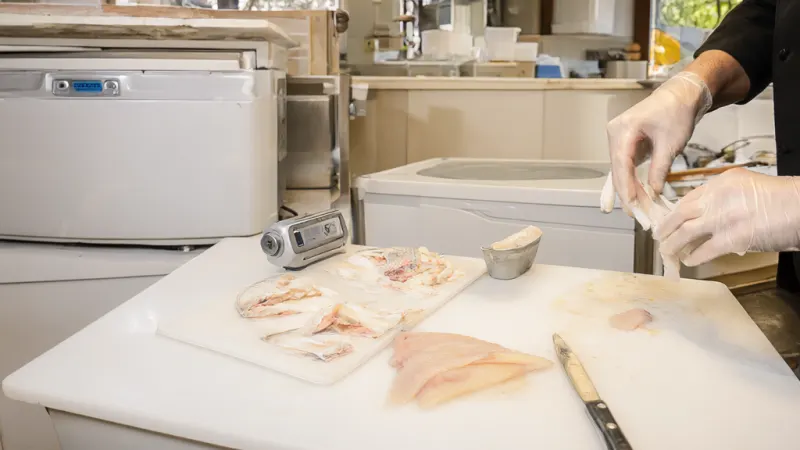
Kitchens use a blast chiller, which takes the fish well below zero quickly, followed by storage at the required temperature. Some caterers buy fish already treated by authorised suppliers. In both cases the step must be recorded in the HACCP self-monitoring plan required by EC Regulation 852/2004.
Marinating is not enough
Lemon, vinegar, salt or soy sauce do not kill parasites. Marinated salmon, marinated anchovies and carpaccio must also be made with fish that has already been frozen.
Frozen does not mean fresh
Freezing deals with parasites. It says nothing about:
- where the fish comes from;
- when it was caught or bought;
- how it was stored and transported.
A quality fish and a mediocre one can both be frozen. These points need separate questions.
The rice
Sushi rice is cooked, seasoned with rice vinegar, sugar and salt, and served at room temperature. Cooked rice is a delicate food too: left too long at room temperature, it can encourage the growth of bacteria such as Bacillus cereus, studied by EFSA (the European Food Safety Authority) in its opinions on food risks. That is why the rice:
- is made on the day;
- is used in small quantities, replenished during service;
- follows the caterer's self-monitoring procedures.
The cold chain at the event
After preparation, sushi with raw fish must be kept cold until it is eaten. At an event this means:
- a refrigerated counter or trays on ice;
- small restocks from the fridge;
- limited display time for each tray;
- a shaded position, away from fryers and hot plates.
With office boxes it means a fridge and delivery close to lunch. A July lunch in a room without air conditioning, with the boxes on the table for an hour, is the situation to avoid. For outdoor heat, read the guide to catering for outdoor events.
Sushi allergens
EU Regulation 1169/2011 lists 14 allergens that must be declared. Many of them are found in sushi:
| Allergen | Where it appears in sushi |
|---|---|
| Fish | Almost every piece, and some sauces |
| Crustaceans | Prawns, crab, surimi in some cases |
| Molluscs | Octopus, squid, scallops |
| Soya | Soy sauce, edamame, some seasonings |
| Sesame | Seeds on uramaki, sesame oil |
| Gluten | Classic soy sauce (contains wheat), tempura, some sauces |
| Eggs | Japanese omelette, mayonnaise, some sauces |
| Milk | Cream cheese in some rolls |
What to ask for:
- the allergen matrix for each piece;
- clear labels at the station or on the boxes;
- gluten-free soy sauce (tamari or certified products) for coeliac guests;
- separate utensils and surfaces if a guest has a severe allergy.
For coeliac disease and other diets, read the guide to catering for special diets.
Pregnancy, children and vulnerable people
This section is general information, not medical advice.
- Pregnancy. Many health authorities advise against sushi with raw fish during pregnancy, even if it has been frozen, and against raw shellfish. They consider sushi with cooked fish safe. In Italy many doctors give similar advice. The decision should be made with your own doctor or gynaecologist.
- Large fish. Health authorities, including the Italian Ministry of Health, advise pregnant women to limit some large predatory fish, such as swordfish, because of their mercury content. Check the current advice on the Ministry's website.
- Smoked fish. Cold-smoked salmon can contain Listeria: several authorities advise caution for people at risk.
- Young children, older people, people with weakened immune systems. These are the groups for which health authorities recommend more caution with raw food.
In practice, at an event: provide clearly labelled cooked and vegetable pieces, so that anyone who has to avoid raw fish still has something to eat.
Who carries out checks
The caterer is responsible for the safety of what it serves. It must have an HACCP plan and comply with European regulations. Official inspections are the job of the ASL (local health authorities). You don't have to be an inspector, but you can ask questions: a serious caterer answers willingly and precisely.
Questions to ask the caterer
- How do you freeze the fish? With what equipment and for how long?
- Do you buy it already frozen? From which supplier?
- When does the fish arrive, and how do you transport it to the venue?
- When do you make the rice, and how do you store it?
- Is there a refrigerated counter at the station? How long is a tray on display?
- For boxes: what time do you deliver, and do we need a fridge?
- Can you give me the allergen matrix?
- Do you have gluten-free soy sauce?
- Which cooked and vegetable pieces do you offer?
- How do you keep pieces separate for guests with severe allergies?
To finish
Sushi at an event is safe when the fish is frozen, the cold chain holds and the allergens are clear. With these questions you can see within a few minutes how a caterer works. You can compare who offers sushi in the sushi catering section, and then request a quote with the questions on this page.
Sources
- Regulation (EC) No 853/2004, Annex III, Section VIII, EUR-Lex: https://eur-lex.europa.eu/legal-content/IT/TXT/?uri=CELEX:32004R0853
- Regulation (EU) No 1276/2011, EUR-Lex: https://eur-lex.europa.eu/legal-content/IT/TXT/?uri=CELEX:32011R1276
- Regulation (EC) No 852/2004 (hygiene of foodstuffs), EUR-Lex: https://eur-lex.europa.eu/legal-content/IT/TXT/?uri=CELEX:32004R0852
- Regulation (EU) No 1169/2011, EUR-Lex: https://eur-lex.europa.eu/legal-content/IT/TXT/?uri=CELEX:32011R1169
- EFSA, "Public health risks of the Bacillus cereus group": https://www.efsa.europa.eu/en/press/news/160720
- Italian Ministry of Health, diet in pregnancy: https://www.salute.gov.it