In short
- Raw fish must be blast-frozen: -20 °C for 24 hours or -35 °C for 15 hours, under EC Reg. 853/2004 and its amendments.
- Oysters are not frozen: they are served alive and must carry the health label of an approved dispatch centre.
- The station needs ice, shade, small top-ups and someone who opens the oysters to order.
- Fish, crustaceans and molluscs are allergens: clear labels and alternatives for those who don't eat them.
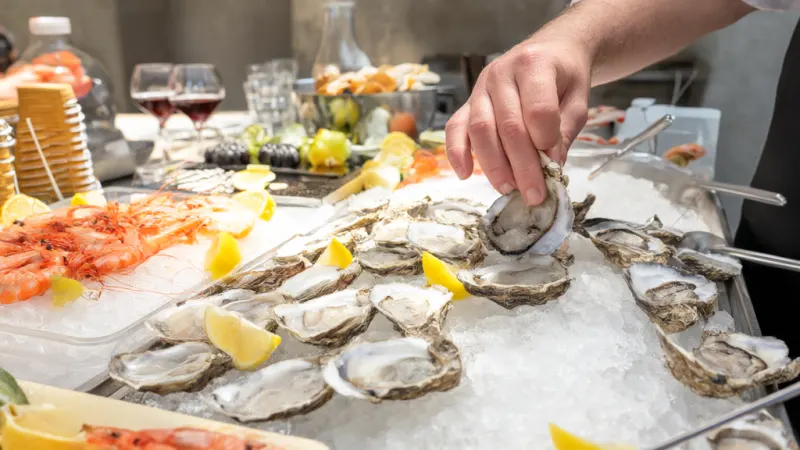
The raw seafood station is the one guests drift towards with a glass in hand: oysters opened to order, tartares, carpaccios, red prawns. It's also the one with the most rules. Before choosing it, it helps to know what the law requires and what to ask the caterer.
What goes on a raw seafood station
| Product | How it's served | Main rule |
|---|---|---|
| Oysters | Opened to order, on ice, with lemon | Live bivalve molluscs: health label, alive when served |
| Other raw bivalves (warty venus, smooth clams) | Like oysters | Same rules as live bivalves |
| Fish tartares and carpaccios | Prepared on the day, portioned | Fish frozen before preparation |
| Red prawns, raw langoustines | Peeled or whole | Fishery products eaten raw: freezing required |
| Marinated fish (anchovies, salmon) | Marinated with citrus or vinegar | Marinating does not replace freezing |
Next to the raw seafood there is often bread, butter, sauces and a few cooked items for those who don't eat raw.
The rules on raw fish
Freezing
EC Regulation 853/2004 (Annex III, Section VIII) requires fishery products to be eaten raw to be frozen to kill any live parasites. With the amendments of EU Regulation 1276/2011 there are two options:
- at least -20 °C for at least 24 hours in every part of the product;
- or at least -35 °C for at least 15 hours in every part of the product.
The most familiar parasite is Anisakis. Marinating in lemon or vinegar doesn't kill it: marinated anchovies and carpaccios must also be made with fish that has already been treated. The regulation allows some exceptions for farmed products or products from specific areas: this is a matter for the caterer and their suppliers, who should be able to explain it.
Frozen does not mean fresh. It's a safety treatment. Freshness, origin and quality are separate questions.
Live bivalve molluscs
Oysters fall under another part of the same regulation (Annex III, Section VII), on live bivalve molluscs. The main points:
- they must come from an approved dispatch centre, with the establishment's identification mark;
- each pack has a label showing the packing date;
- the regulation requires the label to be kept for at least 60 days after the pack is opened, so the harvesting area can be traced if there are problems;
- at service, oysters must be alive: shell closed, or closing when tapped.
The rules are summarised here in general terms. For the details, the text of the regulation on EUR-Lex prevails, and for specific cases, the local health authority (ASL).
The cold chain at the event
A raw seafood station in July in a garden in the Castelli, or on a terrace in Pigneto, is the hardest test for a caterer. What's needed:
- a refrigerated counter or tubs of crushed ice, renewed during service;
- a shaded position, away from the fryer and the griddle of the other stations;
- small top-ups from the back area, where the fish stays refrigerated;
- a short display time for each tray;
- food-grade ice, not the ice from the wine buckets.
Oysters are opened to order. An experienced shucker works in front of the guests, and this slows service down: with many guests you need more than one person. For the other conditions of a summer event, read the guide to catering for outdoor events.
How many oysters and how much raw seafood
There is no official source on quantities. The approximate calculation depends on:
- how many other stations there are: if there's sushi too, guests are split between them;
- how many guests eat raw seafood: not everyone does;
- the length of the aperitivo.
Oysters are counted by the piece, the rest by the portion. Ask the caterer for a written estimate and a price per piece or per portion. That way you can compare different quotes. For quantities in general, see the guide on how much food per person.
Fish from the Lazio coast
Lazio has a long coastline, from Civitavecchia to Gaeta, and Tyrrhenian fish is a natural choice. Some ideas for the station:
- marinated anchovies, made with frozen fish;
- carpaccio of the day's fish, depending on the catch;
- red prawns and langoustines;
- oysters farmed in Italy or France, depending on the supplier.
Ask the caterer where the fish comes from and whether they can show it on the labels. Origin is useful information for guests too.
Guests who don't eat raw seafood
Some guests don't eat raw fish by choice or for health reasons. Health authorities advise caution for certain people: pregnant women, young children, the elderly, people with weakened immune systems. In particular, they advise against raw fish and raw shellfish during pregnancy. For personal advice, ask your own doctor.
That's why the raw station shouldn't be the only seafood station. Alongside it, plan:
- some cooked items: seared prawns, octopus, salt cod;
- a fried food station, such as the Roman fried food station, or a cheese station;
- clear labels that distinguish raw from cooked.
Allergens
Fish, crustaceans and molluscs are three of the 14 allergens in EU Regulation 1169/2011. A raw seafood station almost always has all three. Ask for:
- a label for each product, with its allergens;
- the menu's allergen matrix;
- separate utensils if a guest has a severe allergy.
Questions to ask the caterer
- How do you freeze raw fish? With what equipment and for how long?
- Which supplier do the fish and oysters come from, and when?
- Do the oysters come from a dispatch centre with a health label? Do you keep the labels?
- Who opens the oysters? How many people are at the station?
- Does the station have a refrigerated counter or ice? How long is a tray on display?
- Where would you put it at our venue?
- Which cooked items do you offer for those who don't eat raw?
- How do you show allergens?
- Is the price per person, per piece or per station?
To finish
A raw seafood station should be chosen with a caterer who can answer questions on safety, not just on presentation and produce. To see how it fits with the other stations, there's the guide to buffet food stations. For caterers who work at weddings, see the wedding catering section, then request a quote with the questions on this page.
Sources
- Regulation (EC) No 853/2004, Annex III, Sections VII and VIII, EUR-Lex: https://eur-lex.europa.eu/legal-content/IT/TXT/?uri=CELEX:32004R0853
- Regulation (EU) No 1276/2011 (treatment to kill viable parasites), EUR-Lex: https://eur-lex.europa.eu/legal-content/IT/TXT/?uri=CELEX:32011R1276
- Regulation (EU) No 1169/2011, EUR-Lex: https://eur-lex.europa.eu/legal-content/IT/TXT/?uri=CELEX:32011R1169