In short
- A food truck works in gardens, courtyards, car parks and farmhouses, less well in the historic centre.
- Before booking, check space, access, power and the venue's rules.
- Permits depend on where the vehicle parks: ask the operator and, if needed, the city council.
- Speed of service matters: how many people it serves in an hour.
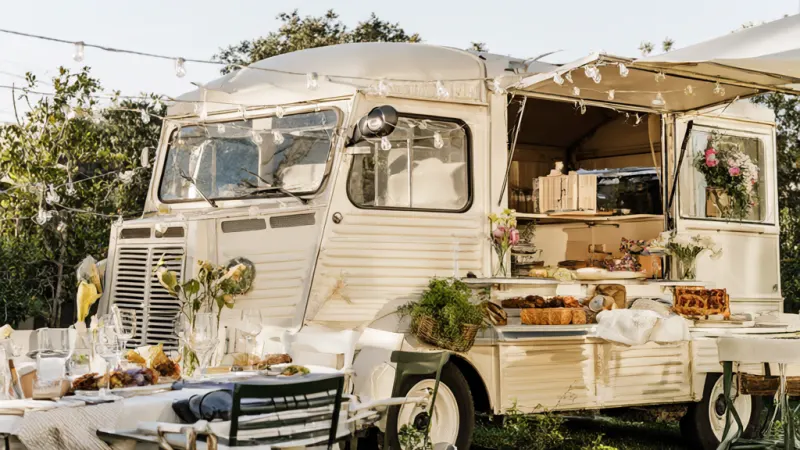
A food truck brings the logic of street food to an event: a kitchen on wheels that arrives, opens its hatch and serves. In Rome you see them at graduation parties in gardens, at weddings in farmhouses in the Agro Romano (the countryside around the city), at corporate events in campus car parks at EUR or along the Via Tiburtina. Here is what to check before booking one.
When a food truck makes sense
| Event | How to use it |
|---|---|
| Private party in a garden | Main format, with a short menu |
| Wedding in a farmhouse or villa | After dinner, or as a second aperitivo station |
| Corporate event | Informal lunch, family day, summer party |
| Graduation party or 18th | Sandwiches, fried food, desserts, with music |
| Launch | An attraction in front of the premises, if the space is private |
A food truck brings movement and an informal atmosphere. It does not replace a served dinner for seated guests, but it complements one.
What you eat
The menus of food trucks working in Rome range from Roman street food to food from other regions and other countries:
- rolls with porchetta di Ariccia, which has PGI status;
- supplì (fried rice balls) and seasonal fried food;
- pizza in trays or fried;
- pizza pockets filled with traditional dishes;
- burgers, piadine, arrosticini (lamb skewers), tacos, poke and Asian food;
- ice cream, crêpes, maritozzi for the sweet side.
The ideal menu is short: three or four savoury options and one sweet. A long menu slows down the queue. If you want Roman recipes to take to the street, read the guide to Roman street food for events.
Space, access and power
A food truck is a vehicle, not a table. Before signing, ask the operator:
| Check | Why |
|---|---|
| Vehicle size and weight | Gates, paths, wet lawns, ramps |
| Manoeuvring space | It must get in and out, even at night |
| Surface | A lawn after rain can trap the vehicle |
| Power | A hook-up or a generator is needed; generators are noisy |
| Water | Some vehicles are self-sufficient, others are not |
| Distance from guests | Fumes and smells: the vehicle should be downwind |
In historic villas and listed gardens the venue may not accept motor vehicles on the lawn. Ask first.
Permits and rules: what to check
The rules on food trucks in Italy are those for trading in public areas, with authorisations issued by city councils, and they vary between regions and municipalities. A few things are generally true:
- private event on private land with no public access: the operator usually works as a supplier to the event, but the exact rules depend on the case;
- event on public land (street, square, park): authorisations and permits to occupy public land are needed;
- event open to the public, even on private land: notifications or authorisations for temporary events may be needed.
The food truck operator must have its own authorisations and the vehicle's health registration, with HACCP procedures. For your event, ask the operator what is needed and, if in doubt, check with the relevant Municipio or Roma Capitale's one-stop business office (Sportello unico attività produttive, SUAP). We cannot give you an answer that holds for every case.
Historic centre and ZTL
Taking a food truck into the centre is difficult. There are the ZTL (limited traffic zones), narrow streets, restrictions on heavy vehicles, cobblestones and loading and unloading hours. If the event is in a palazzo in the Monti district or on a terrace in Trastevere, consider a dismountable counter or a street food caterer without a vehicle. The rules on ZTL and permits are on the Roma Mobilità website. For logistics in the centre, read the guide to catering in the historic centre.
How much to order and how you pay
There is no official table. The most common arrangements are:
| Arrangement | How it works | Watch out for |
|---|---|---|
| Flat rate per person | Fixed price for a number of guests and hours | Minimum number of guests |
| Package by item | You pay for a number of rolls or portions | What happens if they run out |
| By consumption | You pay for what is served | Hard to predict the total |
| Call-out fee + consumption | Travel cost plus consumption | Ask for the estimated total |
As an indicative starting point for a food truck that replaces a meal, allow at least one main savoury portion and one dessert per person, with a little more for teenagers and long evenings. Ask the operator how many people they serve in an hour: that figure tells you whether there will be a queue.
The quote should also say whether plates, cutlery, napkins and rubbish collection are included. Ask too whether the call-out fee changes for events outside the Grande Raccordo Anulare (the ring road), in the Castelli or on the coast.
Food truck and caterer together
At a wedding or a corporate event, the food truck often works alongside a caterer. In this case:
- ask the venue whether it accepts outside suppliers;
- coordinate times and menus so the dishes do not overlap;
- make clear who handles drinks, tables and cleaning.
Plan B for rain
The food truck works outdoors, and so do the guests. In the rain, the queue at the hatch becomes the first problem. Before the event:
- plan a gazebo or canopy in front of the hatch;
- ask the operator whether the vehicle has its own awning;
- check that the ground will bear the vehicle even when wet, or choose a tarmac area;
- agree what happens if the event is moved or cancelled because of bad weather, and put it in the contract.
In April and October the Roman weather changes quickly: the plan B should be written down even if the forecast is good. You will find more points in the guide to catering for outdoor events.
Questions to ask the food truck operator
- What authorisations do you have? Does the vehicle have health registration?
- Are permits needed for my event and my location? Who applies for them?
- What are the vehicle's dimensions? Does it need any particular access?
- How much power do you need? Do you bring a generator, and how noisy is it?
- How many people do you serve in an hour with this menu?
- Do you have vegetarian, pork-free and gluten-free options?
- What is included: plates, cutlery, napkins, rubbish?
- What happens if it rains?
- Do you have public liability insurance?
Before you ask for a quote
Have ready the exact address, the type of space and the number of guests. You can find suppliers for informal parties in the private party caterers section and, for companies, under corporate catering. When you have everything, request a quote.
Sources
- Ravenna Chamber of Commerce, "Street food / truck food" information sheet (national overview): https://ra.camcom.gov.it/attivita-promozionali/sportello-genesi-nuove-imprese-1/schede-informative-sulle-procedure-di-avvio-attivita/street-food-truck-food
- Roma Mobilità, ZTL and permits: https://romamobilita.it/it/servizi/ztl