In short
- An opening is a standing event with guests coming and going: people arrive and leave at different times.
- The hard part is estimating how many people will come through: separate confirmed guests from passers-by.
- Shops and showrooms have tight spaces and no kitchen: you need finger food that arrives ready or is finished on site.
- Counters or tables on the pavement normally require a public land concession: check with Roma Capitale.
You are opening a shop in Monti, an office at EUR, a showroom in Prati. The opening is the first moment when customers, neighbours, partners and press step into your space. The caterer has to welcome them without taking over the scene: the star is the space itself. Here is how to choose the format, the quantities and the supplier.
What kind of opening is it
Not all openings are alike. Before asking for quotes, decide which one you are organising.
| Type | Who comes | Typical format | Note |
|---|---|---|---|
| High-street shop | Customers, neighbours, passers-by | Standing aperitivo, passed trays | Continuous flow, uncertain numbers |
| Office or company premises | Employees, clients, partners | Aperitivo or cocktail with a speech | Confirmed guests |
| Showroom, gallery, studio | Clients, press, selected guests | Carefully made finger food, sparkling wine | The food must not mark the goods |
| Restaurant or bar | Friends, customers, press | Tastings of its own cooking | Often without an outside caterer |
The aperitivo is the Italian early-evening drink served with small bites, a natural fit for an opening.
The format: standing and on the move
At an opening people stand, walk around the space and look. The catering has to follow that movement.
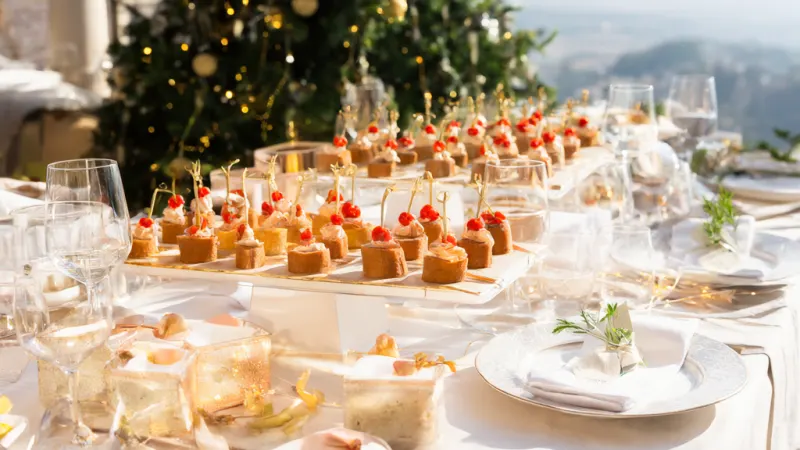
- Trays passed by waiters. The food goes to the people, not the other way round. Keep the display space clear.
- A counter for drinks. Ideally in a spot that does not block the entrance.
- Clean bites. No sauces dripping onto clothes or goods. In a fabric or furniture showroom this is a rule.
- Restocking in waves. The caterer has to keep coming out with new trays for the whole event, not serve everything in the first half hour.
For ideas on formats and seasons, read the guide to finger food ideas for events.
How many people and how much food
This is the hardest question. With free entry you do not know how many people will come in.
A practical method:
- Count the confirmed guests (clients, partners, press).
- Estimate the passing public based on the area and the time. A shopping street in the centre on a Saturday afternoon is not a side street in a residential area on a Tuesday evening.
- Agree a reserve stock with the caterer and a cost for extra top-ups, rather than ordering for the maximum number.
- Spread the service over time. Whoever arrives in the last hour should still find something.
Guideline quantities for a standing aperitivo of a couple of hours:
| Item | Guideline per guest |
|---|---|
| Savoury finger food | 6-10 pieces if the event is before dinner and does not replace it |
| Sweets | 1-2 pieces, optional |
| Drinks | 2-3 glasses, with proper alcohol-free options |
| Water | Always available |
Indicative: it depends on duration, time of day, type of guests and how long each guest stays on average. Someone who drops in for ten minutes eats less than a guest who stays all evening.
The guide on how much buffet food to serve per person goes into the calculations in detail.
The menu: finger food and a taste of Rome
The menu for an opening follows the style of the space or the brand: Mediterranean finger food, raw fish, sushi, international cuisine. If you also want to say where you are, here are a few Roman ideas in bite-size form:
- Pizza bianca (Roman white pizza) with mortadella, or with figs in summer
- Mini supplì (fried rice balls with a mozzarella centre), served hot in a napkin
- Miniature carciofi alla giudia (Jewish-style fried artichokes), in spring
- Courgette flowers with mozzarella and anchovy, in summer
- Pecorino romano with honey or with fresh broad beans, as in the 1 May tradition
- Mini maritozzi (cream-filled sweet buns) or ciambelline al vino (wine biscuits) for dessert
Roman street food works very well at openings of shops and informal venues: you will find ideas in the guide to Roman street food for events.
Tight spaces, no kitchen
Shops, offices and showrooms almost never have a kitchen. The caterer has to arrive with food that is ready or to be finished on site.
- Back-of-house space: a back room, a storeroom, a room where the caterer can prepare trays out of sight.
- Power: keeping things hot or cold needs sockets. Ask the caterer what it brings and how much power it draws.
- Water: if there is no sink, you need water containers and a plan for dirty glasses.
- Rubbish: who takes it away at the end of the evening?
Rome: ZTL and public land
Two Roman rules to check with official sources.
ZTL. If the shop is in the historic centre, in Trastevere or in other limited traffic zones (ZTL), the caterer has to respect the hours and permits of Roma Capitale's ZTL and goods ZTL. Check the current hours on the Roma Mobilità website and ask the caterer how it handles loading and unloading.
Public land. A counter, small tables or a gazebo on the pavement in front of the shop normally count as occupying public land, which in Rome requires a concession. Check the requirements, timings and costs on the Roma Capitale website or at your Municipio, well in advance.
If you are thinking of live or background music, also check what is needed for copyright and for the area's limits on hours and noise.
Drinks
- Sparkling wine for the toast when the ribbon is cut.
- A white and a red from Lazio, or a simple cocktail that can be made in batches.
- Alcohol-free: fresh juices, flavoured water, a house alcohol-free drink.
- Glasses: glass if someone collects and washes them, compostable if space is minimal.
Ask whether the caterer also serves alcohol and on what terms: the rules on serving drinks change depending on the type of event, and it is worth checking beforehand.
Prices
Openings are priced by quote. As an order of magnitude, industry estimates give national averages of €15-20 per person for an aperitivo and €20-25 for a cocktail reception. In Rome the price changes with the area, the duration and the staff.
Items to ask for separately: food, drinks, staff (how many waiters and for how many hours), glasses and hire items, transport and ZTL access, VAT. Also ask the cost of an extra top-up if there are more guests than expected.
Questions to ask the caterer
- Which format do you suggest for a space of this size?
- How many waiters will pass trays, and for how many hours?
- How do you handle more guests than expected? How much does a top-up cost?
- What do you need in the space: power, water, a back room to prepare in?
- Do you bring glasses and napkins? Do you take everything away at the end?
- How do you manage access if the shop is in a ZTL?
- Is the finger food suitable for a space with goods on display?
- Do you have vegetarian and gluten-free options? Do you label allergens?
- Do you serve alcoholic drinks too?
- Is the price inclusive of VAT? Do you issue electronic invoices?
In closing
An opening succeeds when people remember the place and come back. The caterer has to go with the flow of guests, not block it. You will find suppliers in the corporate catering section and in the one dedicated to finger food. Once you have a date, a time and an estimate of guests, request a quote from two or three caterers.
Sources
- Regulation (EU) No 1169/2011, EUR-Lex: https://eur-lex.europa.eu/legal-content/IT/TXT/?uri=CELEX:32011R1169
- Roma Mobilità, ZTL section: https://romamobilita.it/it/servizi/ztl
- Roma Capitale, official website (occupation of public land): https://www.comune.roma.it