In short
- A live pasta station is where guests stop to watch: put it where the queue won't get in the way.
- The most requested in Rome are Roman pasta dishes (cacio e pepe in the wheel, amatriciana, gricia, carbonara), but risottos, seafood pasta and fresh pasta work too.
- You need power, water, space and at least one cook with a helper.
- Ask whether the pasta is cooked to order or pre-cooked, and how you handle gluten-free.
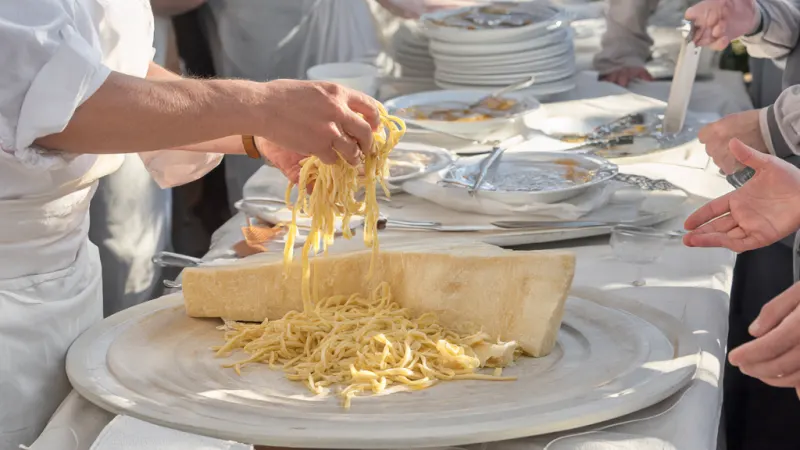
A cook tossing tonnarelli inside a wheel of pecorino is the scene that fills the guests' phones. A live pasta station brings to a wedding or a corporate dinner a dish cooked in front of the guests, whether cacio e pepe, a risotto or a seafood pasta. To do it well you need the right equipment and precise timing.
What's cooked at the station
| Pasta dish | Basic ingredients | Note |
|---|---|---|
| Cacio e pepe in the wheel | Pasta, pecorino romano, pepper | Tossed in the hollowed-out wheel. Spaghetti or tonnarelli. |
| Amatriciana | Guanciale, tomato, pecorino | Amatriciana tradizionale is a Traditional Speciality Guaranteed (TSG, STG in Italian), EU Reg. 2020/395. |
| Gricia | Guanciale, pecorino, pepper | The "white amatriciana", without tomato. |
| Carbonara | Guanciale, eggs, pecorino, pepper | Must be finished to order: the eggs mustn't overcook. |
| Risotto in the wheel | Rice, parmigiano or grana, stock | The same scene as cacio e pepe, with a wheel of aged cheese. |
| Seafood pasta | Paccheri, linguine or fregola with fish or shellfish | For a seafood menu; the fish must stay in the cold chain until cooking. |
| Seasonal pasta | Artichokes in spring, courgettes and flowers in summer, mushrooms in autumn | A good meat-free alternative. |
Cacio e pepe in the wheel is the most requested. Pecorino romano DOP is the traditional cheese. Ask the caterer what happens to the wheel at the end of the evening: usually a shell of cheese is left that isn't served.
Amatriciana tradizionale has a European specification as a TSG, which sets out ingredients and method. If the caterer presents it under this label, they must follow it. Otherwise it's simply "amatriciana".
If the rest of the menu is Roman cooking, read the guide to the Roman cuisine catering menu.
Cooked to order or finished to order
There are two ways to run a pasta station:
- Cooked to order. Water boils at the station, the pasta is cooked and dressed in batches. It stays al dente, but each batch takes a few minutes.
- Finished to order. The pasta is pre-cooked in the kitchen and the cook tosses it in the pan with the sauce. It's faster and handles more guests, but the pasta is less al dente.
There's no right way for everyone. With 60 guests, cooking to order works well. With 200 you need more than one station or the finishing method. Ask the caterer which model they use and how many portions per batch.
Equipment and venue
A pasta station is a small kitchen. You need:
- induction plates or gas burners;
- large pots and water for cooking, with somewhere to drain it;
- pans and utensils for tossing;
- a work surface and one for plates and small bowls;
- dedicated power, if induction is used.
Many historic venues don't allow gas cylinders in their halls. In a villa on the Via Appia Antica or a farmhouse in the Castelli, the station often goes under a portico or a gazebo. On a terrace in the centre, the weight of the equipment and lift access matter. Also read the guide to catering in the historic centre.
Timing, queues and portions
A pasta station creates a queue for two reasons: guests stop to watch, and pasta takes time. To avoid a bottleneck:
- place it away from the bar and the entrance;
- open the station halfway through the aperitivo, once guests have spread out;
- serve mini portions in small bowls or cups, not full plates;
- if there are many guests, two stations or two different pasta dishes.
Cooked food to be eaten hot must be kept at temperature. Presidential Decree 327/1980 (Article 31) sets +60 to +65 °C for cooked foods to be eaten hot. At the station the pasta is eaten straight away, but if it's prepared in advance this rule matters. Check the current text on Normattiva.
How many portions? There's no official figure. As a practical guide, at an apericena (an aperitivo that replaces dinner) almost every guest takes one, and some come back. If the station is part of an aperitivo before a served dinner, many skip it. For grams per person of pasta, read the guide on how much food per person.
Staff
At least one cook and one helper: the first cooks and tosses, the second portions, serves and keeps things clean. With more guests or more dishes, a second cook is needed. The station cook is also a performer: they explain the dish, answer questions, pose for photos. Ask whether they are a cook from the caterer's kitchen or someone dedicated to shows.
Seasons and variations
The station doesn't have to be Roman pasta. Some ideas by season:
- spring: pasta with Romanesco artichokes, pasta and peas, vignarola (spring vegetable stew);
- summer: pasta with courgettes and courgette flowers, cherry tomatoes, basil;
- autumn: porcini mushrooms, pumpkin, sausage;
- winter: Romanesco broccoli, pasta e ceci, cacio e pepe.
A second pot with a vegetable pasta keeps vegetarians and those who don't eat pork happy.
Gluten-free and allergens
Pasta contains gluten, pecorino milk, carbonara eggs. They are among the 14 allergens in EU Regulation 1169/2011. For coeliac guests, gluten-free pasta must be cooked in separate water, with dedicated utensils, and served in recognisable bowls. Read the guide to gluten-free catering for the questions to ask.
Questions to ask the caterer
- Is the pasta cooked to order or pre-cooked and finished in the pan?
- How many pasta dishes do you offer, and how many portions per batch?
- How much power is needed? Do you use gas?
- How much space does the station need?
- How many people work at it?
- Is the pecorino wheel included? Is it pecorino romano DOP?
- How do you serve: small bowls, cups or plates?
- How do you prepare gluten-free pasta?
- Do you have a vegetable pasta?
- What time do you suggest opening the station?
To finish
A live pasta station works if the pasta arrives hot, the queue moves and the equipment suits the venue. To see how it fits with the other stations, read the guide to buffet food stations. For a standing dinner with colleagues, there's the corporate catering section. Once you know guest numbers and venue, request a quote with the station as a separate item.
Sources
- Implementing Regulation (EU) 2020/395 (Amatriciana Tradizionale TSG), ARSIAL: https://www.arsial.it/app/uploads/Reg_2020_395_STG-AmatricianaTradizionale.pdf
- Pecorino Romano DOP product specification, Consorzio di tutela: https://www.pecorinoromano.com
- Presidential Decree No 327/1980, Normattiva: https://www.normattiva.it
- Regulation (EU) No 1169/2011, EUR-Lex: https://eur-lex.europa.eu/legal-content/IT/TXT/?uri=CELEX:32011R1169