In short
- A good menu is built on three questions: who the guests are, how they eat (seated or standing), and the season.
- Every course should have a proper vegetarian alternative, not a side dish.
- In the Roman heat, the buffet needs small platters, shade and frequent top-ups.
- The most common mistake is too much variety: better a few dishes, repeated and done well.
Choosing what to feed your guests seems easy until you have to please a hundred different people. The good news: the mistakes are almost always the same, and a few simple rules avoid them. Here are practical tips, with a Roman touch, so you arrive at the caterer with clear ideas.
Start from the guests, not the dishes
Before choosing a dish, consider who is coming:
- age: children, teenagers and grandparents have different needs;
- where they are from: international guests usually enjoy the most familiar Italian dishes, such as pasta, pizza or a carbonara, and are less keen on offal and very strong flavours;
- habits: vegetarians, vegans, people who do not eat pork for religious reasons;
- allergies and coeliac disease: these should be collected with the RSVPs.
With this list in hand, the menu almost writes itself. For diets there is the guide to special diets.
The balance between meat, fish and vegetables
There is no official percentage. There are, however, three useful principles.
- One course, two routes. For each stage of the menu, at least one option with meat or fish and one substantial vegetarian option. A single-portion parmigiana is a dish; a grilled courgette is a side.
- Not everything on one ingredient. A menu entirely of raw fish leaves out anyone who is pregnant or does not like raw food. A menu full of cured meats, guanciale and porchetta leaves out anyone who does not eat pork.
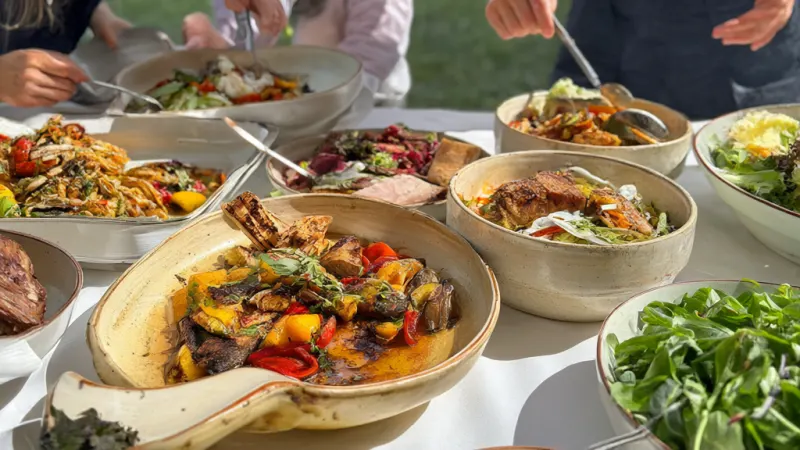
- Seasonal vegetables act as a bridge. Artichokes in spring, Roman courgettes in summer, Romanesco broccoli and puntarelle (a Roman chicory) in winter appeal to almost everyone and lighten the menu.
Dishes that hold up at a buffet
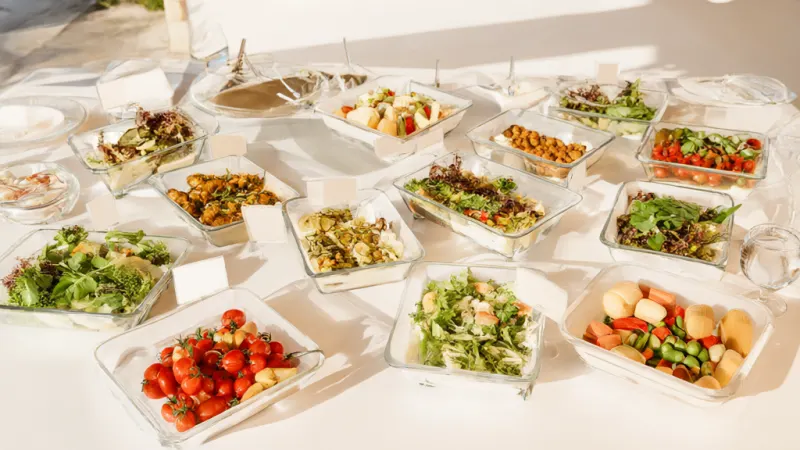
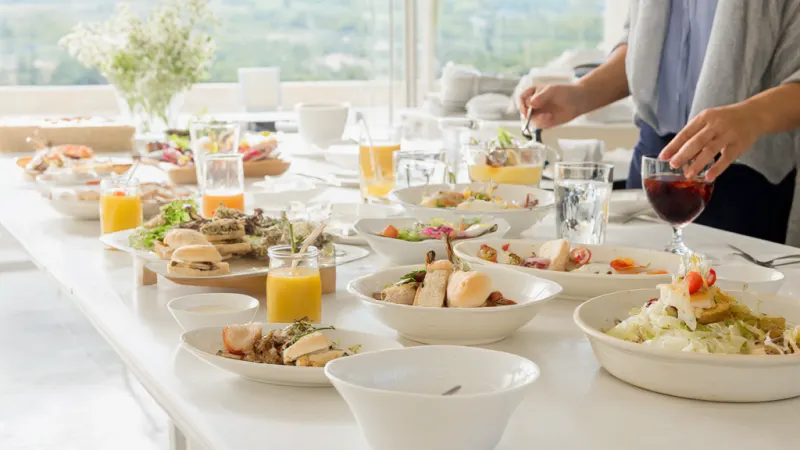
At a buffet the food waits for the guest, sometimes for half an hour. Some dishes hold up, others do not.
| Hold up well | Serve immediately or make on site |
|---|---|
| Roast or grilled vegetables, carciofi alla romana | Fried food: tempura, supplì, courgette flowers, croquettes |
| Spelt, rice and pulse salads | Pasta tossed to order: cacio e pepe, carbonara, seafood pasta |
| Savoury tarts, frittatas, parmigiana | Risottos |
| Sliced roasts, roast beef, porchetta | Rare meat, grilled fish, sushi and raw fish |
| Tarts, ciambelline, biscuits | Ice cream, semifreddo, whipped cream |
If you want a dish from the second column, ask for a live station (a cook preparing it to order) or tray service. Stations where first courses are finished in front of guests, from risotto to cacio e pepe, are common at receptions for exactly this reason.
The Roman heat
From June to September in Rome, heat is the real issue for an outdoor menu. International food safety guidelines identify a danger zone of roughly 4 to 60 °C, in which bacteria multiply, and advise not leaving perishable food out of the fridge for more than two hours, or one hour above 32 °C. It is a useful reference in Italy too, where hygiene rules follow Reg. (EC) 852/2004 and the caterer's HACCP plan.
In practice:
- small platters and frequent top-ups rather than a buffet piled high at the start;
- no creams, mayonnaise or whipped cream in the sun;
- raw dishes on ice and in the shade, or served from trays;
- plenty of cool water, more than you think.
On shade, timings and the plan B, see the guide to catering outdoor events.
Foods to avoid when eating standing up
At an aperitivo or apericena (an aperitivo generous enough to replace dinner), the guest has a glass in one hand and no table. Avoid:
- meat on the bone: ribs, abbacchio scottadito (lamb chops) not boned;
- spaghetti and long pasta: better rigatoni, mezze maniche, cut paccheri;
- runny sauces that drip onto formal clothes;
- flaky pastry that crumbles;
- pieces that are too big, which do not fit in one bite and cannot be put down.
The rule: everything must be eaten with one hand or a fork, never with a knife. You will find concrete ideas in the guide to finger food ideas for events.
The season: the simplest choice
A seasonal menu is fresher and usually cheaper. In Rome the calendar is rich:
- spring: the Roman artichoke (at its peak in March and April, according to Turismo Roma), broad beans, peas, abbacchio (milk-fed lamb);
- summer: Roman courgettes, courgette flowers, tomatoes, aubergines, fish from the coast;
- autumn: mushrooms, chestnuts, grapes, figs, new olive oil at the end of the season;
- winter: Romanesco broccoli, puntarelle, chicory, pulses.
The month-by-month calendar is in the guide to the seasonal menu in Rome.
Allergens: a legal requirement
Reg. (EU) 1169/2011 requires anyone serving food to provide information on the 14 allergens even for unpackaged dishes. For you this means:
- asking the caterer for the menu's allergen matrix;
- insisting on labels at the buffet;
- for severe allergies and coeliac disease, a dedicated dish served at the guest's seat, not self-service.
The most common mistakes
- Too much variety. Fifteen kinds of finger food with one piece each create queues. Better six kinds, repeated.
- Everything fried. At an aperitivo fried food is always popular, but after the third piece it palls. Alternate with raw dishes and vegetables.
- Underestimating the time of day. After 19:00 guests are hungry: an evening aperitivo with no dinner afterwards has to be a meal.
- Forgetting those who do not eat pork. Cured meats, guanciale, porchetta and lard go into many dishes without being visible: ask the caterer for an alternative for every course.
- Divisive dishes as the only choice. Coda alla vaccinara (oxtail stew) and tripe should be offered as a taste, not as a main course for everyone.
- No alternative for children. A simple menu for the youngest avoids plates sent back full. There is a guide to the children's menu.
- Too little water. In summer it runs out before the wine.
Questions to ask the caterer
- Which dishes on the menu hold up at the buffet and which should be served straight away?
- Are there live stations? Do they need power or gas at the venue?
- How do you keep raw dishes and desserts cold in the heat?
- What is the vegetarian alternative for each course?
- Which dishes contain pork, alcohol or nuts?
- Will you give me the allergen matrix and labels for the buffet?
- How often do you restock the buffet?
- Does the menu change if the event moves to another season?
To close
A menu that works starts from the guests, the season and the way people eat. Explore the city's caterers in the catering section and, once your ideas are clear, request a quote, stating guests, format and special diets from the outset.
Sources
- Regulation (EC) No 852/2004, EUR-Lex: https://eur-lex.europa.eu/legal-content/IT/TXT/?uri=CELEX:32004R0852
- Regulation (EU) No 1169/2011, EUR-Lex: https://eur-lex.europa.eu/legal-content/IT/TXT/?uri=CELEX:32011R1169
- Turismo Roma, "I prodotti della campagna romana: le verdure romanesche protagoniste in cucina": https://turismoroma.it/it/node/127323