In short
- At a wedding, sushi is almost always served at the aperitivo, as one of the food stations, sometimes as a midnight snack.
- A station (ready pieces, topped up) and show cooking (cook in view) can be combined.
- Always plan cooked and plant-based pieces for those who don't eat raw fish, clearly labelled.
- In a Roman summer, the point to check is the cold chain outdoors.
The sushi station has joined Roman wedding drinks receptions alongside fried food, raw seafood and cheeses. Couples choose it because it's light, colourful and popular with many guests under forty. To make it work at a wedding you need three decisions: when to serve it, in what format and for whom.
For the rules on raw fish and formats in general, there's already the guide to sushi catering for events. Here we focus on weddings.
When to serve sushi during the day
| Moment | How it works | Pros | Watch out for |
|---|---|---|---|
| Welcome drinks | One of the stations, next to cheeses, fried food, bar | Light, doesn't spoil appetites before dinner | Queue at the station in the first few minutes |
| Dinner | A course or a served starter | Every guest gets their own plate | Not everyone eats raw fish |
| Midnight snack | A station after the cake cutting | A surprise for those dancing | The cook stays late, at extra cost |
The aperitivo is the most common moment. Sushi is fresh, eaten in one bite and doesn't take away the appetite for dinner. For organising the drinks reception as a whole, read the guide to the wedding aperitivo.
Station, show or both
The station
Pieces prepared shortly beforehand and topped up in small amounts. A member of staff tidies and explains. It's the format that serves the most guests in the least time.
Show cooking
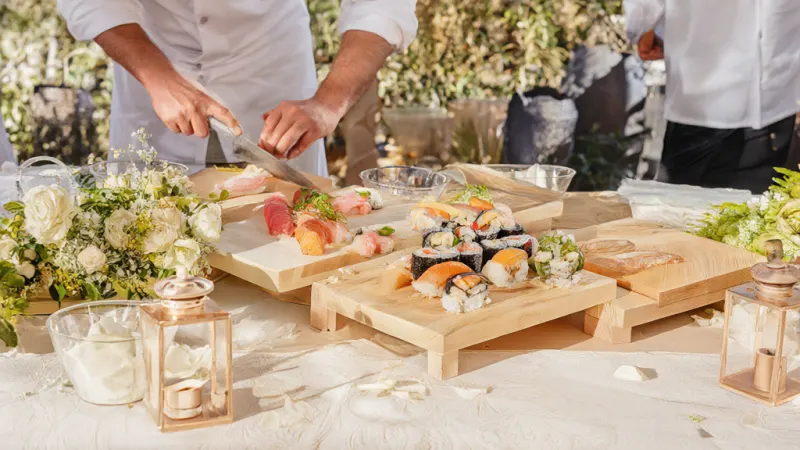
One or more cooks prepare in view: fish sliced to order, rice shaped by hand, temaki rolled in front of the guest. It's the part guests photograph. It's also the slowest: each piece takes time.
The combination
With 100 guests or more, the most common solution is mixed: a counter with ready pieces for those who want to grab and go, and a cook preparing something special in view, such as sashimi sliced to order or temaki. That way the queue splits.
Ask the caterer how many pieces they can serve in an hour with the planned staff. That figure tells you whether the station can cope with your number of guests.
What to put on the station
A short selection works better than a long menu:
- nigiri with salmon, tuna, sea bass or amberjack, depending on the catch;
- uramaki with raw fish and with cooked ingredients;
- sashimi, if there's a cook slicing to order;
- plant-based pieces: cucumber, avocado, vegetable tempura;
- cooked pieces: cooked prawns, eel, Japanese omelette.
The Tyrrhenian Sea off Lazio offers seasonal fish. Ask the caterer whether they can use local fish alongside salmon and tuna, and where it comes from.
Guests who don't eat raw sushi
Some guests don't eat raw fish. Some by taste, others for health reasons: for example, health authorities in several countries advise pregnant women to avoid it. Young children and the elderly often avoid it too. So:
- the sushi station shouldn't be the only seafood station;
- you need cooked and plant-based pieces, kept well apart;
- the labels must clearly say raw or cooked, and show allergens.
For food safety in detail, including pregnancy, read the guide on sushi and food safety.
Heat, space and venue
A June wedding in a villa in the Castelli Romani or an estate near Lake Bracciano puts sushi to the test. Raw fish must stay cold until it's served.
What's needed:
- a refrigerated counter or trays on ice;
- shade, under a gazebo or a portico;
- distance from the fryer and the griddle of the other stations;
- a back area with a fridge for the fish;
- water for washing hands and utensils;
- power for the refrigerated counter and lights.
In a historic hall or on a terrace, space is the limit. Ask the caterer for the station's minimum dimensions and check them with the venue.
Timing and the day's organisation
Sushi is made on the day. A few practical points:
- the rice is cooked and seasoned the same day;
- the fish arrives already blast-frozen and stays in the fridge until preparation;
- the station is set up before the guests arrive, but the fish only comes out when it opens;
- if sushi is also served at midnight, the cook stays on duty all evening: ask how the cost of extra hours is calculated.
For costs in general, there's the guide to how much sushi catering costs.
Sushi alongside the other stations
A wedding aperitivo with sushi works well when every guest finds something for them, whether the rest of the menu is seafood, Italian or Roman. An example combination:
- sushi station with a cook in view;
- fried food station, for example supplì, courgette flowers or tempura;
- Lazio cheese and cured meat station;
- bar with bubbles and alcohol-free drinks.
To choose and arrange the stations, read the guide to buffet food stations.
Questions to ask the caterer
- Is the sushi made by specialist cooks? How many, and for how many hours?
- How many pieces can you serve in an hour?
- Station, show or both? What is prepared in view?
- How do you freeze the fish and which supplier does it come from?
- Does the station have a refrigerated counter? How long is a piece on display?
- Which cooked and plant-based pieces do you offer?
- Do you have gluten-free soy sauce?
- How do you show allergens and raw or cooked on the labels?
- Is the price per person, per piece or per station?
- How much does the cook cost if they stay until midnight?
To finish
A wedding sushi station works if it's one choice among others, if it can cope with the number of guests and if the fish stays cold. You can compare who offers this service in the sushi catering section, then request a quote giving guest numbers, the moment of the day and the venue.
Sources
- Regulation (EC) No 853/2004, Annex III, Section VIII, EUR-Lex: https://eur-lex.europa.eu/legal-content/IT/TXT/?uri=CELEX:32004R0853