In short
- For an office lunch or a meeting: delivered boxes or platters, with no staff.
- For a cocktail party, an opening or a company party: one or more live sushi chefs.
- In both cases the critical point is the cold chain: a fridge at the office, delivery close to service.
- Ask for allergens for every box, cooked and vegetable pieces, and an invoice that is clear about VAT.
Sushi has made its way into working lunches and corporate events in Rome because it is light, quick to eat and liked by people of different ages. But a platter for a meeting in EUR and a live chef for an end-of-year cocktail party are two different services, with different costs, logistics and rules.
Two formats, two kinds of event
| Boxes and platters | Live chef | |
|---|---|---|
| Typical events | Working lunch, meeting, training, a break in the meeting room | Cocktail party, opening, standing dinner, company Christmas party |
| Staff | None, or delivery only | One or more chefs, sometimes a counter attendant |
| Space | A table and a fridge | Work counter, refrigerated surface, water, power |
| Freshness | Prepared in the kitchen, delivered | Prepared on the spot |
| Cost | Lower | Higher, because of staff and equipment |
| Effect | Practical | Eye-catching, a moment of the event |
For corporate catering prices in general, read the guide to corporate catering prices.
Boxes and platters for the office
How it works
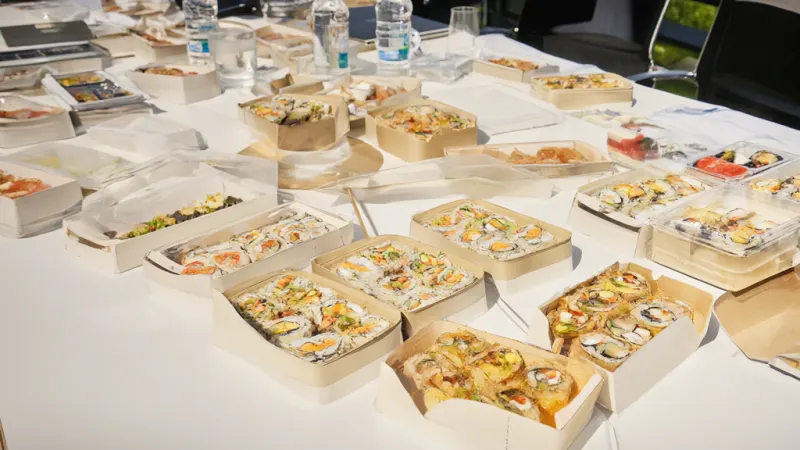
The caterer prepares the sushi in its kitchen and delivers it to the office, in individual boxes or sharing platters. This is the right format for lunch during a working day, a meeting with clients or a training session.
Individual boxes: everyone has their own, with a mix of pieces. They are convenient, hygienic and easy to hand out, and they allow dedicated boxes for people with specific needs.
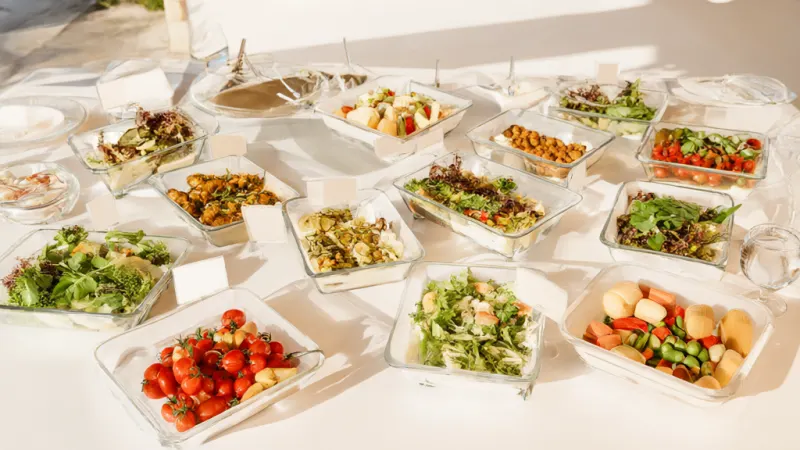
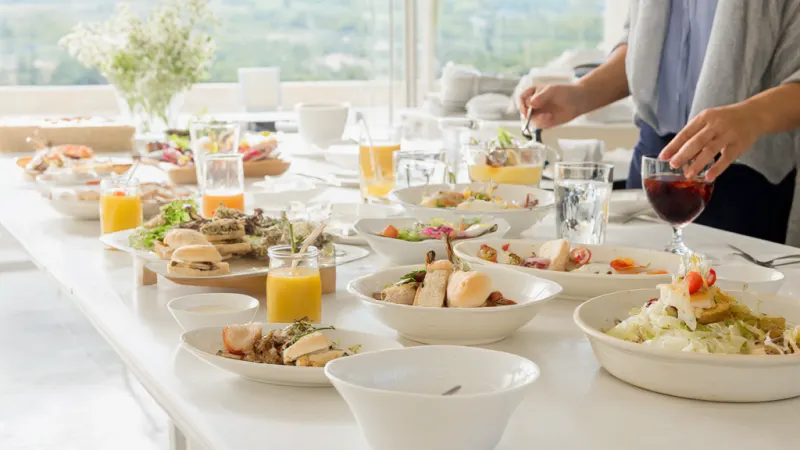
Sharing platters: more convivial, useful for informal meetings. You need plates, chopsticks or cutlery and a table.
Logistics at the office
An office is not a kitchen. Before ordering, check:
- a fridge that can hold all the boxes, if the delivery arrives before lunch;
- a delivery time close to service: sushi should be eaten as soon as possible;
- access: reception, passes, floor, lift, building hours. For an office in the centre, inside the ZTL (limited traffic zone), the van may have restricted hours;
- who receives the delivery and puts it in the fridge;
- cutlery, napkins, sauces: included or not.
For organising a working lunch in general, there is the guide to the business lunch in Rome.
The live chef
When it makes sense
A live sushi chef works when the food is part of the event: a cocktail party for clients on a terrace in Prati, the opening of a showroom, the company Christmas party in a hall in Ostiense. Guests come up, watch and ask questions. It becomes a conversation point.
What is needed
- a work counter for the chef;
- a refrigerated surface or trays on ice;
- a back area with a fridge for the fish;
- water for washing hands and utensils;
- power for the refrigerated counter and the lights;
- space in front for waiting guests.
In a hotel function room or a conference centre these facilities are almost always available. In an office or a showroom they are not: ask the caterer what they bring and what they need to find on site.
How many chefs
There is no official rule. Ask the caterer how many pieces one chef makes in an hour and compare with the number of guests and the duration. With many guests, the most practical solution is mixed: ready-made pieces at the counter, and a chef preparing in view.
Cold chain and safety
Raw fish must be blast-frozen before preparation: EC Regulation 853/2004 requires at least -20 °C for 24 hours, or -35 °C for 15 hours as provided by the amendments in EU Regulation 1276/2011. It is the caterer's obligation, but it is fair to ask how they comply.
After preparation, sushi must be kept cold until eaten. For office boxes this means a fridge and delivery close to lunch. For the live chef, a refrigerated counter and small restocks. The details are in the guide on sushi and food safety.
Allergens, diets and labels
In a group of colleagues there are many different needs. Sushi contains several of the 14 allergens in EU Regulation 1169/2011: fish, crustaceans, molluscs, soya, sesame, sometimes eggs and gluten (soy sauce, tempura).
What to ask for:
- a label or sheet for each box, with ingredients and allergens;
- dedicated named boxes for people who are coeliac, allergic or vegetarian;
- gluten-free soy sauce;
- cooked and vegetable pieces for those who don't eat raw fish, including for health reasons such as pregnancy.
Before ordering, collect participants' requirements with a form. It is the simplest way to make sure nobody is left without lunch.
Invoice, VAT and ordering
For a company, the administrative side matters too:
- VAT: for food served with service, 10% normally applies; for delivery only, the rate of the individual products may apply. Ask how the caterer invoices and check with your accounts team;
- an electronic invoice (mandatory in Italy) with the correct details;
- a minimum order for delivery;
- delivery cost and supplements for times or areas;
- change terms: until when you can change the number of boxes.
To read a quote line by line, there is the guide on how to read a catering quote.
Questions to ask the caterer
- Do you do individual boxes, platters or a live chef?
- What time do you deliver, and how long before lunch?
- What do we need at the office: fridge, table, cutlery?
- For the chef: how much space, water and power is needed?
- How many pieces does one chef make in an hour?
- How do you freeze the fish and which supplier does it come from?
- Does every box have an allergen label?
- Do you prepare dedicated named boxes for coeliac and vegetarian guests?
- Is there a minimum order? How much does delivery cost?
- How do you invoice, and at what VAT rate?
To finish
For an office lunch, choose simple boxes and punctual delivery. For an event with clients, a live chef is worth the investment. You can compare who does sushi for companies in the sushi catering section and in the corporate catering section, then request a quote with guest numbers, time and address.
Sources
- Regulation (EC) No 853/2004, Annex III, Section VIII, EUR-Lex: https://eur-lex.europa.eu/legal-content/IT/TXT/?uri=CELEX:32004R0853
- Regulation (EU) No 1276/2011, EUR-Lex: https://eur-lex.europa.eu/legal-content/IT/TXT/?uri=CELEX:32011R1276
- Regulation (EU) No 1169/2011, EUR-Lex: https://eur-lex.europa.eu/legal-content/IT/TXT/?uri=CELEX:32011R1169