In short
- Three main formats: show cooking (you watch and taste), cooking class (you cook), team challenge (you cook and compete).
- The space decides the format: you need workstations, water, power and somewhere to eat together at the end.
- Choose recipes to suit the group: fresh pasta and pizza, sushi, Roman cooking (cacio e pepe, supplì, maritozzi) for visitors.
- Allergens, hygiene and insurance must be clarified beforehand, because the food passes through everyone's hands.
Putting a group of colleagues at the stove works because everyone starts on an equal footing: the sales director and the intern knead the same pasta. But a cooking team building is also a small catering event, with spaces, safety and timings to organise. Here are the formats, what to ask and how to choose the space in Rome.
The formats
| Format | What participants do | Suits | Critical point |
|---|---|---|---|
| Show cooking | Watch the chef, ask questions, taste | Large groups, evenings, events with clients | Everyone being able to see the station |
| Cooking class | Cook a recipe guided by the chef | Medium and small groups | Workstations and equipment for everyone |
| Team challenge | Cook in groups, with a jury and a prize | Teams that like to compete | Clear rules and strict timings |
| Themed workshop | A single technique: fresh pasta, pizza, desserts | Half days, training | Rising and resting times |
| Dinner cooked together | Everyone prepares part of the menu, then you eat | End of a working day | Coordinating the courses |
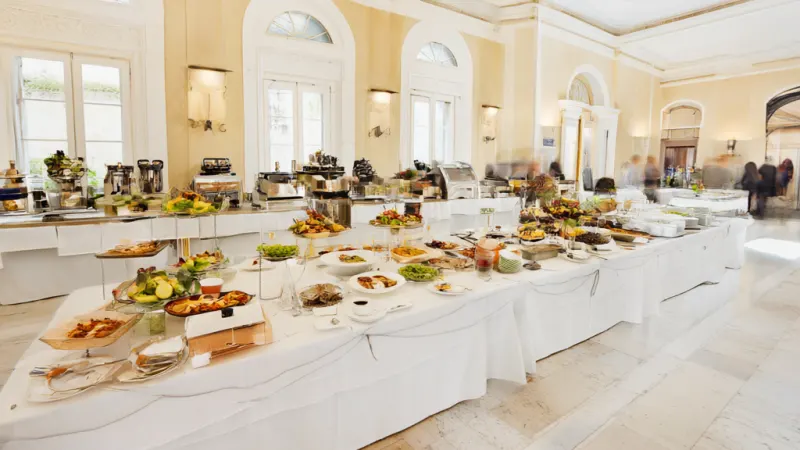
Show cooking is the easiest to manage with many people: the chef cooks, the others watch and taste. A cooking class is more involving, but each participant needs space and tools. A team challenge brings energy, as long as the rules are clear and nobody feels left out.
The space: the choice that decides everything
A cooking team building needs more than a room.
- Cookery schools and workshops: they have equipped workstations, work surfaces and sinks. This is the simplest solution for a cooking class.
- Venues with an open kitchen: restaurants closed to the public, event spaces with a kitchen. Useful for show cooking with dinner.
- Farmhouses and agriturismi (working farms with hospitality) in the Castelli Romani or the Roman countryside: they let you combine a workshop, a vegetable garden and lunch outdoors, in the right season.
- Company offices or a conference hall: possible with mobile workstations and induction hobs, but you need power, water and a plan for the washing-up.
At the site visit, check: number of workstations, sockets and electrical capacity, water points, extraction, and space to eat together at the end. In the historic centre, add the ZTL (limited traffic zone) issue for deliveries of equipment and ingredients: check the current hours on the Roma Mobilità website.
What to cook
The most common workshops are Italian cooking: fresh pasta, gnocchi, pizza, tiramisù. Some caterers also offer sushi, international cuisine or finger food challenges. For international groups visiting Rome, a Roman theme is a frequent choice.
- Cacio e pepe: it looks simple and is perfect for a challenge, because the pecorino cream either comes together or splits. You can tell straight away who listened to the chef.
- Potato gnocchi: in Rome, tradition links them to Thursday. Kneading and ridging them is teamwork.
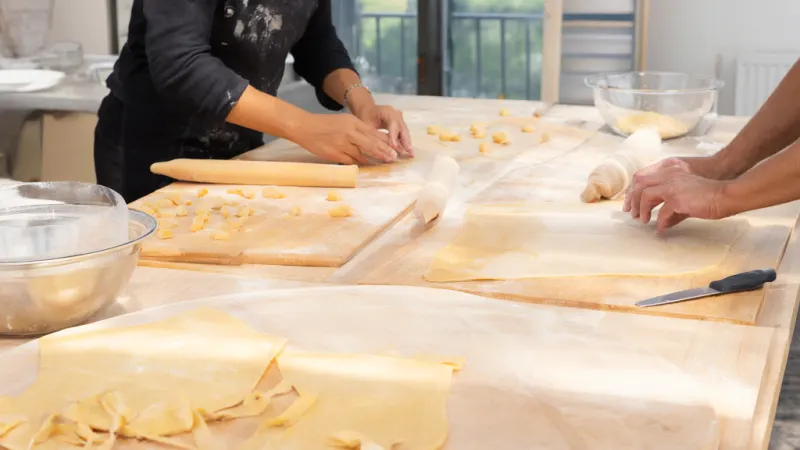
- Fresh egg pasta: fettuccine to dress with a Roman sauce.
- Supplì: shaping, breadcrumbing, frying. The frying should be handled by staff, for safety.
- Pizza: dough prepared in advance, rolled out and topped by participants. You need a suitable oven.
- Maritozzi or ricotta and sour cherry tart: for a sweet workshop, with the rising times organised in advance.
Follow the season: artichokes in spring, Roman courgettes and courgette flowers in summer, Romanesco broccoli and puntarelle in winter. If you choose the Roman theme, you will find more ideas in the guide to the Roman cooking menu for catering.
Indicative timings
| Stage | Indicative duration |
|---|---|
| Welcome, aprons, hygiene rules | 15-20 min |
| The chef's explanation | 15-30 min |
| Workshop or challenge | 1-2 hours |
| Cooking and plating | 20-40 min |
| Meal together and prize-giving | 1 hour or more |
Indicative: it depends on the recipe, the number of participants and the equipment. Recipes that need rising require dough prepared in advance.
Safety, hygiene and allergens
Here the food passes through the hands of people who are not cooks. The caterer or school remains responsible for hygiene under European food hygiene rules (EC Regulation 852/2004 and the HACCP system). The practical arrangements need to be agreed with them.
- Hygiene: hand washing, aprons, hair tied back, clean work surfaces. Ask how the caterer organises this part.
- Allergens: EU Regulation 1169/2011 requires information on the 14 allergens. Collect allergies before the event; for severe allergies or coeliac disease, separate workstations and utensils are needed, and sometimes it is better for the person to take part without handling the ingredient.
- Knives, flames, frying: decide what participants do and what stays with the staff.
- Insurance: ask whether the supplier's liability insurance covers participants during the workshop.
For special diets, read the guide to special diets.
How to make the challenge work
- Mixed teams: different departments in the same team, if the aim is to get to know each other.
- Written rules: time, ingredients, judging criteria.
- A credible jury: the chef, plus a company representative.
- A symbolic prize: the story matters more than the value.
- Roles for everyone: those who don't enjoy cooking can plate, present the dish or keep time.
Prices
We have not found reliable public price lists for cooking team building in Rome: the price is by quote. The items that make it up are usually:
- the chef and assistants running the session;
- ingredients for the workshop;
- hire of the space and workstations;
- the final meal and drinks;
- aprons, materials, any gadgets;
- VAT, which should be clarified with the supplier and your accounts team.
Ask for separate items, so you can compare a full-service package (everything included, from the space to the meal) with a workshop in a venue of your choice.
Questions to ask the caterer
- Which format do you recommend for our number of people, and why?
- How many workstations are there, and how many people per station?
- How many chefs and assistants look after the group?
- What do participants do, and what stays with the staff (knives, frying, oven)?
- How do you manage hygiene and allergens during the workshop?
- Does your insurance cover the participants?
- Does the space have enough power, water and extraction?
- After the workshop, do we eat what we cooked or a menu from the caterer?
- What is included in the price and what isn't?
- Can you adapt the workshop for an international group, with explanations in English?
To finish
A good cooking team building ends at the table, with colleagues telling each other who rescued the cacio e pepe. To get there, choose the format based on the group and the space, then clarify safety and allergens. You will find suppliers in the corporate catering section and an overview of company events in the guide to corporate catering in Rome. When you know how many of you there are and where, request a quote.
Sources
- Regulation (EC) No 852/2004 on the hygiene of foodstuffs, EUR-Lex: https://eur-lex.europa.eu/legal-content/IT/TXT/?uri=CELEX:32004R0852
- Regulation (EU) No 1169/2011, EUR-Lex: https://eur-lex.europa.eu/legal-content/IT/TXT/?uri=CELEX:32011R1169
- Roma Mobilità, ZTL section: https://romamobilita.it/it/servizi/ztl