In short
- At a corporate event the set-up communicates the brand: colours, logo, messages.
- Stage, lighting, screens and furniture are usually the set designer's job; buffets and service areas the caterer's.
- Structures and materials may require certificates: check with the venue.
- Prepare artwork files and a floor plan early: they are the bottleneck of every set-up.
Convention, product launch, gala dinner, trade fair stand: at a corporate event the set-up does more than decorate. It has to make the company recognisable, guide people around and leave room for the caterer to work. This guide helps you divide the tasks and forget nothing.
The elements of a corporate set-up
| Element | What it is for | Usually supplied by |
|---|---|---|
| Stage and platforms | Speeches, awards, presentations | Set designer, technical services |
| Screens and LED walls | Videos, slides, live streams | Audio-visual company |
| Lighting | Staging, atmosphere, brand colours | Lighting company |
| Branding | Logo, colours, messages | Set designer, printer |
| Furniture | Lounge, high tables, seating | Furniture hire |
| Signage | Routes, rooms, facilities | Set designer |
| Registration area | Welcome, badges | Set designer, hostesses |
| Buffet and bar | Food and drink | Caterer |
| Table mise en place (table setting) | Seated dinners | Caterer |
For small events, such as an aperitivo at the office, the caterer may also handle flowers, matching table linen and a few branding elements. For large events you need a set designer. You will find set-up companies on the page event set-up in Rome.
Branding: where to put the brand
The brand belongs where people look, without covering every surface.
- Entrance: a panel or totem with the logo and event name.
- Stage backdrop: the background of every photo.
- Photocall: a panel for guests' photos.
- Signage: routes and rooms in the company colours.
- Lighting: light in a colour that matches the brand transforms a room with little effort.
- Catering: napkins, glasses, menus, buffet signs, coasters.
Ask the set designer for the deadlines for artwork files and the formats required. This is the most common cause of delays.
Stage and technical set-up
A corporate stage is often a platform with a backdrop, lectern, microphones and a screen. What to check:
- size, based on the number of people on stage;
- visibility from the whole room;
- access by steps or a ramp, including for people with disabilities;
- paperwork: whoever builds stages and structures normally provides a certificate of correct assembly;
- power for audio, video and lighting, separate from the caterer's if possible.
Lighting is a subject of its own: read the guide to event lighting.
Trade fair stands
A trade fair stand has its own rules, set by the fair organiser: maximum heights, materials, set-up times, supplier access. In Rome many fairs and congresses take place in the exhibition halls to the north-west of the city and in the conference centres of EUR. Before designing:
- download the event's technical regulations;
- check whether outside catering is allowed or whether there is an official supplier;
- ask for loading and unloading times;
- check the material requirements, including fire reaction.
If you want to offer coffee or an aperitivo at the stand, agree with the fair organiser what can be served and who may serve it.
Furniture and zones
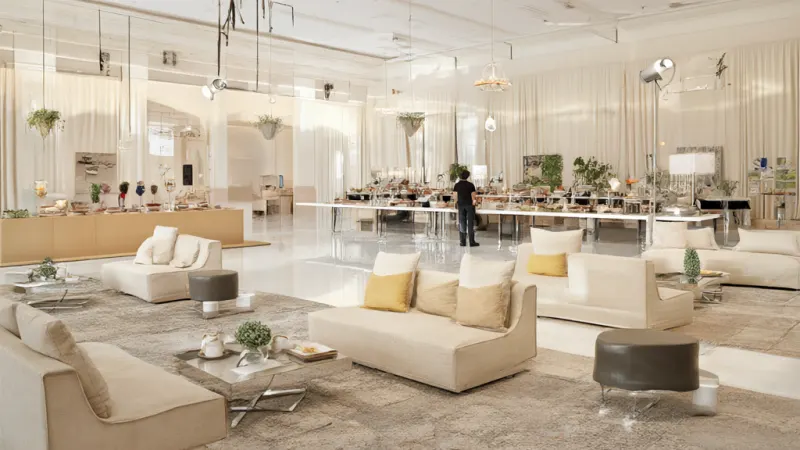
A corporate event works in zones: welcome, plenary, networking, buffet, lounge. Furniture defines them.
- High tables for standing networking.
- Lounge with sofas and armchairs for longer conversations.
- Round tables for seated dinners.
- Theatre-style seating for the plenary.
Changing from one layout to another (for example from theatre seating to dinner) needs planning: who moves the chairs, and how long does it take? You will find types of furniture and what to ask in the guide to event furniture hire.
Space for the caterer
The set-up has to leave room for the caterer. Often it is designed without it, and the buffet ends up in a corner.
Ask the set designer to mark on the floor plan:
- where the buffets and bar go, accessible and not in the middle of a walkway;
- a service area hidden from guests, for trolleys, restocking and dirty dishes;
- the staff route from the kitchen to the room;
- power sockets for food warmers, coffee machines and fridges.
If the event is a congress with several breaks, also read the guide to catering for congresses in Rome.
Rules and safety
The rules change with the venue and the type of event. In general:
- materials used in places open to the public may need a certified fire-reaction class;
- escape routes and emergency exits must stay clear;
- fixings to walls and ceilings are often forbidden in historic venues;
- temporary electrical installations must be carried out by qualified technicians.
Ask the venue for its rules and have every supplier read them.
Set-up times
| Stage | What happens |
|---|---|
| Days before | Artwork approved, final floor plan, orders placed |
| The day before or that morning | Stage, technical equipment, furniture, branding installed |
| A few hours before | Caterer: buffet, bar, table setting |
| Rehearsal | Sound, video, lighting and running-order check |
| After the event | Take-down, materials returned |
The caterer usually arrives last: if the set-up runs late, the caterer loses valuable time. Fix a time for handing over the spaces.
Sustainable set-up
Many companies ask for events with less waste. In the set-up this comes down to simple choices:
- reusable materials (fabrics, modular panels) instead of disposable prints;
- undated artwork, so totems and backdrops can be reused across events;
- hired furniture rather than bought;
- LED lighting, which uses less energy;
- washable tableware at the buffet, agreed with the caterer.
Ask the set designer what happens to the materials after the event: who stores them, who recycles them, what ends up as waste.
Questions to ask the set designer and the caterer
- What is included in your quote and what is extra?
- What formats and deadlines do you have for artwork files?
- Do the stage and structures have a certificate of correct assembly?
- Do the materials have the fire-reaction class the venue requires?
- How much power do you need and where will you take it from?
- Have you worked at this venue before?
- Who moves the furniture between one part of the event and the next?
- Can the caterer personalise napkins, glasses and signs?
- What time do you hand the spaces over to the caterer?
To finish
A corporate set-up works when every supplier knows what they bring, where it goes and at what time. Look at the companies on the page event set-up in Rome and the caterers in the corporate catering section. With your floor plan and programme ready, request a quote.