In short
- If you are organising a party, the simplest route is a caterer that brings its own staff.
- If you run a catering business, combine trusted freelancers with agencies for peaks.
- Everyone who works must be legally employed: check the contract with INPS or an employment consultant.
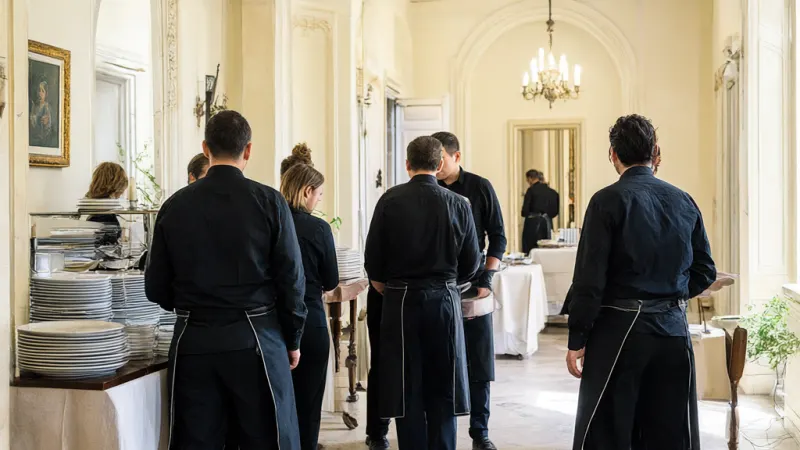
- A written briefing and a uniform decided in advance make the difference on the night.
Looking for waiters at the last minute is one of the most common situations before an event. It happens to people throwing a party at home and to caterers on peak Saturdays. This guide is in two parts: first for those organising a private event, then for those running a catering business.
If you are organising a party or a private event
Option 1: the caterer with its own staff
This is the simplest route. The caterer knows its waiters, has trained them and handles the contract. You pay for an item in the quote. Ask:
- how many people are included and in which roles;
- for how many hours;
- how much each extra hour costs.
The guide to floor staff for events explains how to read this item in the quote.
Option 2: staff only, without a caterer
If you are preparing the food yourself, or buying it from a delicatessen, you can look for staff only. In Rome there are agencies and companies that supply waiters, bartenders and hosts, including for private events. You will find the companies that do this in the directory of catering staff in Rome.
Option 3: someone you know or an independent professional
It can be done, but be careful: even for a single evening, the worker must be legally employed. There are schemes designed for households and for occasional work, managed through INPS (the Italian social security institute), with limits on amounts and use. The rules change over time: check on the INPS website or with an employment consultant before you come to an arrangement.
If you run a catering business
The channels
| Channel | Advantages | Limits |
|---|---|---|
| Permanent team | Knows how you work | A cost even in quiet months |
| On-call freelancers | Flexible, already tested | On peak Saturdays everyone wants them |
| Employment agency | Handles selection and contract | Service fee, people to train |
| Catering schools | Motivated young people, lasting relationships | Experience to build, rules for internships and placements |
| Word of mouth among colleagues | Reliable profiles | Hard to scale |
In Rome, hotel and catering schools are a resource for building up a list of freelancers over time, through internships and first jobs. The rules on internships and school work placements are specific: ask the school.
Contracts: what to check
The forms most used in the sector are intermittent work (on call, governed by Legislative Decree 81/2015), agency work through an authorised employment agency and, within precise limits, occasional work managed through INPS. Each form has different requirements, limits and formalities. The general picture is in the guide to catering staff in Rome; for your own situation you need an employment consultant.
How to choose the right people
- Ask for concrete experience: "Have you ever served a wedding for 150 people?"
- Try people out at a small event before an important one.
- Assess punctuality, care of the uniform and the ability to work in a team.
- Keep a list with roles, availability, sizes and training certificates.
The roles and what each one does are explained in the guide to catering staff roles.
How many waiters you need
The number depends on the format, the number of guests, the space and the distance from the kitchen. A served meal needs more people than a buffet; a standing aperitivo with trays going round needs different numbers again. There is no figure that works for everyone: the calculation is made event by event. The guide on how many waiters you need helps you think it through by format.
The briefing: one page that saves the evening
Outside staff do not know the venue, the guests or the menu. A written briefing, sent the day before, answers questions before they are asked.
What to write:
| Item | Example |
|---|---|
| Where | Address, floor, entryphone, service entrance |
| When | Arrival time, start of service, expected finish |
| Getting there | Parking, ZTL, public transport |
| Uniform | White shirt, black trousers, closed black shoes, apron supplied |
| Contact | Name and phone number of the coordinator |
| Programme | Aperitivo, dinner, cake, toast, end of music |
| Menu | Dishes, order of service, allergens |
| Guests | Number, children, guests with diets or allergies, people to welcome |
| Rules | No phones on the floor, smoking only in the designated area, venue rules |
On arrival, a 15-minute spoken briefing: a tour of the venue, positions, signals between floor and kitchen.
In Rome's historic centre, with its ZTL (limited traffic zone) and scarce parking, the directions on how to get there are often the most useful part. Tell staff to set off early.
Dress code: decide in advance
| Style of event | Typical uniform |
|---|---|
| Gala, classic wedding | White shirt, waistcoat or jacket, bow tie or tie, black trousers |
| Corporate event | White or black shirt, black trousers, apron |
| Informal party, street food | Matching polo shirt or T-shirt, apron, comfortable closed shoes |
| Outdoor event in summer | Light fabrics, pale colours, a hat if needed for the sun |
Always closed, non-slip shoes, for safety. Hair tied back for anyone handling food. Write in the briefing who supplies what: apron, waistcoat, bow tie.
On the night of the event
Even with a good briefing, coordination on the night is what counts. A few useful habits:
- arrive early: staff should be on site before the guests, with time to change and see the room;
- a single contact person giving instructions, to avoid conflicting orders;
- breaks taken in turns, especially at long events;
- a meal for the staff, agreed in advance;
- a shared close-down: who clears, who counts the glasses, who takes the rubbish away.
At the end of the evening, note who worked well. That is how you build up a list of trusted freelancers for future events.
Questions to ask (a caterer or an agency)
- How many people will you send, and in which roles?
- On what contract do they work? Are they insured?
- Have they already worked at similar events?
- Do they have food hygiene training for serving food?
- What is the minimum number of hours? How much does each extra hour cost?
- Are there supplements for evenings, nights or public holidays?
- Do you supply the uniform?
- Who replaces anyone who does not turn up?
- Who is the contact person on site?
To finish
Finding waiters is easier when you know what you need: roles, hours, uniform, briefing. If you are looking for staffing companies, see the directory of catering staff. If you prefer a complete service, request a quote from a caterer that brings its own team.